




Where is jelly deposited as a covering on the egg of a frog?
A. In the oviduct
B. In the water during fertilization
C. In the water after fertilization
D. In the ovary
Answer
 Verified
594.9k+ views
Hint: The process of covering the frog's egg with jelly takes place during the process of reproduction. In addition to it, the egg is surrounded by a tertiary egg membrane during its passage from the mullerian duct to the cloaca. As a frog is an amphibian it can live on both land and water.
Complete step-by-step answer: Frogs are the amphibians in which fertilization takes place outside the body but in some species, internal fertilization is also seen. In external fertilization female frogs release their eggs in water from their body. Then the male frogs release their sperm into the water for fertilization. The vitelline membrane and an adhesive jelly coating which is also known as the tertiary egg membrane surround the egg of a female frog. This tertiary egg membrane is deposited on an egg in the oviduct during its passage from the oviduct to the cloaca. The female oviduct is also called the mullerian duct. Due to the location of the jelly receptor, the capable sperm readily fertilizes the female egg. The common exit for the intestinal, urinary, and reproductive tract is the cloaca.
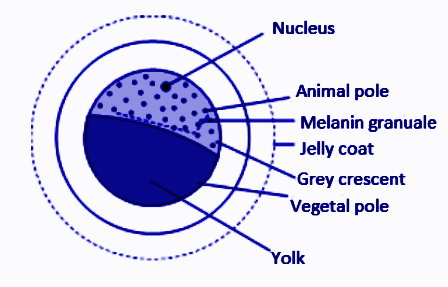
Hence, the correct answer is option A: in the oviduct as the jelly covering on the egg is seen during its passage from the oviduct.
Note: The female oviduct is also called a rudimentary oviduct. Due to the absence of lumen, its size is very much reduced. Therefore, locating these ducts is difficult due to its small size. Oviducts present in male frogs have no role in reproduction and are vestigial in nature.
Complete step-by-step answer: Frogs are the amphibians in which fertilization takes place outside the body but in some species, internal fertilization is also seen. In external fertilization female frogs release their eggs in water from their body. Then the male frogs release their sperm into the water for fertilization. The vitelline membrane and an adhesive jelly coating which is also known as the tertiary egg membrane surround the egg of a female frog. This tertiary egg membrane is deposited on an egg in the oviduct during its passage from the oviduct to the cloaca. The female oviduct is also called the mullerian duct. Due to the location of the jelly receptor, the capable sperm readily fertilizes the female egg. The common exit for the intestinal, urinary, and reproductive tract is the cloaca.
Hence, the correct answer is option A: in the oviduct as the jelly covering on the egg is seen during its passage from the oviduct.
Note: The female oviduct is also called a rudimentary oviduct. Due to the absence of lumen, its size is very much reduced. Therefore, locating these ducts is difficult due to its small size. Oviducts present in male frogs have no role in reproduction and are vestigial in nature.
Recently Updated Pages
Master Class 11 Social Science: Engaging Questions & Answers for Success

Master Class 11 English: Engaging Questions & Answers for Success
Master Class 11 Maths: Engaging Questions & Answers for Success
Master Class 11 Chemistry: Engaging Questions & Answers for Success
Master Class 11 Biology: Engaging Questions & Answers for Success
Master Class 11 Physics: Engaging Questions & Answers for Success
Trending doubts
One Metric ton is equal to kg A 10000 B 1000 C 100 class 11 physics CBSE
Difference Between Prokaryotic Cells and Eukaryotic Cells
How many of the following diseases can be studied with class 11 biology CBSE
Which of the following enzymes is used for carboxylation class 11 biology CBSE
Draw a diagram of a plant cell and label at least eight class 11 biology CBSE
Two of the body parts which do not appear in MRI are class 11 biology CBSE