




IUPAC name of the following compound is:
$C{{H}_{3}}C{{({{C}_{2}}{{H}_{5}})}_{2}}C{{H}_{2}}Br$
Answer
 Verified
599.7k+ views
Hint: Before naming the compound, we should first know about the IUPAC. The concept of IUPAC was introduced so that there is a standardized manner to name the compound all over the world and it will be the same. The motive was to give identity to every compound and a unique name.
Complete answer:
Rule for the IUPAC Nomenclature-
We have to find the parent hydrocarbon chain: It should have the maximum number of branches, substituents, length, number of multiple bonds, or single bonds.
We have to identify the parent functional group, we should know which group holds the highest priority.
Then identify the side chains that are branched from the parent chain.
Identify the functional groups that are left and see the positions they are attached to. Write those numbers as the prefix while naming.
Identify the bonds (double/triple)
Then, we have to do the numbering of the chain in the order of priority.
If a type of substituent is present more than once, then we add a prefix like di for 2, tri for 3, tetra for 4, etc.
Now, we have to find out the IUPAC name of $C{{H}_{3}}C{{({{C}_{2}}{{H}_{5}})}_{2}}C{{H}_{2}}Br$
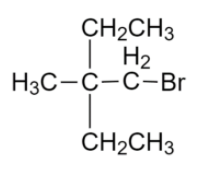
We will identify the parent hydrocarbon chain
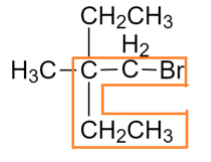
Then we have to find the parent functional group that is Bromine
We will number the chain according to the priority
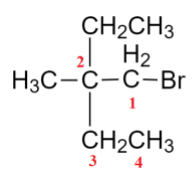
We will see the functional groups that are left that are methyl and ethyl. We can see the position of these groups, write them.
So, The IUPAC Nomenclature of this compound is 1-Bromo-2-ethyl 2-MethylButane.
Note:
Different IUPAC Methods are:
Compositional Nomenclature- The nomenclature involves naming based on the composition of the substance.
Substitutive Nomenclature- The nomenclature in which hydrogen atom gets replaced by a substituent group and the parent hydride gets changed.
Additive Nomenclature- The nomenclature is used to name the coordination compounds.
Complete answer:
Rule for the IUPAC Nomenclature-
We have to find the parent hydrocarbon chain: It should have the maximum number of branches, substituents, length, number of multiple bonds, or single bonds.
We have to identify the parent functional group, we should know which group holds the highest priority.
Then identify the side chains that are branched from the parent chain.
Identify the functional groups that are left and see the positions they are attached to. Write those numbers as the prefix while naming.
Identify the bonds (double/triple)
Then, we have to do the numbering of the chain in the order of priority.
If a type of substituent is present more than once, then we add a prefix like di for 2, tri for 3, tetra for 4, etc.
Now, we have to find out the IUPAC name of $C{{H}_{3}}C{{({{C}_{2}}{{H}_{5}})}_{2}}C{{H}_{2}}Br$
We will identify the parent hydrocarbon chain
Then we have to find the parent functional group that is Bromine
We will number the chain according to the priority
We will see the functional groups that are left that are methyl and ethyl. We can see the position of these groups, write them.
So, The IUPAC Nomenclature of this compound is 1-Bromo-2-ethyl 2-MethylButane.
Note:
Different IUPAC Methods are:
Compositional Nomenclature- The nomenclature involves naming based on the composition of the substance.
Substitutive Nomenclature- The nomenclature in which hydrogen atom gets replaced by a substituent group and the parent hydride gets changed.
Additive Nomenclature- The nomenclature is used to name the coordination compounds.
Recently Updated Pages
If x a + bt + ct2 where x is in meters and t is in class 11 physics CBSE

A car covers the first half distance between two places class 11 physics CBSE
The resultant of two vectors overrightarrow P and overrightarrow class 11 physics CBSE
Find the value of cos 135 class 11 maths CBSE
A mass M is held in place by an applied force F and class 11 physics CBSE
A solution of glucose in water is labelled as 10 dfracwv class 11 chemistry CBSE
Trending doubts
One Metric ton is equal to kg A 10000 B 1000 C 100 class 11 physics CBSE
Find the value of the expression given below sin 30circ class 11 maths CBSE
What do you mean by retardation What is its SI uni class 11 physics CBSE
Draw a diagram of nephron and explain its structur class 11 biology CBSE
10 examples of friction in our daily life
Difference between physical and chemical change class 11 chemistry CBSE