




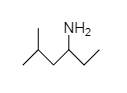
What is the IUPAC name of the following compound ?
(1) $2 - $methyl$ - 4 - $hexanamine
(2) $5 - $methyl$ - 3 - $hexanamine
(3) $2 - $methyl$ - 4 - $amino hexane
(4) $5 - $methyl$ - 3 - $amino hexane
Answer
 Verified
529.2k+ views
Hint: The systematic approach followed for the nomenclature of organic compounds as recommended by the International Union of Pure and Applied Chemistry is referred to as IUPAC nomenclature of organic compounds. The stem name, prefix, and suffix are the three elements of the IUPAC nomenclature for organic compounds.
Complete answer:
In the given compound the longest chain has six carbon atoms.
$N{H_2}$ functional group is attached to the third carbon atom. It is added at the suffix as amine. The substituent Methyl group is attached to the fifth carbon atom.
Therefore, the IUPAC name of the compound is $5 - $methyl$ - 3 - $amino hexane.
Hence, the correct option is (4) $5 - $methyl$ - 3 - $amino hexane.
Functional groups are groups of one or more atoms with different chemical properties regardless of what is attached to them. The atoms of functional groups are bound by covalent bonds with one another and with the rest of the molecule.
So, the correct answer is “Option 4”.
Note:
The amino group is made up of a nitrogen atom connected to hydrogen atoms by single bonds. An organic compound that contains an amino group is known as an amine. Nitrogen, like oxygen, is more electronegative than both carbon and hydrogen, causing the amino group to have a polar property. Chemists do not always follow the IUPAC nomenclature guidelines since some compounds have exceedingly long and tedious names according to the IUPAC nomenclature guidelines.
Complete answer:
In the given compound the longest chain has six carbon atoms.
$N{H_2}$ functional group is attached to the third carbon atom. It is added at the suffix as amine. The substituent Methyl group is attached to the fifth carbon atom.
Therefore, the IUPAC name of the compound is $5 - $methyl$ - 3 - $amino hexane.
Hence, the correct option is (4) $5 - $methyl$ - 3 - $amino hexane.
Functional groups are groups of one or more atoms with different chemical properties regardless of what is attached to them. The atoms of functional groups are bound by covalent bonds with one another and with the rest of the molecule.
So, the correct answer is “Option 4”.
Note:
The amino group is made up of a nitrogen atom connected to hydrogen atoms by single bonds. An organic compound that contains an amino group is known as an amine. Nitrogen, like oxygen, is more electronegative than both carbon and hydrogen, causing the amino group to have a polar property. Chemists do not always follow the IUPAC nomenclature guidelines since some compounds have exceedingly long and tedious names according to the IUPAC nomenclature guidelines.
Recently Updated Pages
Master Class 11 Social Science: Engaging Questions & Answers for Success

Master Class 11 English: Engaging Questions & Answers for Success
Master Class 11 Maths: Engaging Questions & Answers for Success
Master Class 11 Chemistry: Engaging Questions & Answers for Success
Master Class 11 Biology: Engaging Questions & Answers for Success
Master Class 11 Physics: Engaging Questions & Answers for Success
Trending doubts
Differentiate between an exothermic and an endothermic class 11 chemistry CBSE
One Metric ton is equal to kg A 10000 B 1000 C 100 class 11 physics CBSE
Difference Between Prokaryotic Cells and Eukaryotic Cells
There are 720 permutations of the digits 1 2 3 4 5 class 11 maths CBSE
Two of the body parts which do not appear in MRI are class 11 biology CBSE
Which gas is abundant in air class 11 chemistry CBSE