




IUPAC name of neo-pentane is
(A) $2 - {\text{ethylpentane}}$ (B) $2,2 - {\text{dimethylpentane}}$
(C) $2,2 - {\text{dimethylpropane}}$ (D) $2 - {\text{dimethylpentane}}$
Answer
 Verified
638.1k+ views
Hint: IUPAC nomenclature is a method of naming organic chemical compounds. Ideally, every possible organic compound can be named from its structural formula and vice-versa.
Complete step by step answer:
The name of compound ‘neo-pentane’ is a trivial or common name which is used to replace the IUPAC name of the compound. However, the prefix ‘neo’ is used when the two carbons form a continuous chain and these two carbons also do are the part of a termination tert-butyl group (tert refers to tertiary which means three atoms). The tert-butyl group is shown below:

The word ‘pentane’ in the given common name of compound suggests that there are a total five carbon atoms in the given compound as the word ‘pent’ does refer to the number five. So, form these two points, the chemical structure having neo-pentane as its common name, can be concluded as:
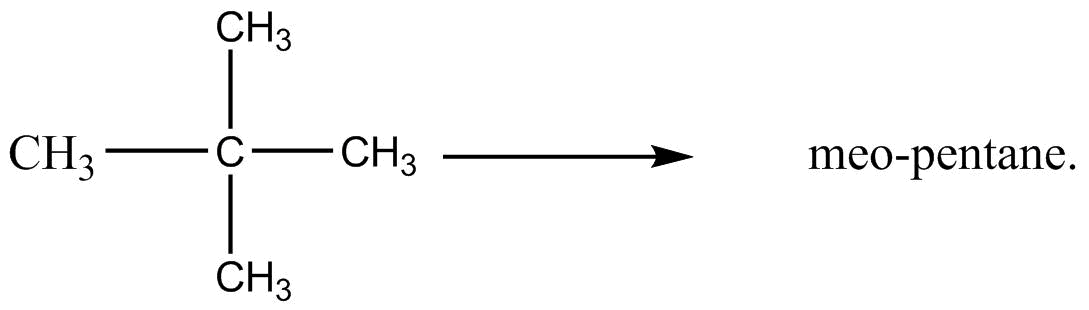
Now, for the IUPAC naming of the compound, firstly, we need to determine the longest possible straight carbon chain. In the given compound, the possible longest straight chain can be of three carbon atoms. We can see from the above structure of neo-pentane that two methyl groups are attached on the second carbon atom from the straight chain of three carbon atoms.
So, the IUPAC name of neo-pentane is: $2,2 - {\text{dimethylpropane}}$
Here, the number $2,2$ represents that both the methyl groups, which are shown by the word $'di'$ are attached on the second carbon atom of the chain and the word $'propane'$ represents that the straight chain contains three carbon atoms.
Hence, the answer is option (C).
Note:
IUPAC stands for international union of pure and applied chemistry. The IUPAC states different rules for the naming of organic and inorganic compounds.
Complete step by step answer:
The name of compound ‘neo-pentane’ is a trivial or common name which is used to replace the IUPAC name of the compound. However, the prefix ‘neo’ is used when the two carbons form a continuous chain and these two carbons also do are the part of a termination tert-butyl group (tert refers to tertiary which means three atoms). The tert-butyl group is shown below:
The word ‘pentane’ in the given common name of compound suggests that there are a total five carbon atoms in the given compound as the word ‘pent’ does refer to the number five. So, form these two points, the chemical structure having neo-pentane as its common name, can be concluded as:
Now, for the IUPAC naming of the compound, firstly, we need to determine the longest possible straight carbon chain. In the given compound, the possible longest straight chain can be of three carbon atoms. We can see from the above structure of neo-pentane that two methyl groups are attached on the second carbon atom from the straight chain of three carbon atoms.
So, the IUPAC name of neo-pentane is: $2,2 - {\text{dimethylpropane}}$
Here, the number $2,2$ represents that both the methyl groups, which are shown by the word $'di'$ are attached on the second carbon atom of the chain and the word $'propane'$ represents that the straight chain contains three carbon atoms.
Hence, the answer is option (C).
Note:
IUPAC stands for international union of pure and applied chemistry. The IUPAC states different rules for the naming of organic and inorganic compounds.
Recently Updated Pages
Master Class 11 English: Engaging Questions & Answers for Success

Master Class 11 Physics: Engaging Questions & Answers for Success
Master Class 11 Computer Science: Engaging Questions & Answers for Success
Master Class 11 Chemistry: Engaging Questions & Answers for Success
Master Class 11 Social Science: Engaging Questions & Answers for Success
Master Class 11 Accountancy: Engaging Questions & Answers for Success
Trending doubts
Difference Between Prokaryotic Cells and Eukaryotic Cells
Two of the body parts which do not appear in MRI are class 11 biology CBSE
One Metric ton is equal to kg A 10000 B 1000 C 100 class 11 physics CBSE
10 examples of friction in our daily life
Draw a diagram of nephron and explain its structur class 11 biology CBSE
Draw a diagram of a plant cell and label at least eight class 11 biology CBSE