




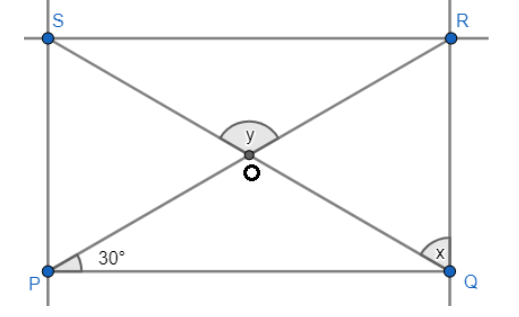
It’s given that PQRS is a rectangle. If $\angle RPQ={{30}^{\circ }}$. Then find the value of $\left( x+y \right)$.
Answer
 Verified
619.5k+ views
Hint: We apply the theorem of sum of angles of a triangle. It tells us that the sum of all three angles of any triangle is always ${{180}^{\circ }}$. We apply this theorem on $\Delta POQ$ where O is the intersecting point of the two diagonals of the triangle. We calculate the angles from the theorem of opposite and angles of the rectangle to find the answer of the problem.
Complete step-by-step answer:
In the given figure we have been shown that $\angle RPQ={{30}^{\circ }}$. Also, we know that $\angle RQS=x$, $\angle SOR=y$.
We know that if two line-segments or lines intersect each other then the opposite angles are equal.
Here PR and QS intersect each other at O.
So, the opposite angles $\angle SOR$ and $\angle POQ$ are equal which means $\angle SOR=y=\angle POQ$.
Again, we know that all the angles of a rectangle are ${{90}^{\circ }}$.
In this figure $\angle RQS$ and $\angle PQS$ are angles whose sum is ${{90}^{\circ }}$ as they are on the both sides of the line of QS.
So, $\angle RQS+\angle PQS={{90}^{\circ }}\Rightarrow \angle PQS={{90}^{\circ }}-\angle RQS={{90}^{\circ }}-x$.
Now we know the sum of all three angles of any triangle is always ${{180}^{\circ }}$.
So, in case of $\Delta POQ$ sum of the angles will be ${{180}^{\circ }}$ which means $\angle RPQ+\angle POQ+\angle PQS={{180}^{\circ }}$
We put all the given values in the equation to get
$\begin{align}
& \angle RPQ+\angle POQ+\angle PQS={{180}^{\circ }} \\
& \Rightarrow {{30}^{\circ }}+y+x={{180}^{\circ }} \\
& \Rightarrow x+y={{180}^{\circ }}-{{30}^{\circ }}={{150}^{\circ }} \\
\end{align}$
Solving the equation, we get the value of $\left( x+y \right)$ as ${{150}^{\circ }}$.
Note: Although the figure is of rectangle, we don’t need to use all the properties of it. We need to remember that the angles $\angle RQS$ and $\angle PQS$ are not consecutive angles as the sum of consecutive angles are ${{180}^{\circ }}$. We can use the concept of alternate angles but that will lengthen the problem more. So, it’s better to look at the equation we need to find before starting to solve it.
Complete step-by-step answer:
In the given figure we have been shown that $\angle RPQ={{30}^{\circ }}$. Also, we know that $\angle RQS=x$, $\angle SOR=y$.
We know that if two line-segments or lines intersect each other then the opposite angles are equal.
Here PR and QS intersect each other at O.
So, the opposite angles $\angle SOR$ and $\angle POQ$ are equal which means $\angle SOR=y=\angle POQ$.
Again, we know that all the angles of a rectangle are ${{90}^{\circ }}$.
In this figure $\angle RQS$ and $\angle PQS$ are angles whose sum is ${{90}^{\circ }}$ as they are on the both sides of the line of QS.
So, $\angle RQS+\angle PQS={{90}^{\circ }}\Rightarrow \angle PQS={{90}^{\circ }}-\angle RQS={{90}^{\circ }}-x$.
Now we know the sum of all three angles of any triangle is always ${{180}^{\circ }}$.
So, in case of $\Delta POQ$ sum of the angles will be ${{180}^{\circ }}$ which means $\angle RPQ+\angle POQ+\angle PQS={{180}^{\circ }}$
We put all the given values in the equation to get
$\begin{align}
& \angle RPQ+\angle POQ+\angle PQS={{180}^{\circ }} \\
& \Rightarrow {{30}^{\circ }}+y+x={{180}^{\circ }} \\
& \Rightarrow x+y={{180}^{\circ }}-{{30}^{\circ }}={{150}^{\circ }} \\
\end{align}$
Solving the equation, we get the value of $\left( x+y \right)$ as ${{150}^{\circ }}$.
Note: Although the figure is of rectangle, we don’t need to use all the properties of it. We need to remember that the angles $\angle RQS$ and $\angle PQS$ are not consecutive angles as the sum of consecutive angles are ${{180}^{\circ }}$. We can use the concept of alternate angles but that will lengthen the problem more. So, it’s better to look at the equation we need to find before starting to solve it.
Recently Updated Pages
Master Class 12 Economics: Engaging Questions & Answers for Success

Master Class 12 English: Engaging Questions & Answers for Success
Master Class 12 Social Science: Engaging Questions & Answers for Success
Master Class 12 Maths: Engaging Questions & Answers for Success
Master Class 12 Physics: Engaging Questions & Answers for Success
Master Class 9 General Knowledge: Engaging Questions & Answers for Success
Trending doubts
Find the sum of series 1 + 2 + 3 + 4 + 5 + + 100 class 9 maths CBSE
Difference Between Plant Cell and Animal Cell
Fill the blanks with the suitable prepositions 1 The class 9 english CBSE
What is pollution? How many types of pollution? Define it
What is the Full Form of ICSE / ISC ?
Name 10 Living and Non living things class 9 biology CBSE