



It is given that $\vartriangle ABC \sim \vartriangle PQR$ with $\dfrac{{BC}}{{PQ}} = \dfrac{1}{3}$. Then $\dfrac{{ar\vartriangle PQR}}{{ar\vartriangle BCA}}$ is equals to
A.9
B.3
C.31
D.91
Answer
 Verified
584.1k+ views
Hint: In this question, we need to determine the ratio of the area of the triangle PQR and the triangle BCA such that the ratio of sides BC and PQ is given as 3:1. For this, we will use the property of the similar triangle, which states that the ratio of the area of the similar triangles is equivalent to the square of the ratio of the corresponding sides of the triangles.
Complete step-by-step answer:
Two triangles are said to be similar if their corresponding angles are congruent, and the corresponding sides are in proportion. In other words, similar triangles are the same shape but not necessarily the same size. The triangles are congruent if, in addition to this, their corresponding sides are of equal length.
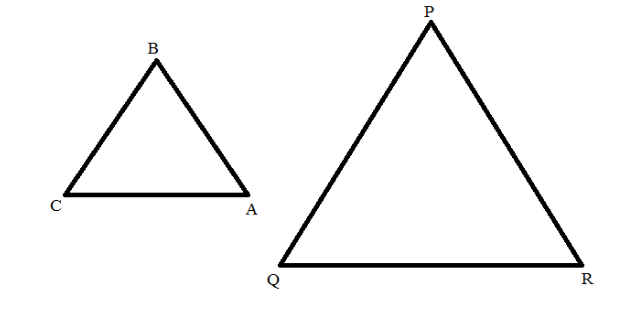
Following the property of the similar triangles, which states that the ratio of the area of the similar triangles is equivalent to the square of the ratio of the corresponding sides of the triangles. Mathematically, if the triangles ABC and PQR are similar $\left( {\vartriangle ABC \sim \vartriangle PQR} \right)$, then, $\dfrac{{ar\vartriangle ABC}}{{ar\vartriangle PQR}} = {\left( {\dfrac{{AB}}{{PQ}}} \right)^2} = {\left( {\dfrac{{BC}}{{QR}}} \right)^2} = {\left( {\dfrac{{CA}}{{RP}}} \right)^2}$
Here, the triangle ABC is similar to the triangle PQR and the ratio of the sides of BC and PQ is given as 1:3,i.e., $\dfrac{{BC}}{{PQ}} = \dfrac{1}{3}$ or $\dfrac{{PQ}}{{BC}} = \dfrac{3}{1} - - - - (i)$
Hence, the ratio of the area of the triangle PQR and the area of the triangle ABC is given as the square of the ratio of the corresponding sides of the triangles. So, we can write
$
\dfrac{{ar\vartriangle PQR}}{{ar\vartriangle BCA}} = {\left( {\dfrac{{PQ}}{{BC}}} \right)^2} \\
= {\left( {\dfrac{3}{1}} \right)^2} \\
= \dfrac{9}{1} \\
= 9:1 \\
$
Hence, $\dfrac{{ar\vartriangle PQR}}{{ar\vartriangle BCA}} = 9$
Option A is correct.
So, the correct answer is “Option A”.
Note: Nomenclature of similar triangles plays an important such as, $\dfrac{{ar\vartriangle ABC}}{{ar\vartriangle PQR}} = {\left( {\dfrac{{AB}}{{PQ}}} \right)^2} = {\left( {\dfrac{{BC}}{{QR}}} \right)^2} = {\left( {\dfrac{{CA}}{{RP}}} \right)^2}$. Here we can see that the positions of the letters (vertex) in the nomenclature of the triangles are strictly followed while writing the ratios of the sides.
Complete step-by-step answer:
Two triangles are said to be similar if their corresponding angles are congruent, and the corresponding sides are in proportion. In other words, similar triangles are the same shape but not necessarily the same size. The triangles are congruent if, in addition to this, their corresponding sides are of equal length.
Following the property of the similar triangles, which states that the ratio of the area of the similar triangles is equivalent to the square of the ratio of the corresponding sides of the triangles. Mathematically, if the triangles ABC and PQR are similar $\left( {\vartriangle ABC \sim \vartriangle PQR} \right)$, then, $\dfrac{{ar\vartriangle ABC}}{{ar\vartriangle PQR}} = {\left( {\dfrac{{AB}}{{PQ}}} \right)^2} = {\left( {\dfrac{{BC}}{{QR}}} \right)^2} = {\left( {\dfrac{{CA}}{{RP}}} \right)^2}$
Here, the triangle ABC is similar to the triangle PQR and the ratio of the sides of BC and PQ is given as 1:3,i.e., $\dfrac{{BC}}{{PQ}} = \dfrac{1}{3}$ or $\dfrac{{PQ}}{{BC}} = \dfrac{3}{1} - - - - (i)$
Hence, the ratio of the area of the triangle PQR and the area of the triangle ABC is given as the square of the ratio of the corresponding sides of the triangles. So, we can write
$
\dfrac{{ar\vartriangle PQR}}{{ar\vartriangle BCA}} = {\left( {\dfrac{{PQ}}{{BC}}} \right)^2} \\
= {\left( {\dfrac{3}{1}} \right)^2} \\
= \dfrac{9}{1} \\
= 9:1 \\
$
Hence, $\dfrac{{ar\vartriangle PQR}}{{ar\vartriangle BCA}} = 9$
Option A is correct.
So, the correct answer is “Option A”.
Note: Nomenclature of similar triangles plays an important such as, $\dfrac{{ar\vartriangle ABC}}{{ar\vartriangle PQR}} = {\left( {\dfrac{{AB}}{{PQ}}} \right)^2} = {\left( {\dfrac{{BC}}{{QR}}} \right)^2} = {\left( {\dfrac{{CA}}{{RP}}} \right)^2}$. Here we can see that the positions of the letters (vertex) in the nomenclature of the triangles are strictly followed while writing the ratios of the sides.

Recently Updated Pages
Master Class 8 Social Science: Engaging Questions & Answers for Success

Master Class 8 English: Engaging Questions & Answers for Success
Class 8 Question and Answer - Your Ultimate Solutions Guide
Master Class 8 Maths: Engaging Questions & Answers for Success
Master Class 8 Science: Engaging Questions & Answers for Success
Master Class 9 General Knowledge: Engaging Questions & Answers for Success
Trending doubts
What is BLO What is the full form of BLO class 8 social science CBSE
Citizens of India can vote at the age of A 18 years class 8 social science CBSE
Full form of STD, ISD and PCO
Advantages and disadvantages of science
Right to vote is a AFundamental Right BFundamental class 8 social science CBSE
What are the 12 elements of nature class 8 chemistry CBSE