




It is found that on walking $x$ metres towards a chimney in a horizontal line through its base, the elevation of its top changes from ${{30}^{0}}$ to ${{60}^{0}}$ . The height of the chimney is.
(a) $3\sqrt{2}x$
(b) $2\sqrt{3}x$
(c) $\dfrac{\sqrt{3}}{2}x$
(d) $\dfrac{2}{\sqrt{3}}x$
Answer
 Verified
637.8k+ views
Hint: For solving this problem first we will draw the geometrical figure as per the given data. After that, we will use the basic formula of trigonometry $\tan \theta =\dfrac{\left( \text{length of the perpendicular} \right)}{\left( \text{length of the base} \right)}$ . Then, we will comfortably solve to find the value of the height of the chimney easily.
Complete step-by-step answer:
Given:
It is given that when we walk $x$ metres towards a chimney in a horizontal line through its base, the elevation of its top changes from ${{30}^{0}}$ to ${{60}^{0}}$ . And we have to find the height of the chimney.
Now, first, we will draw a geometrical figure as per the given data. For more clarity look at the figure given below:
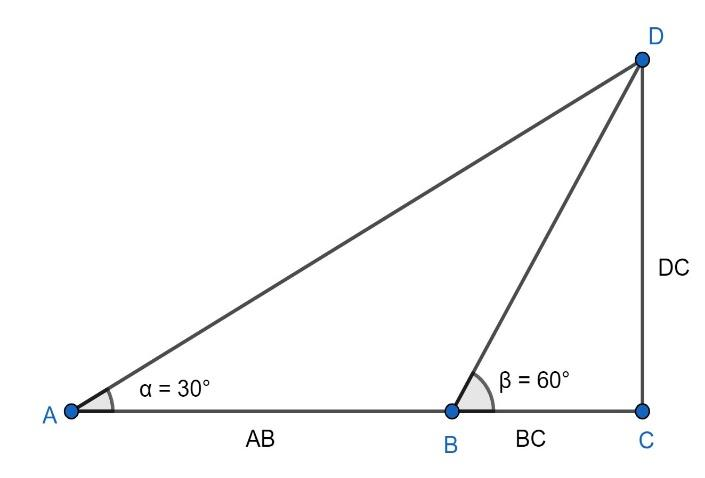
In the above figure, Dc represents the height of the chimney. Our initial position is represented by the point A and angle of elevation of the top of the chimney at point A is equal to $\angle DAC=\alpha ={{30}^{0}}$ then, we walk $x$ metres to reach at the point B so, length of $AB=x$ and angle of elevation of the top of the chimney at point B is equal to $\angle DBC=\beta ={{60}^{0}}$ .
Now, as point A, B and C lie on a horizontal line and DC is vertical so, $\angle DCA=\angle DCB={{90}^{0}}$ . Then,
$\begin{align}
& AB+BC=AC \\
& \Rightarrow AB=AC-BC \\
& \Rightarrow x=AC-BC.......................\left( 1 \right) \\
\end{align}$
Now, we consider $\Delta DAC$ in which $\angle DCA={{90}^{0}}$ , DC is the length of the perpendicular, AC is the length of the base and $\angle DAC={{30}^{0}}$ . Then,
$\begin{align}
& \tan \left( \angle DAC \right)=\dfrac{\left( \text{length of the perpendicular} \right)}{\left( \text{length of the base} \right)} \\
& \Rightarrow \tan {{30}^{0}}=\dfrac{DC}{AC} \\
& \Rightarrow \dfrac{1}{\sqrt{3}}=\dfrac{DC}{AC} \\
& \Rightarrow AC=\sqrt{3}\left( DC \right).........................\left( 2 \right) \\
\end{align}$
Now, we consider $\Delta DBC$ in which $\angle DCB={{90}^{0}}$ , DC is the length of the perpendicular, BC is the length of the base and $\angle DBC={{60}^{0}}$ . Then,
$\begin{align}
& \tan \left( \angle DBC \right)=\dfrac{\left( \text{length of the perpendicular} \right)}{\left( \text{length of the base} \right)} \\
& \Rightarrow \tan {{60}^{0}}=\dfrac{DC}{BC} \\
& \Rightarrow \sqrt{3}=\dfrac{DC}{BC} \\
& \Rightarrow BC=\dfrac{\left( DC \right)}{\sqrt{3}}.........................\left( 3 \right) \\
\end{align}$
Now, substitute $AC=\sqrt{3}\left( DC \right)$ from equation (2) and $BC=\dfrac{\left( DC \right)}{\sqrt{3}}$ from equation (3) into equation (1). Then,
$\begin{align}
& x=AC-BC \\
& \Rightarrow x=\sqrt{3}\left( DC \right)-\dfrac{\left( DC \right)}{\sqrt{3}} \\
& \Rightarrow x=\left( DC \right)\left( \dfrac{3-1}{\sqrt{3}} \right) \\
& \Rightarrow x=\left( DC \right)\dfrac{2}{\sqrt{3}} \\
& \Rightarrow DC=\dfrac{\sqrt{3}}{2}x \\
\end{align}$
Now, from the above result, we conclude that the length of DC is equal to $\dfrac{\sqrt{3}}{2}x$ metres.
Thus, the height of the chimney will be $\dfrac{\sqrt{3}}{2}x$ metres.
Hence, (c) is the correct option.
Note: Here, the student should first try to understand what is asked in the problem. After that, we should try to draw the geometrical figure as per the given data and proceed stepwise. Moreover, we should apply the basic formula of trigonometry properly without any error and avoid calculation mistakes while solving to get the correct answer.
Complete step-by-step answer:
Given:
It is given that when we walk $x$ metres towards a chimney in a horizontal line through its base, the elevation of its top changes from ${{30}^{0}}$ to ${{60}^{0}}$ . And we have to find the height of the chimney.
Now, first, we will draw a geometrical figure as per the given data. For more clarity look at the figure given below:
In the above figure, Dc represents the height of the chimney. Our initial position is represented by the point A and angle of elevation of the top of the chimney at point A is equal to $\angle DAC=\alpha ={{30}^{0}}$ then, we walk $x$ metres to reach at the point B so, length of $AB=x$ and angle of elevation of the top of the chimney at point B is equal to $\angle DBC=\beta ={{60}^{0}}$ .
Now, as point A, B and C lie on a horizontal line and DC is vertical so, $\angle DCA=\angle DCB={{90}^{0}}$ . Then,
$\begin{align}
& AB+BC=AC \\
& \Rightarrow AB=AC-BC \\
& \Rightarrow x=AC-BC.......................\left( 1 \right) \\
\end{align}$
Now, we consider $\Delta DAC$ in which $\angle DCA={{90}^{0}}$ , DC is the length of the perpendicular, AC is the length of the base and $\angle DAC={{30}^{0}}$ . Then,
$\begin{align}
& \tan \left( \angle DAC \right)=\dfrac{\left( \text{length of the perpendicular} \right)}{\left( \text{length of the base} \right)} \\
& \Rightarrow \tan {{30}^{0}}=\dfrac{DC}{AC} \\
& \Rightarrow \dfrac{1}{\sqrt{3}}=\dfrac{DC}{AC} \\
& \Rightarrow AC=\sqrt{3}\left( DC \right).........................\left( 2 \right) \\
\end{align}$
Now, we consider $\Delta DBC$ in which $\angle DCB={{90}^{0}}$ , DC is the length of the perpendicular, BC is the length of the base and $\angle DBC={{60}^{0}}$ . Then,
$\begin{align}
& \tan \left( \angle DBC \right)=\dfrac{\left( \text{length of the perpendicular} \right)}{\left( \text{length of the base} \right)} \\
& \Rightarrow \tan {{60}^{0}}=\dfrac{DC}{BC} \\
& \Rightarrow \sqrt{3}=\dfrac{DC}{BC} \\
& \Rightarrow BC=\dfrac{\left( DC \right)}{\sqrt{3}}.........................\left( 3 \right) \\
\end{align}$
Now, substitute $AC=\sqrt{3}\left( DC \right)$ from equation (2) and $BC=\dfrac{\left( DC \right)}{\sqrt{3}}$ from equation (3) into equation (1). Then,
$\begin{align}
& x=AC-BC \\
& \Rightarrow x=\sqrt{3}\left( DC \right)-\dfrac{\left( DC \right)}{\sqrt{3}} \\
& \Rightarrow x=\left( DC \right)\left( \dfrac{3-1}{\sqrt{3}} \right) \\
& \Rightarrow x=\left( DC \right)\dfrac{2}{\sqrt{3}} \\
& \Rightarrow DC=\dfrac{\sqrt{3}}{2}x \\
\end{align}$
Now, from the above result, we conclude that the length of DC is equal to $\dfrac{\sqrt{3}}{2}x$ metres.
Thus, the height of the chimney will be $\dfrac{\sqrt{3}}{2}x$ metres.
Hence, (c) is the correct option.
Note: Here, the student should first try to understand what is asked in the problem. After that, we should try to draw the geometrical figure as per the given data and proceed stepwise. Moreover, we should apply the basic formula of trigonometry properly without any error and avoid calculation mistakes while solving to get the correct answer.
Recently Updated Pages
Master Class 11 Social Science: Engaging Questions & Answers for Success

Master Class 11 English: Engaging Questions & Answers for Success
Master Class 11 Maths: Engaging Questions & Answers for Success
Master Class 11 Chemistry: Engaging Questions & Answers for Success
Master Class 11 Biology: Engaging Questions & Answers for Success
Master Class 11 Physics: Engaging Questions & Answers for Success
Trending doubts
One Metric ton is equal to kg A 10000 B 1000 C 100 class 11 physics CBSE
Difference Between Prokaryotic Cells and Eukaryotic Cells
How many of the following diseases can be studied with class 11 biology CBSE
Draw a diagram of a plant cell and label at least eight class 11 biology CBSE
Two of the body parts which do not appear in MRI are class 11 biology CBSE
Which gas is abundant in air class 11 chemistry CBSE