




It costs Rs.$2200$ to paint the inner curved surface of a cylindrical vessel $10$ m deep. If the cost of the painting is at the rate of Rs. $20$ per ${{\text{m}}^2}$, find-
i) Inner curved surface area of the vessel
ii) Radius of the base
iii) Capacity of the vessel
Answer
 Verified
585.6k+ views
Hint: Use the formula of cost of painting= (Inner curved surface area × Rate of painting) to find out the value of the inner curved surface area. Then use the formula of Area of curved surface which is given as-
The area of the curved surface of the cylinder=${{2\pi rh}}$ where r is the radius and h is the height of the cylinder.
Put the given values to find the radius of the base of the cylinder. Then use the formula of volume of the cylinder which is given as-
Volume of cylinder=${{\pi }}{{{r}}^{\text{2}}}{{h}}$ where r is the radius and h is the height of the cylinder. Put the given values to find the volume of the cylinder.
Complete step-by-step answer:
Given, A cylindrical vessel has height=$10$ m
The cost of the painting of the inner curved surface of a cylindrical vessel = Rs.$2200$
The rate of painting = Rs. $20$ per ${{\text{m}}^2}$
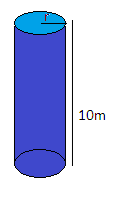
i) We have to find the inner curved surface area.
Now we know that cost of painting= Inner curved surface area × Rate of painting
Then on putting the given values we get,
$ \Rightarrow 2200 = {\text{Inner curved surface area}} \times {\text{20}}$
On adjusting we get,
$ \Rightarrow $ Inner curved surface area= $\dfrac{{2200}}{{20}}$
On solving we get,
Inner curved surface area=$110{\text{ }}{{\text{m}}^2}$ .
ii) We have to find the radius of the base.
Let the radius of the cylinder be r.
Now we know that-
The area of the curved surface of the cylinder=${{2\pi rh}}$ where r is the radius and h is the height of the cylinder.
So on putting the value of inner curved surface area in the given formula we get-
$ \Rightarrow 110 = 2{{\pi r}} \times 10$
On solving we get-
$ \Rightarrow r = \dfrac{{110 \times 7}}{{10 \times 22 \times 2}}$ {Because${{\pi }} = \dfrac{{22}}{7}$}
On simplifying we get,
$ \Rightarrow r = \dfrac{{77}}{{2 \times 22}} = \dfrac{7}{{2 \times 2}} = \dfrac{7}{4}$
On division, we get-
$ \Rightarrow r = 1.75{\text{ m}}$
Hence the radius of the base is $1.75{\text{ m}}$ .
iii) We have to find the capacity of the vessel and we know that capacity is measured by volume.
So we will use the formula of Volume of the cylinder which is given as-
$ \Rightarrow $ Volume of cylinder=${{\pi }}{{{r}}^{\text{2}}}{{h}}$
On putting the given values we get-
$ \Rightarrow $ Volume of cylinder=$\dfrac{{22}}{7} \times {\left( {1.75} \right)^2} \times 10$
On solving we get,
$ \Rightarrow $ Volume of cylinder=$\dfrac{{673.75}}{7}$
On division, we get-
$ \Rightarrow $ Volume of cylinder=$96.25$ ${{\text{m}}^3}$
Hence the capacity of the vessel is $96.25$ ${{\text{m}}^3}$.
Note: Here the student may go wrong if they directly use the formula of Area of the curved surface area of the cylinder in i) because we do not know the value of r, so we will not be able to solve the equation formed-
Area of curved surface of cylinder=${{2\pi r}} \times {{10}}$
After this, we cannot solve further as we only know the value of h.
Hence we use the data given in the question and find the area of the curved surface using the formula-
Cost of painting= Inner curved surface area × Rate of painting
The area of the curved surface of the cylinder=${{2\pi rh}}$ where r is the radius and h is the height of the cylinder.
Put the given values to find the radius of the base of the cylinder. Then use the formula of volume of the cylinder which is given as-
Volume of cylinder=${{\pi }}{{{r}}^{\text{2}}}{{h}}$ where r is the radius and h is the height of the cylinder. Put the given values to find the volume of the cylinder.
Complete step-by-step answer:
Given, A cylindrical vessel has height=$10$ m
The cost of the painting of the inner curved surface of a cylindrical vessel = Rs.$2200$
The rate of painting = Rs. $20$ per ${{\text{m}}^2}$
i) We have to find the inner curved surface area.
Now we know that cost of painting= Inner curved surface area × Rate of painting
Then on putting the given values we get,
$ \Rightarrow 2200 = {\text{Inner curved surface area}} \times {\text{20}}$
On adjusting we get,
$ \Rightarrow $ Inner curved surface area= $\dfrac{{2200}}{{20}}$
On solving we get,
Inner curved surface area=$110{\text{ }}{{\text{m}}^2}$ .
ii) We have to find the radius of the base.
Let the radius of the cylinder be r.
Now we know that-
The area of the curved surface of the cylinder=${{2\pi rh}}$ where r is the radius and h is the height of the cylinder.
So on putting the value of inner curved surface area in the given formula we get-
$ \Rightarrow 110 = 2{{\pi r}} \times 10$
On solving we get-
$ \Rightarrow r = \dfrac{{110 \times 7}}{{10 \times 22 \times 2}}$ {Because${{\pi }} = \dfrac{{22}}{7}$}
On simplifying we get,
$ \Rightarrow r = \dfrac{{77}}{{2 \times 22}} = \dfrac{7}{{2 \times 2}} = \dfrac{7}{4}$
On division, we get-
$ \Rightarrow r = 1.75{\text{ m}}$
Hence the radius of the base is $1.75{\text{ m}}$ .
iii) We have to find the capacity of the vessel and we know that capacity is measured by volume.
So we will use the formula of Volume of the cylinder which is given as-
$ \Rightarrow $ Volume of cylinder=${{\pi }}{{{r}}^{\text{2}}}{{h}}$
On putting the given values we get-
$ \Rightarrow $ Volume of cylinder=$\dfrac{{22}}{7} \times {\left( {1.75} \right)^2} \times 10$
On solving we get,
$ \Rightarrow $ Volume of cylinder=$\dfrac{{673.75}}{7}$
On division, we get-
$ \Rightarrow $ Volume of cylinder=$96.25$ ${{\text{m}}^3}$
Hence the capacity of the vessel is $96.25$ ${{\text{m}}^3}$.
Note: Here the student may go wrong if they directly use the formula of Area of the curved surface area of the cylinder in i) because we do not know the value of r, so we will not be able to solve the equation formed-
Area of curved surface of cylinder=${{2\pi r}} \times {{10}}$
After this, we cannot solve further as we only know the value of h.
Hence we use the data given in the question and find the area of the curved surface using the formula-
Cost of painting= Inner curved surface area × Rate of painting
Recently Updated Pages
Master Class 11 English: Engaging Questions & Answers for Success

Master Class 11 Maths: Engaging Questions & Answers for Success
Master Class 11 Biology: Engaging Questions & Answers for Success
Master Class 11 Physics: Engaging Questions & Answers for Success
Master Class 11 Accountancy: Engaging Questions & Answers for Success
Class 11 Question and Answer - Your Ultimate Solutions Guide
Trending doubts
One Metric ton is equal to kg A 10000 B 1000 C 100 class 11 physics CBSE
Discuss the various forms of bacteria class 11 biology CBSE
Draw a diagram of a plant cell and label at least eight class 11 biology CBSE
State the laws of reflection of light
Explain zero factorial class 11 maths CBSE
10 examples of friction in our daily life