




How do isosceles trapezoids relate to parallelogram?
Answer
 Verified
577.2k+ views
Hint: First of all we must know the difference between a parallelogram and the trapezoid. If we talk about parallelograms, it is a polygon but a unique polygon. Opposite sides of this polygon are equal but the angles are not equal. Only the opposite angles are equal and the angles are \[120{}^\circ \] and $60{}^\circ $. Whereas a trapezoid is also a polygon but not all the sides are parallel. Only 2 sides are parallel in trapezoids and the angles are also different.
Complete step-by-step solution:
First of all let us consider an isosceles trapezoid. An isosceles trapezoid is a trapezoid that has 2 sides equal i.e. the sides that are not parallel. Let there be an isosceles trapezium ABCD. Let the length of the sides be a, b, c and d.
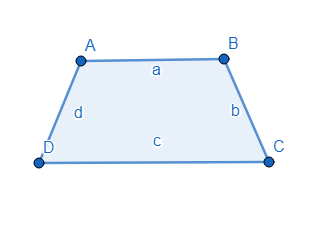
We know that the side b and d of the isosceles trapezoid are equal. Let there be a parallelogram WXYZ and let the length of the sides be w, x, y and z.
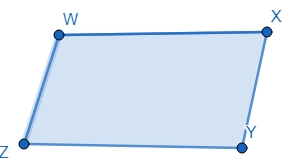
We know that in parallelogram \[wx = yz\] and \[xy = wz\] and in the isosceles trapezoid \[d=b\]. Hence isosceles triangle is related to the parallelogram such that both of them are a polygon or a quadrilateral (it is a polygon that has only 4 sides), in parallelogram all the sides are equal and opposite sides are parallel to each other and in isosceles trapezoid only 2 opposite sides are equal and only 2 opposite sides are parallel.
Note: We should not confuse parallelogram with a rhombus. Rhombus is a polygon similar to the parallelogram but has all the sides equal. In other words all rhombus are parallelograms but all parallelograms are not rhombus.
Complete step-by-step solution:
First of all let us consider an isosceles trapezoid. An isosceles trapezoid is a trapezoid that has 2 sides equal i.e. the sides that are not parallel. Let there be an isosceles trapezium ABCD. Let the length of the sides be a, b, c and d.
We know that the side b and d of the isosceles trapezoid are equal. Let there be a parallelogram WXYZ and let the length of the sides be w, x, y and z.
We know that in parallelogram \[wx = yz\] and \[xy = wz\] and in the isosceles trapezoid \[d=b\]. Hence isosceles triangle is related to the parallelogram such that both of them are a polygon or a quadrilateral (it is a polygon that has only 4 sides), in parallelogram all the sides are equal and opposite sides are parallel to each other and in isosceles trapezoid only 2 opposite sides are equal and only 2 opposite sides are parallel.
Note: We should not confuse parallelogram with a rhombus. Rhombus is a polygon similar to the parallelogram but has all the sides equal. In other words all rhombus are parallelograms but all parallelograms are not rhombus.

Recently Updated Pages
Master Class 8 English: Engaging Questions & Answers for Success

Master Class 8 Science: Engaging Questions & Answers for Success
Master Class 8 Maths: Engaging Questions & Answers for Success
Class 8 Question and Answer - Your Ultimate Solutions Guide
Master Class 8 Social Science: Engaging Questions & Answers for Success
Master Class 9 General Knowledge: Engaging Questions & Answers for Success
Trending doubts
What is BLO What is the full form of BLO class 8 social science CBSE
Citizens of India can vote at the age of A 18 years class 8 social science CBSE
Right to vote is a AFundamental Right BFundamental class 8 social science CBSE
Give me the opposite gender of Duck class 8 english CBSE
Full form of STD, ISD and PCO
Explain land use pattern in India and why has the land class 8 social science CBSE