




Isopropylbenzene is oxidized in the presence of air to compound ‘A′. When compound ′A′ is treated with dilute mineral acid, the aromatic product formed is:
A. Phenol
B. Benzene
C. Benzaldehyde
D. Acetophenone
E. Toluene
Answer
 Verified
645.6k+ views
Hint:
It is \[X \to \;A\; \to \;Y\] type of reaction. The major product will be A then the appropriate answer can be known. Here oxidize means the addition of the oxygen molecule. By adding oxygen to the organic molecule in the given compound the peroxide is formed, which is product A .it is further treated to give aromatic products which contain delocalized pi- electrons and other products will be non-aromatic ketone.
Complete step by step solution:
We can see that we have to find the first product A form isopropylbenzene, then after knowing A, the final product can be derived and the appropriate answer can be chosen. Here, we should not get confused with the product A but is taken as the intermediate product to derive the final product as shown in the figure the product A needs to be formed to get the aromatic product. The reactivity of cumene should be known and the structure of the compound will help to detect the tertiary carbon.
As shown in the figure the reaction is oxidation of cumene. Cumene is also known as Isopropyl benzene. Isopropyl benzene contains tertiary carbon to which the benzene ring is attached so the oxidation of it will give us product A which is cumene hydrogen peroxide. Further if it is treated with dilute mineral acid it will give us phenol as aromatic product and acetone as a by-product. In the given options, both the products are mentioned but the aromatic product as question specifies phenol,
Hence the correct answer is option (A).
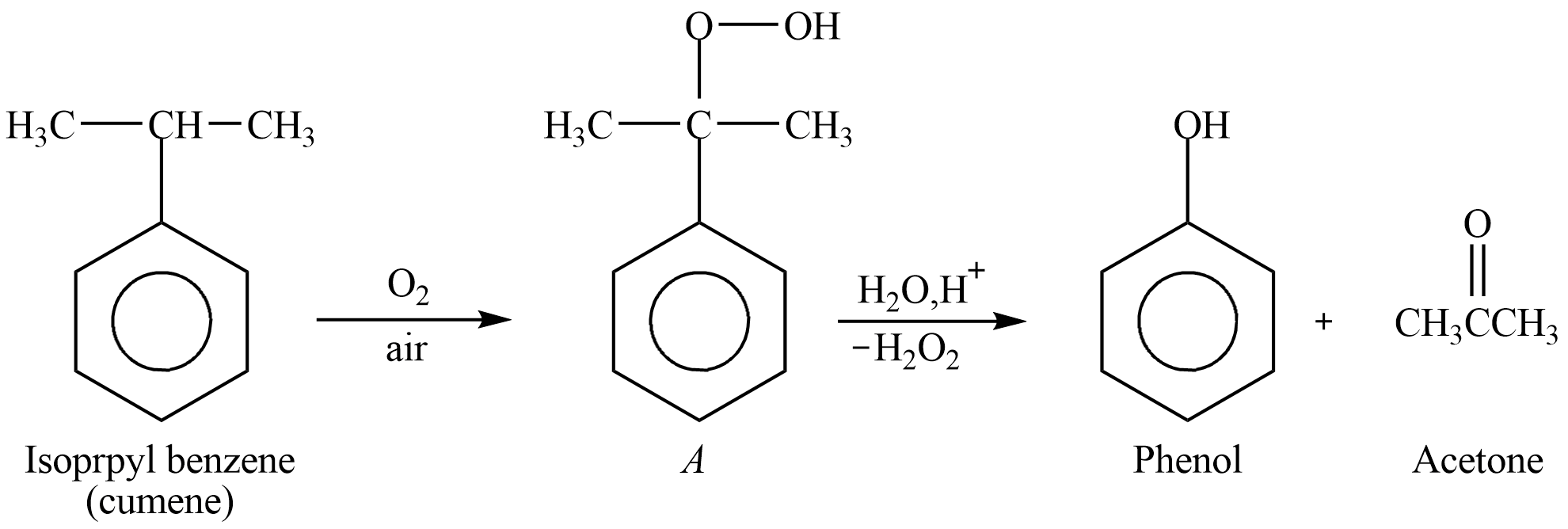
You may have a question why the oxygen attacks the tertiary carbon and no other carbon of the methyl group present at the neighboring carbon. The answer is that the tertiary carbocation is most stable, and hydrogen attached to it can be easily substituted by water molecule, carbon oxygen bond is formed in presence of acid. Here the role of adding acid is that, the bond between the tertiary carbon and carbon of the benzene breaks easily, so that hydroxyl group is attached to benzene aromatic ring and aliphatic ketone is formed with three carbon known as acetone or propanone, which is non-aromatic.
It is an important reaction as cumene hydrogen peroxide is used for the formation of the phenol and acetone.
Note:
Isopropylbenzene is also known as cumene. There are various reactions of cumene is possible. It is produced by Friedel crafts alkylation of benzene reacts with propylene. The use of cumene is to produce phenol and acetone.it is also used as a solvent in the paint industry.
It is \[X \to \;A\; \to \;Y\] type of reaction. The major product will be A then the appropriate answer can be known. Here oxidize means the addition of the oxygen molecule. By adding oxygen to the organic molecule in the given compound the peroxide is formed, which is product A .it is further treated to give aromatic products which contain delocalized pi- electrons and other products will be non-aromatic ketone.
Complete step by step solution:
We can see that we have to find the first product A form isopropylbenzene, then after knowing A, the final product can be derived and the appropriate answer can be chosen. Here, we should not get confused with the product A but is taken as the intermediate product to derive the final product as shown in the figure the product A needs to be formed to get the aromatic product. The reactivity of cumene should be known and the structure of the compound will help to detect the tertiary carbon.
As shown in the figure the reaction is oxidation of cumene. Cumene is also known as Isopropyl benzene. Isopropyl benzene contains tertiary carbon to which the benzene ring is attached so the oxidation of it will give us product A which is cumene hydrogen peroxide. Further if it is treated with dilute mineral acid it will give us phenol as aromatic product and acetone as a by-product. In the given options, both the products are mentioned but the aromatic product as question specifies phenol,
Hence the correct answer is option (A).
You may have a question why the oxygen attacks the tertiary carbon and no other carbon of the methyl group present at the neighboring carbon. The answer is that the tertiary carbocation is most stable, and hydrogen attached to it can be easily substituted by water molecule, carbon oxygen bond is formed in presence of acid. Here the role of adding acid is that, the bond between the tertiary carbon and carbon of the benzene breaks easily, so that hydroxyl group is attached to benzene aromatic ring and aliphatic ketone is formed with three carbon known as acetone or propanone, which is non-aromatic.
It is an important reaction as cumene hydrogen peroxide is used for the formation of the phenol and acetone.
Note:
Isopropylbenzene is also known as cumene. There are various reactions of cumene is possible. It is produced by Friedel crafts alkylation of benzene reacts with propylene. The use of cumene is to produce phenol and acetone.it is also used as a solvent in the paint industry.
Recently Updated Pages
Explain the structure of megasporangium class 12 biology CBSE

Why is chloroform kept in dark coloured bottles class 12 chemistry CBSE
Derive the balancing condition of a Wheatstone bri class 12 physics CBSE
Draw VI characteristics of a pn junction diode Explain class 12 physics CBSE
Is it possible to carry pride in ones language too class 12 english CBSE
In a population at Hardy Weinberg equilibrium the allele class 12 biology CBSE
Trending doubts
Draw a labelled sketch of the human eye class 12 physics CBSE
Which are the Top 10 Largest Countries of the World?
Draw ray diagrams each showing i myopic eye and ii class 12 physics CBSE
Which is the correct genotypic ratio of mendel dihybrid class 12 biology CBSE
Differentiate between homogeneous and heterogeneous class 12 chemistry CBSE
Give 10 examples of unisexual and bisexual flowers