




What is an isobilateral leaf? Give an example.
Answer
 Verified
651.3k+ views
Hint: In the case of isobilateral leaf, it is made up of either only spongy or palisade parenchyma cells. These forms of leaves are similar in appearance on both the sides and are known as isobilateral types of leaves.
Complete answer:
Key Features of isobilateral leaf are
- Isobilateral leaf is differentiated into upper as well as lower epidermis, and mesophyll, which occurs in between the two epidermises.
- The stomata in type of leaves are distributed on both the epidermises.
- The mesophyll cells consist of one type of cells, i.e. the cells are either more or less isodiametric that means simulate spongy parenchyma or elongated that means simulate palisade parenchyma. The cells lie in between the upper and lower epidermis having a little intercellular space.
- In the transverse section of the Isobilateral leaf there is vascular bundles are more or less of same sizes as well as they are arranged in a transverse line.
- The vascular bundles in the leaf are usually surrounded by the bundle sheath, which may be found in one or two layers. In the latter case the outer sheath is made of thin walled parenchyma cells. The cells of the inner sheath are smaller in cross-sectional diameter as well as thick walled in comparison to the outer sheath.
- Bulliform cells are present.
Examples of the Isobilateral leaf are- monocots such as maize, lilies, irises, amaryllises etc.
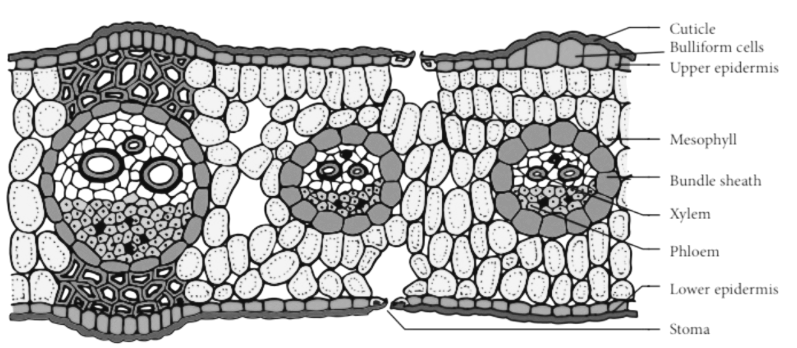
Note: Isobilateral leaves orient themselves as parallel to the main axis as well as parallel to the direction of sunlight. Most of the monocots plants possess parallel-veined isobilateral leaves, including grasses and grasses like plants.
Complete answer:
Key Features of isobilateral leaf are
- Isobilateral leaf is differentiated into upper as well as lower epidermis, and mesophyll, which occurs in between the two epidermises.
- The stomata in type of leaves are distributed on both the epidermises.
- The mesophyll cells consist of one type of cells, i.e. the cells are either more or less isodiametric that means simulate spongy parenchyma or elongated that means simulate palisade parenchyma. The cells lie in between the upper and lower epidermis having a little intercellular space.
- In the transverse section of the Isobilateral leaf there is vascular bundles are more or less of same sizes as well as they are arranged in a transverse line.
- The vascular bundles in the leaf are usually surrounded by the bundle sheath, which may be found in one or two layers. In the latter case the outer sheath is made of thin walled parenchyma cells. The cells of the inner sheath are smaller in cross-sectional diameter as well as thick walled in comparison to the outer sheath.
- Bulliform cells are present.
Examples of the Isobilateral leaf are- monocots such as maize, lilies, irises, amaryllises etc.
Note: Isobilateral leaves orient themselves as parallel to the main axis as well as parallel to the direction of sunlight. Most of the monocots plants possess parallel-veined isobilateral leaves, including grasses and grasses like plants.
Recently Updated Pages
If x a + bt + ct2 where x is in meters and t is in class 11 physics CBSE

A car covers the first half distance between two places class 11 physics CBSE
The resultant of two vectors overrightarrow P and overrightarrow class 11 physics CBSE
Find the value of cos 135 class 11 maths CBSE
A mass M is held in place by an applied force F and class 11 physics CBSE
A solution of glucose in water is labelled as 10 dfracwv class 11 chemistry CBSE
Trending doubts
One Metric ton is equal to kg A 10000 B 1000 C 100 class 11 physics CBSE
Find the value of the expression given below sin 30circ class 11 maths CBSE
Draw a diagram of nephron and explain its structur class 11 biology CBSE
10 examples of friction in our daily life
Proton was discovered by A Thomson B Rutherford C Chadwick class 11 chemistry CBSE
Bond order ofO2 O2+ O2 and O22 is in order A O2 langle class 11 chemistry CBSE