




Isha's eyeballs are too short due to which she cannot see
Answer
 Verified
568.5k+ views
Hint: The eyeball is a bilateral and spherical organ that houses the structures that allow us to see. It is located in the bony orbit, a bony cavity within the facial skeleton. The eyeball is anatomically divided into three layers: fibrous, vascular, and inner.
Complete answer:
Isha has hypermetropia because her eyeballs are too short. A person with this defect is unable to see nearby objects. Hypermetropia (long-sightedness) is a common eye condition in which nearby objects appear blurry but your vision is clearer when you look further away. You may have hypermetropia if your eyes are frequently tired and you have difficulty focusing on objects close to your eyes.
Causes:
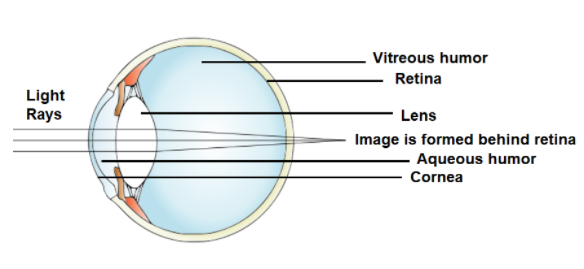
- Your eye functions similarly to a camera. It focuses light on the back of your eye (on a structure known as the retina), allowing you to see clearly. Long-sight is caused by light that is not properly focused, causing light to travel behind the retina.
- One possible explanation is that your eyeballs are shorter than usual. This means that the retina is closer to the pupil, allowing light to pass through it. A normal eye is usually around 23mm long, so a hypermetropic eye will be shorter than that.
- If your cornea is flat, you can also have hypermetropia. To direct light onto the retina, the cornea should be curved.
- Both of these factors contribute to long-sightedness by allowing light to pass through the retina. This causes blurry vision and can have an impact on your daily life.
The figure below showing hypermetropia.
Note: When hypermetropia is fully corrected: When hypermetropia is fully corrected (vision is normal), the patient develops asthenopic symptoms due to continued accommodative efforts.
- Asthenopia is a type of blindness (eyestrain).
- Headache on the frontal or frontotemporal lobe.
- Watering is being done.
- A slight aversion to light.
Complete answer:
Isha has hypermetropia because her eyeballs are too short. A person with this defect is unable to see nearby objects. Hypermetropia (long-sightedness) is a common eye condition in which nearby objects appear blurry but your vision is clearer when you look further away. You may have hypermetropia if your eyes are frequently tired and you have difficulty focusing on objects close to your eyes.
Causes:
- Your eye functions similarly to a camera. It focuses light on the back of your eye (on a structure known as the retina), allowing you to see clearly. Long-sight is caused by light that is not properly focused, causing light to travel behind the retina.
- One possible explanation is that your eyeballs are shorter than usual. This means that the retina is closer to the pupil, allowing light to pass through it. A normal eye is usually around 23mm long, so a hypermetropic eye will be shorter than that.
- If your cornea is flat, you can also have hypermetropia. To direct light onto the retina, the cornea should be curved.
- Both of these factors contribute to long-sightedness by allowing light to pass through the retina. This causes blurry vision and can have an impact on your daily life.
The figure below showing hypermetropia.
Note: When hypermetropia is fully corrected: When hypermetropia is fully corrected (vision is normal), the patient develops asthenopic symptoms due to continued accommodative efforts.
- Asthenopia is a type of blindness (eyestrain).
- Headache on the frontal or frontotemporal lobe.
- Watering is being done.
- A slight aversion to light.
Recently Updated Pages
Class 10 Question and Answer - Your Ultimate Solutions Guide

Master Class 10 Computer Science: Engaging Questions & Answers for Success
Master Class 10 General Knowledge: Engaging Questions & Answers for Success
Master Class 12 Economics: Engaging Questions & Answers for Success
Master Class 12 Social Science: Engaging Questions & Answers for Success
Master Class 12 English: Engaging Questions & Answers for Success
Trending doubts
Explain the Treaty of Vienna of 1815 class 10 social science CBSE
The slogan Jai Hind was given by A Lal Bahadur Shastri class 10 social science CBSE
10 examples of evaporation in daily life with explanations
What is the full form of POSCO class 10 social science CBSE
Five things I will do to build a great India class 10 english CBSE
Identify the feminine form of noun nephew a shenephew class 10 english CBSE