




Is the sperm or the egg is responsible for the sex of the chicks?
Answer
 Verified
615.3k+ views
Hint: Birds have a ZW system of sex determination. The ZW sex-determination system is a chromosomal system that determines the sex of offspring in birds, some fish and crustaceans such as the giant river prawn, some insects (including butterflies and moths), and in some reptiles.
Complete answer:
Only the egg is responsible for the sex of the chicks. If the egg containing Z chromosome combines with sperm then it will result in the male formation and if the egg-containing W chromosome combines with the sperm, it will result in female formation.
Additional Information: In birds, the sex of the embryo is determined by the egg, not the sperm (as it is in humans). Avian sex differentiation is not determined by XY chromosomes like it is in humans and most mammals (or even the XO system used by some insects). In those systems, the sex is determined by the sperm, by what the male contributes to the offspring. By contrast, birds have a ZW system of sex determination (shared with butterflies, moths, fish and reptiles). In that system, sex is determined by the female within her ova, and the sex of offspring is not affected at all by the sperm which the male contributes. Some people think it is this difference which makes parthenogenesis possible for birds. Parthenogenesis occurs when unfertilized eggs see embryonic development.
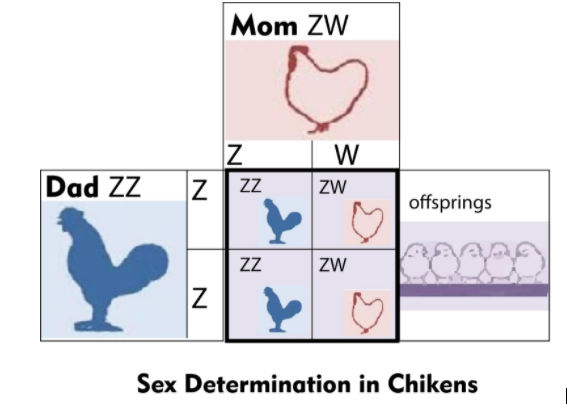
Note: A sex-determination system determines the event of sexual characteristics in an organism. Most organisms that make their offspring by heterogametic fusion have two sexes. Occasionally, they are hermaphrodites in place of one or both sexes. The sex of the offspring will be the sex of either one of the parent. Few of the examples are given below.
Complete answer:
Only the egg is responsible for the sex of the chicks. If the egg containing Z chromosome combines with sperm then it will result in the male formation and if the egg-containing W chromosome combines with the sperm, it will result in female formation.
Additional Information: In birds, the sex of the embryo is determined by the egg, not the sperm (as it is in humans). Avian sex differentiation is not determined by XY chromosomes like it is in humans and most mammals (or even the XO system used by some insects). In those systems, the sex is determined by the sperm, by what the male contributes to the offspring. By contrast, birds have a ZW system of sex determination (shared with butterflies, moths, fish and reptiles). In that system, sex is determined by the female within her ova, and the sex of offspring is not affected at all by the sperm which the male contributes. Some people think it is this difference which makes parthenogenesis possible for birds. Parthenogenesis occurs when unfertilized eggs see embryonic development.
Note: A sex-determination system determines the event of sexual characteristics in an organism. Most organisms that make their offspring by heterogametic fusion have two sexes. Occasionally, they are hermaphrodites in place of one or both sexes. The sex of the offspring will be the sex of either one of the parent. Few of the examples are given below.
| Organism | Male sex chromosome(father) | Female sex chromosome(mother) | Sex determined by(father/Mother) |
| Human beings | XY | XX | Father |
| Birds | ZZ | ZW | Mother |
| Grasshoppers, crickets, and some other insects | XO | XX | Father |
Recently Updated Pages
Master Class 12 Business Studies: Engaging Questions & Answers for Success

Master Class 12 Biology: Engaging Questions & Answers for Success
Master Class 12 Chemistry: Engaging Questions & Answers for Success
Class 12 Question and Answer - Your Ultimate Solutions Guide
Master Class 11 Social Science: Engaging Questions & Answers for Success
Master Class 11 English: Engaging Questions & Answers for Success
Trending doubts
Which is more stable and why class 12 chemistry CBSE
What are the major means of transport Explain each class 12 social science CBSE
The value of constant k in coulombs law is beginalign class 12 physics CBSE
The first microscope was invented by A Leeuwenhoek class 12 biology CBSE
What is the Full Form of 1.DPT 2.DDT 3.BCG
What is the Full Form of PVC, PET, HDPE, LDPE, PP and PS ?