




___________ is the second largest Phylum in the Animal Kingdom.
Answer
 Verified
653.4k+ views
Hint: Second largest Phylum is both terrestrial and aquatic
Complete answer:
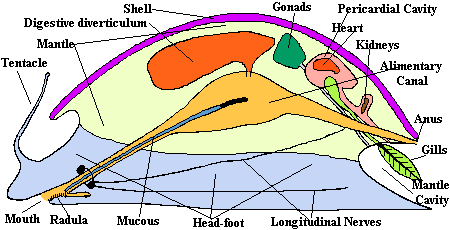
Mollusca is the second largest Phylum in the Animal Kingdom. Molluscs are both terrestrial and aquatic (marine or freshwater). They have an organ-system level of organisation. They are bilaterally symmetrical, triploblastic and coelomate animals. Their body is covered by a shell. They have a distinct head, muscular foot and visceral hump. Mantle cavity is the space between the visceral hump and soft skin, in which feather-like gills are present. They have distinct respiratory and digestive functions. Anterior head has sensory organs, Radula is the feeding organ. They are diacious, oviparous and undergo indirect development.
Additional Information:
Usually molluscs are hermaphrodites, that is they are diacious, produce both male and female gametes and do not need a partner for sexual reproduction. Molluscs are further divided into six classes; Monoplacophora, Amphineura, Scaphopoda, Gastropoda, Bivalvia and Cephalopoda; each of them have a distinct character. Molluscs have several economic importance - they are used as food, for decoration, in jewelry, and in scientific studies. They are even used as roadbed material and in vitamin supplements.
Notes:
- The largest phylum in the animal kingdom is Arthropods.
- Examples of Molluscs include - Pila, Pinctada, Loliga, Octopus, Dentalium etc.
- Chordata is the third largest phylum in Animal Kingdom.
Complete answer:
Mollusca is the second largest Phylum in the Animal Kingdom. Molluscs are both terrestrial and aquatic (marine or freshwater). They have an organ-system level of organisation. They are bilaterally symmetrical, triploblastic and coelomate animals. Their body is covered by a shell. They have a distinct head, muscular foot and visceral hump. Mantle cavity is the space between the visceral hump and soft skin, in which feather-like gills are present. They have distinct respiratory and digestive functions. Anterior head has sensory organs, Radula is the feeding organ. They are diacious, oviparous and undergo indirect development.
Additional Information:
Usually molluscs are hermaphrodites, that is they are diacious, produce both male and female gametes and do not need a partner for sexual reproduction. Molluscs are further divided into six classes; Monoplacophora, Amphineura, Scaphopoda, Gastropoda, Bivalvia and Cephalopoda; each of them have a distinct character. Molluscs have several economic importance - they are used as food, for decoration, in jewelry, and in scientific studies. They are even used as roadbed material and in vitamin supplements.
Notes:
- The largest phylum in the animal kingdom is Arthropods.
- Examples of Molluscs include - Pila, Pinctada, Loliga, Octopus, Dentalium etc.
- Chordata is the third largest phylum in Animal Kingdom.
Recently Updated Pages
Master Class 11 English: Engaging Questions & Answers for Success

Master Class 11 Physics: Engaging Questions & Answers for Success
Master Class 11 Computer Science: Engaging Questions & Answers for Success
Master Class 11 Chemistry: Engaging Questions & Answers for Success
Master Class 11 Social Science: Engaging Questions & Answers for Success
Master Class 11 Accountancy: Engaging Questions & Answers for Success
Trending doubts
Difference Between Prokaryotic Cells and Eukaryotic Cells
Two of the body parts which do not appear in MRI are class 11 biology CBSE
One Metric ton is equal to kg A 10000 B 1000 C 100 class 11 physics CBSE
10 examples of friction in our daily life
Draw a diagram of nephron and explain its structur class 11 biology CBSE
Draw a diagram of a plant cell and label at least eight class 11 biology CBSE