




Is it true that for a value of $n$ (n-principal quantum number), the value of ${m_l}$ (${m_l}$-magnetic quantum number) is equal to ${n^2}$ ? If it is true, can you please explain this to me? Thanks.
Answer
 Verified
561.3k+ views
Hint: In the atom, there are four quantum numbers which are: Principal quantum number ($n$), Azimuthal quantum number ($l$ ), magnetic quantum number (${m_l}$ ) and spin quantum number (${m_s}$ ). Each electron of the atom has its own unique set of quantum numbers.
Complete answer:
For this we have to know about the four quantum numbers. Principal quantum number ($n$), is to describe the principal electron shell, i.e. the shell in which the electron is present. Azimuthal quantum number ($l$ ), describes the shape of the orbital in which an electron is present. Magnetic quantum number (${m_l}$ ) is to determine the number of orbitals and their orientation within the shell. And the spin quantum number (${m_s}$ ) tells the direction of the electron spin.
The Azimuthal quantum number $l$ depends upon the value of principal quantum $n$ whereas ${m_l}$ values depend upon Azimuthal quantum number $l$.
The Azimuthal quantum number $l$ can be any value ranging from $0$ to $n - 1$ when the principal quantum number $n$ is $n$. So, the Azimuthal quantum number $l$:
$l = 0,1,2,......,(n - 1)$
The range of magnetic quantum number ${m_l}$ from $ - l$ to $l$ . So, the magnetic quantum number ${m_l}$:
${m_l} = \; - l,...., - 1,0,1,...,l$
If we substitute the value of $l$, we can get the relation between ${m_l}$ and $n$ which can be:
${m_l} = \; - (n - 1),..., - 1,0,1,...,(n - 1)$
To make it more clear let’s take an example $n = 2$ ,
for $l = 0$ , ${m_l} = 0$
And for $l = 1$, ${m_l} = \{ - 1,0,1\} $
We can see that the values of ${m_l}$ is not even close to ${n^2}$but the total number of ${m_l}$ is, if you take the values of $l$, is indeed equal to ${n^2}$.
The magnetic quantum number tells us about the number of orbitals the subshell has. By above example, we can see if $n = 2$ then $l = 0$ , ${m_l} = 0$ indicates $2s - orbital$
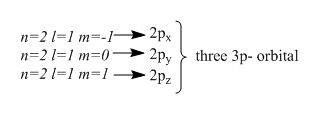
This indicates the second energy level has two subshells , one is of $2s$ and other one is $2p$ subshell. And by ${m_l}$ values we can get the number of orbitals each subshell has. For $2s - subshell$, there is only one possible value of ${m_l}$ so it has one orbital. Whereas $2p - subshell$ there are three orbitals as it has three different values of ${m_l}$. Hence the total number of orbitals in the second energy level is $4$ , which equals ${n^2}$ .
Note:
The only one quantum number which is not dependent on the other is spin quantum number as it indicates the direction of the electron spin. The spin of $ + \dfrac{1}{2}$ is represented by $ \uparrow $ , whereas the spin $ - \dfrac{1}{2}$ is represented by $ \downarrow $ .
Complete answer:
For this we have to know about the four quantum numbers. Principal quantum number ($n$), is to describe the principal electron shell, i.e. the shell in which the electron is present. Azimuthal quantum number ($l$ ), describes the shape of the orbital in which an electron is present. Magnetic quantum number (${m_l}$ ) is to determine the number of orbitals and their orientation within the shell. And the spin quantum number (${m_s}$ ) tells the direction of the electron spin.
The Azimuthal quantum number $l$ depends upon the value of principal quantum $n$ whereas ${m_l}$ values depend upon Azimuthal quantum number $l$.
The Azimuthal quantum number $l$ can be any value ranging from $0$ to $n - 1$ when the principal quantum number $n$ is $n$. So, the Azimuthal quantum number $l$:
$l = 0,1,2,......,(n - 1)$
The range of magnetic quantum number ${m_l}$ from $ - l$ to $l$ . So, the magnetic quantum number ${m_l}$:
${m_l} = \; - l,...., - 1,0,1,...,l$
If we substitute the value of $l$, we can get the relation between ${m_l}$ and $n$ which can be:
${m_l} = \; - (n - 1),..., - 1,0,1,...,(n - 1)$
To make it more clear let’s take an example $n = 2$ ,
for $l = 0$ , ${m_l} = 0$
And for $l = 1$, ${m_l} = \{ - 1,0,1\} $
We can see that the values of ${m_l}$ is not even close to ${n^2}$but the total number of ${m_l}$ is, if you take the values of $l$, is indeed equal to ${n^2}$.
The magnetic quantum number tells us about the number of orbitals the subshell has. By above example, we can see if $n = 2$ then $l = 0$ , ${m_l} = 0$ indicates $2s - orbital$
This indicates the second energy level has two subshells , one is of $2s$ and other one is $2p$ subshell. And by ${m_l}$ values we can get the number of orbitals each subshell has. For $2s - subshell$, there is only one possible value of ${m_l}$ so it has one orbital. Whereas $2p - subshell$ there are three orbitals as it has three different values of ${m_l}$. Hence the total number of orbitals in the second energy level is $4$ , which equals ${n^2}$ .
Note:
The only one quantum number which is not dependent on the other is spin quantum number as it indicates the direction of the electron spin. The spin of $ + \dfrac{1}{2}$ is represented by $ \uparrow $ , whereas the spin $ - \dfrac{1}{2}$ is represented by $ \downarrow $ .
Recently Updated Pages
If x a + bt + ct2 where x is in meters and t is in class 11 physics CBSE

A car covers the first half distance between two places class 11 physics CBSE
The resultant of two vectors overrightarrow P and overrightarrow class 11 physics CBSE
Find the value of cos 135 class 11 maths CBSE
A mass M is held in place by an applied force F and class 11 physics CBSE
A solution of glucose in water is labelled as 10 dfracwv class 11 chemistry CBSE
Trending doubts
Find the value of the expression given below sin 30circ class 11 maths CBSE
One Metric ton is equal to kg A 10000 B 1000 C 100 class 11 physics CBSE
Draw a diagram of nephron and explain its structur class 11 biology CBSE
10 examples of friction in our daily life
Proton was discovered by A Thomson B Rutherford C Chadwick class 11 chemistry CBSE
Bond order ofO2 O2+ O2 and O22 is in order A O2 langle class 11 chemistry CBSE