




Is it possible to isolate the poles of a magnet?
$\left( a \right)$ Yes
$\left( b \right)$ No
$\left( c \right)$ May be
$\left( d \right)$ Can’t say
Answer
 Verified
630.9k+ views
Hint – In this question think of the concept that magnetic lines of forces form a closed loop in case of a magnet and are straightened inside the magnet. So if we isolate the poles then continuous loop behavior of a magnet will be affected and thus the magnet will lose its magnetic or magnetizing properties. Thus this will help commenting on the given problem statement.
Step-By-Step answer:
As we all know that the magnetic field of lines always forms a closed loop i.e. if it originates from one of the poles it always goes back from the other pole just like an electric current, an electric current always forms a closed loop otherwise it will not flow.
But this is not in the case of magnetic field lines.
Such as if we have a voltage source and we did not connect a load then electric current will not flow.
But if we have a bar magnet, it always has a north and south-pole so there is always a magnetic field of lines coming from one end going back from the other end.
It is an imaginary field of lines as we cannot see these lines from the naked eyes.
So suppose we cut this bar magnet into two pieces, doing this these two pieces behave like two separate magnets having individual north and south-poles.
So these two pieces of bar magnet have their individual magnetic field of lines which form a closed loop.
So it is not possible to isolate the poles of a magnet (i.e. one single pole or we can say monopole)
So this is the required answer.
Hence option (B) is the correct answer.
Note – The diagrammatic representation of the magnetic field lines of a magnet is shown in figure.
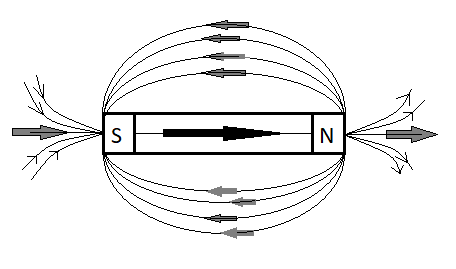
Image above shows the magnetic field lines of a simple magnet. From the North Pole they point towards the South Pole. The magnetic field lines, however, do not necessarily stop at the edge of the magnet. They travel through it so that the magnetic field points from the southern pole to the North Pole within the magnet.
Step-By-Step answer:
As we all know that the magnetic field of lines always forms a closed loop i.e. if it originates from one of the poles it always goes back from the other pole just like an electric current, an electric current always forms a closed loop otherwise it will not flow.
But this is not in the case of magnetic field lines.
Such as if we have a voltage source and we did not connect a load then electric current will not flow.
But if we have a bar magnet, it always has a north and south-pole so there is always a magnetic field of lines coming from one end going back from the other end.
It is an imaginary field of lines as we cannot see these lines from the naked eyes.
So suppose we cut this bar magnet into two pieces, doing this these two pieces behave like two separate magnets having individual north and south-poles.
So these two pieces of bar magnet have their individual magnetic field of lines which form a closed loop.
So it is not possible to isolate the poles of a magnet (i.e. one single pole or we can say monopole)
So this is the required answer.
Hence option (B) is the correct answer.
Note – The diagrammatic representation of the magnetic field lines of a magnet is shown in figure.
Image above shows the magnetic field lines of a simple magnet. From the North Pole they point towards the South Pole. The magnetic field lines, however, do not necessarily stop at the edge of the magnet. They travel through it so that the magnetic field points from the southern pole to the North Pole within the magnet.
Recently Updated Pages
Master Class 12 Economics: Engaging Questions & Answers for Success

Master Class 12 English: Engaging Questions & Answers for Success
Master Class 12 Social Science: Engaging Questions & Answers for Success
Master Class 12 Maths: Engaging Questions & Answers for Success
Master Class 12 Physics: Engaging Questions & Answers for Success
Master Class 10 English: Engaging Questions & Answers for Success
Trending doubts
Explain the Treaty of Vienna of 1815 class 10 social science CBSE
Why is it 530 pm in india when it is 1200 afternoon class 10 social science CBSE
What is the full form of POSCO class 10 social science CBSE
Define Potential, Developed, Stock and Reserved resources
The speaker of the Lok Sabha is elected by the APresident class 10 social science CBSE
Complete the sentence with the most appropriate word class 10 english CBSE