




Is $ {H_2}C{O_3} $ a polar molecule?
Answer
 Verified
525k+ views
Hint: Molecules are the combination of atoms, one carbon atom, two hydrogen atoms, and three oxygen atoms forming a molecule known as carbonic acid. The molecular formula of carbonic acid is $ {H_2}C{O_3} $ , the bonds in carbonic acid were not balanced. Thus, there is a polarity or movement of electrons.
Complete answer:
Carbonic acid is represented by a chemical formula of $ {H_2}C{O_3} $ consisting of elements of carbon, hydrogen and oxygen. It can be prepared by dissolving carbon dioxide in water. The valence electrons of carbon is $ 4 $ and the valence electrons of hydrogen is $ 1 $ , as there were two hydrogen atoms, the valence electrons were $ 2 $ , oxygen has $ 6 $ valence electrons, as there were three oxygen atoms, the valence electrons were $ 18 $ valence electrons. Thus, the total valence electrons n carbonic acid were $ 18 + 2 + 4 = 24 $
Out of these $ 24 $ valence electrons, $ 12 $ valence electrons were involved in bonding electrons, and remaining electrons exist as lone pairs on three oxygen atoms in carbonic acid. The two $ C - O $ bonds are two dipoles which will not equal the magnitude of a dipole of $ C = O $ . Thus, there is a dipole moment in the carbonic acid molecule. The presence of a dipole moment makes the molecule a polar molecule.
The structure of carbonic acid is:
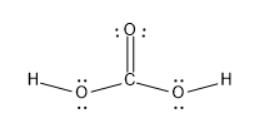
Thus, $ {H_2}C{O_3} $ a polar molecule is a polar molecule.h
Note:
Carbonic acid is a weak acid as it has two hydroxyl groups with the lone pair of electrons on the oxygen atoms. It is a conjugate acid of hydrogen carbonate; it is a dibasic acid due to the presence of two $ - OH $ groups. It can also be known as chalco carbonic acid.
Complete answer:
Carbonic acid is represented by a chemical formula of $ {H_2}C{O_3} $ consisting of elements of carbon, hydrogen and oxygen. It can be prepared by dissolving carbon dioxide in water. The valence electrons of carbon is $ 4 $ and the valence electrons of hydrogen is $ 1 $ , as there were two hydrogen atoms, the valence electrons were $ 2 $ , oxygen has $ 6 $ valence electrons, as there were three oxygen atoms, the valence electrons were $ 18 $ valence electrons. Thus, the total valence electrons n carbonic acid were $ 18 + 2 + 4 = 24 $
Out of these $ 24 $ valence electrons, $ 12 $ valence electrons were involved in bonding electrons, and remaining electrons exist as lone pairs on three oxygen atoms in carbonic acid. The two $ C - O $ bonds are two dipoles which will not equal the magnitude of a dipole of $ C = O $ . Thus, there is a dipole moment in the carbonic acid molecule. The presence of a dipole moment makes the molecule a polar molecule.
The structure of carbonic acid is:
Thus, $ {H_2}C{O_3} $ a polar molecule is a polar molecule.h
Note:
Carbonic acid is a weak acid as it has two hydroxyl groups with the lone pair of electrons on the oxygen atoms. It is a conjugate acid of hydrogen carbonate; it is a dibasic acid due to the presence of two $ - OH $ groups. It can also be known as chalco carbonic acid.
Recently Updated Pages
Master Class 12 Economics: Engaging Questions & Answers for Success

Master Class 12 English: Engaging Questions & Answers for Success
Master Class 12 Social Science: Engaging Questions & Answers for Success
Master Class 12 Maths: Engaging Questions & Answers for Success
Master Class 12 Physics: Engaging Questions & Answers for Success
Master Class 9 General Knowledge: Engaging Questions & Answers for Success
Trending doubts
One Metric ton is equal to kg A 10000 B 1000 C 100 class 11 physics CBSE
Difference Between Prokaryotic Cells and Eukaryotic Cells
Two of the body parts which do not appear in MRI are class 11 biology CBSE
Find the value of the expression given below sin 30circ class 11 maths CBSE
1 ton equals to A 100 kg B 1000 kg C 10 kg D 10000 class 11 physics CBSE
Draw a diagram of nephron and explain its structur class 11 biology CBSE