




Is cyclopropenyl cation, $ {C_3}{H_3}^ + $ aromatic?
Answer
 Verified
560.1k+ views
Hint: Cyclopropenyl cation is a cyclopropane with a positive charge on one carbon atom formed by the loss of one hydrogen atom. The compounds that are cyclic, planar, conjugation of pi-electrons and obeying Huckel’s rule can be defined as aromatic compounds, these are stable compounds.
Complete answer:
Cycloalkenes are alkenes arranged in a cyclic manner. Alkenes are unsaturated hydrocarbons consisting of double bonded carbon atoms. When one hydrogen atom is removed from the cyclopropene, it forms a compound known as cyclopropenyl cation which is represented by a formula of $ {C_3}{H_3}^ + $ .
Aromatic compounds are the compounds that are cyclic, planar which means all the carbon atoms have $ s{p^2} $ hybridization, conjugation of $ \pi $ electrons, and obeying Huckel’s rule. Huckel's rule states that the compound must contain $ \left( {4n + 2} \right)\pi $ electrons, where n is a positive whole number.
The structure of cyclopropenyl cation $ \left( {{C_3}{H_3}^ + } \right) $ is
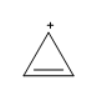
The above molecule is in cyclic arrangement, all the carbon atoms are $ s{p^2} $ hybridized, as the double bonded are $ s{p^2} $ hybridized and the carbocation is also $ s{p^2} $ hybridized, the double bond and the positive charge are in conjugation, and the compound has two pi-electrons which obeys Huckel’s rule as $ \left( {4\left( 0 \right) + 2} \right)\pi = 2\pi $ electrons. cyclopropenyl cation obeys all the conditions required to be an aromatic compound.
Thus, cyclopropenyl cation, $ {C_3}{H_3}^ + $ is an aromatic compound.
Note:
Conjugation means the two double bonds or one double bond and charge separated by a single bond. In the above molecule, charge and double bond are separated by a single bond. Carbocation is the carbon bearing a positive charge and involves in $ s{p^2} $ hybridization.
Complete answer:
Cycloalkenes are alkenes arranged in a cyclic manner. Alkenes are unsaturated hydrocarbons consisting of double bonded carbon atoms. When one hydrogen atom is removed from the cyclopropene, it forms a compound known as cyclopropenyl cation which is represented by a formula of $ {C_3}{H_3}^ + $ .
Aromatic compounds are the compounds that are cyclic, planar which means all the carbon atoms have $ s{p^2} $ hybridization, conjugation of $ \pi $ electrons, and obeying Huckel’s rule. Huckel's rule states that the compound must contain $ \left( {4n + 2} \right)\pi $ electrons, where n is a positive whole number.
The structure of cyclopropenyl cation $ \left( {{C_3}{H_3}^ + } \right) $ is
The above molecule is in cyclic arrangement, all the carbon atoms are $ s{p^2} $ hybridized, as the double bonded are $ s{p^2} $ hybridized and the carbocation is also $ s{p^2} $ hybridized, the double bond and the positive charge are in conjugation, and the compound has two pi-electrons which obeys Huckel’s rule as $ \left( {4\left( 0 \right) + 2} \right)\pi = 2\pi $ electrons. cyclopropenyl cation obeys all the conditions required to be an aromatic compound.
Thus, cyclopropenyl cation, $ {C_3}{H_3}^ + $ is an aromatic compound.
Note:
Conjugation means the two double bonds or one double bond and charge separated by a single bond. In the above molecule, charge and double bond are separated by a single bond. Carbocation is the carbon bearing a positive charge and involves in $ s{p^2} $ hybridization.
Recently Updated Pages
If x a + bt + ct2 where x is in meters and t is in class 11 physics CBSE

A car covers the first half distance between two places class 11 physics CBSE
The resultant of two vectors overrightarrow P and overrightarrow class 11 physics CBSE
Find the value of cos 135 class 11 maths CBSE
A mass M is held in place by an applied force F and class 11 physics CBSE
A solution of glucose in water is labelled as 10 dfracwv class 11 chemistry CBSE
Trending doubts
One Metric ton is equal to kg A 10000 B 1000 C 100 class 11 physics CBSE
Find the value of the expression given below sin 30circ class 11 maths CBSE
What do you mean by retardation What is its SI uni class 11 physics CBSE
Draw a diagram of nephron and explain its structur class 11 biology CBSE
10 examples of friction in our daily life
Difference between physical and chemical change class 11 chemistry CBSE