




Is $ C{H_3}C{H_2}OC{H_2}C{H_3} $ soluble in water?
Answer
 Verified
534.6k+ views
Hint :In organic chemistry, when an oxygen atom is bonded with two alkyl groups via single bonds, then the compound is characterized by the functional group known as ether. These compounds are similar to alcohols $ (R - O - H) $ in structure as there is only a difference of an alkyl group within the structure.
Complete Step By Step Answer:
Ethers are the nonpolar compounds due to the presence of alkyl groups on both sides of the central oxygen atom. If the alkyl groups bonded to the oxygen atom are bulky, then the oxygen atom is unable to participate in the hydrogen bonding and thus the boiling points are comparatively less than alcohols.
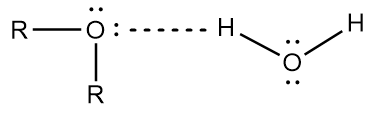
The solubility of ether depends on the number of carbon atoms present in the alkyl groups of the ether. The solubility of ether decreases with an increase in the number of carbon atoms in the alkyl chain. To be more specific, ethers containing up to three carbon atoms have the tendency to dissolve in water because of less steric hindrance and effective hydrogen bonding as shown below:
Due to its nonpolar nature, the ethers are appreciably soluble in organic solvents like alcohol, benzene, acetone, etc.
Now, as per question the given compound is $ C{H_3}C{H_2}OC{H_2}C{H_3} $ . The chemical name of the compound is diethyl ether and because there are two carbon atoms present in the alkyl group of ether, so as per the condition for solubility of ethers given above, we can conclude that the given compound i.e., $ C{H_3}C{H_2}OC{H_2}C{H_3} $ is soluble in water.
Note :
It is important to note that on increasing the alkyl chain of ethers, the difference in the boiling point of ether and alcohols becomes relatively smaller because on increasing the number of carbon atoms, the number of electrons increases as well and therefore, an increase in the van der Waals interactions is observed.
Complete Step By Step Answer:
Ethers are the nonpolar compounds due to the presence of alkyl groups on both sides of the central oxygen atom. If the alkyl groups bonded to the oxygen atom are bulky, then the oxygen atom is unable to participate in the hydrogen bonding and thus the boiling points are comparatively less than alcohols.
The solubility of ether depends on the number of carbon atoms present in the alkyl groups of the ether. The solubility of ether decreases with an increase in the number of carbon atoms in the alkyl chain. To be more specific, ethers containing up to three carbon atoms have the tendency to dissolve in water because of less steric hindrance and effective hydrogen bonding as shown below:
Due to its nonpolar nature, the ethers are appreciably soluble in organic solvents like alcohol, benzene, acetone, etc.
Now, as per question the given compound is $ C{H_3}C{H_2}OC{H_2}C{H_3} $ . The chemical name of the compound is diethyl ether and because there are two carbon atoms present in the alkyl group of ether, so as per the condition for solubility of ethers given above, we can conclude that the given compound i.e., $ C{H_3}C{H_2}OC{H_2}C{H_3} $ is soluble in water.
Note :
It is important to note that on increasing the alkyl chain of ethers, the difference in the boiling point of ether and alcohols becomes relatively smaller because on increasing the number of carbon atoms, the number of electrons increases as well and therefore, an increase in the van der Waals interactions is observed.
Recently Updated Pages
Master Class 11 Social Science: Engaging Questions & Answers for Success

Master Class 11 English: Engaging Questions & Answers for Success
Master Class 11 Maths: Engaging Questions & Answers for Success
Master Class 11 Chemistry: Engaging Questions & Answers for Success
Master Class 11 Biology: Engaging Questions & Answers for Success
Master Class 11 Physics: Engaging Questions & Answers for Success
Trending doubts
One Metric ton is equal to kg A 10000 B 1000 C 100 class 11 physics CBSE
Difference Between Prokaryotic Cells and Eukaryotic Cells
How many of the following diseases can be studied with class 11 biology CBSE
Which of the following enzymes is used for carboxylation class 11 biology CBSE
Draw a diagram of a plant cell and label at least eight class 11 biology CBSE
Two of the body parts which do not appear in MRI are class 11 biology CBSE