




Is action always equal to reaction; Explain.
Answer
 Verified
642.3k+ views
Hint: Here we will proceed by using the concept of Newton’s third law of motion and will understand the statement theoretically and diagrammatically.
Complete Step-by-Step solution:
According to Newton’s third law of motion, action force is equal to reaction but acts on two different bodies and in opposite directions. Whenever one object exerts a force on the second object, the second object exerts an equal and opposite force on the first object.
Let us take an example to explain it –
When a horse pushes the ground, the ground reacts and exerts a force on the horse in the forward direction. This force is able to overcome the friction force of the cart and it moves.
Let us explain the above example diagrammatically,
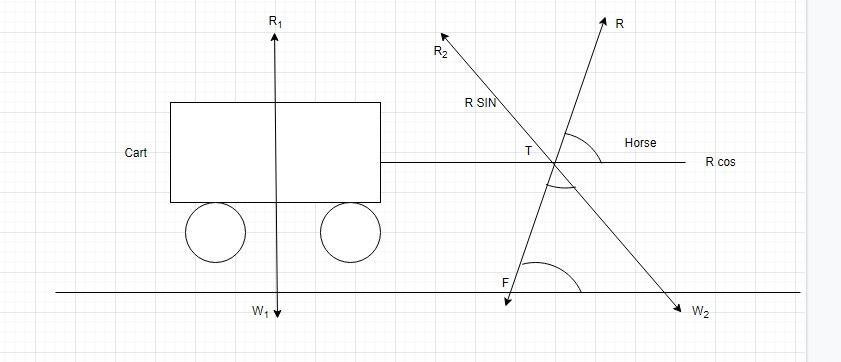
The horse pulls the cart by pushing the ground backwards with its foot with a force $F$ making an angle $\theta $ with the horizontal. The ground in turn exerts a force $R$ on the horse equal and opposite of $F$.
The reaction R can be resolved in two rectangular components viz. $R{\text{cos}}\theta $ and $R\sin \theta $ as shown in figure. Therefore, the component $R\cos \theta \left( { = T} \right)$ tends to move the cart to the right. Whether the cart moves or not depends on the relative magnitudes of $R\cos \theta $ and frictional force $F$ between the cart and the ground. If $R\cos \theta > F$, the cart will move forward, that is to the right.
So, we can say that the actual motion occurs when forward reaction exceeds the opposing force of friction between the cart and the ground.
Note: Whenever we come up with this type of problem where we have to explain a statement. Then we first write the meaning of the statement and then try to explain the statement by using various examples and diagrams like we did in the question.
Complete Step-by-Step solution:
According to Newton’s third law of motion, action force is equal to reaction but acts on two different bodies and in opposite directions. Whenever one object exerts a force on the second object, the second object exerts an equal and opposite force on the first object.
Let us take an example to explain it –
When a horse pushes the ground, the ground reacts and exerts a force on the horse in the forward direction. This force is able to overcome the friction force of the cart and it moves.
Let us explain the above example diagrammatically,
The horse pulls the cart by pushing the ground backwards with its foot with a force $F$ making an angle $\theta $ with the horizontal. The ground in turn exerts a force $R$ on the horse equal and opposite of $F$.
The reaction R can be resolved in two rectangular components viz. $R{\text{cos}}\theta $ and $R\sin \theta $ as shown in figure. Therefore, the component $R\cos \theta \left( { = T} \right)$ tends to move the cart to the right. Whether the cart moves or not depends on the relative magnitudes of $R\cos \theta $ and frictional force $F$ between the cart and the ground. If $R\cos \theta > F$, the cart will move forward, that is to the right.
So, we can say that the actual motion occurs when forward reaction exceeds the opposing force of friction between the cart and the ground.
Note: Whenever we come up with this type of problem where we have to explain a statement. Then we first write the meaning of the statement and then try to explain the statement by using various examples and diagrams like we did in the question.
Recently Updated Pages
Master Class 12 Business Studies: Engaging Questions & Answers for Success

Master Class 12 Biology: Engaging Questions & Answers for Success
Master Class 12 Chemistry: Engaging Questions & Answers for Success
Class 12 Question and Answer - Your Ultimate Solutions Guide
Master Class 11 Social Science: Engaging Questions & Answers for Success
Master Class 11 English: Engaging Questions & Answers for Success
Trending doubts
What is the full form of NDA a National Democratic class 10 social science CBSE
Explain the Treaty of Vienna of 1815 class 10 social science CBSE
Who Won 36 Oscar Awards? Record Holder Revealed
Bharatiya Janata Party was founded in the year A 1979 class 10 social science CBSE
What is the median of the first 10 natural numbers class 10 maths CBSE
Why is it 530 pm in india when it is 1200 afternoon class 10 social science CBSE