




Iqbal has to push a lighter box and Seema has to push a similar heavier box on the same floor. Who will have to apply a larger force and why?
Answer
 Verified
624.9k+ views
Hint: For dragging a body on the floor, we need to overcome the frictional force present between the surface of the body and the floor. The more the frictional force, the more is the force required to drag the body.
Formula used:
$f=\mu N$
Complete step by step answer:
Friction is the force that opposes the motion of two objects sliding on each other. Frictional force acts in a direction opposite to the direction of motion of the body. Here, the motion is actually relative motion. Friction always tends to oppose the relative motion between two objects or bodies. There are four types of friction – Static friction, Sliding friction, Rolling friction, and Fluid friction.
Expression for frictional force:
$f=\mu N$
$\begin{align}
& f=\text{frictional force} \\
& \mu \text{= coefficient of friction} \\
& N=\text{normal force} \\
\end{align}$
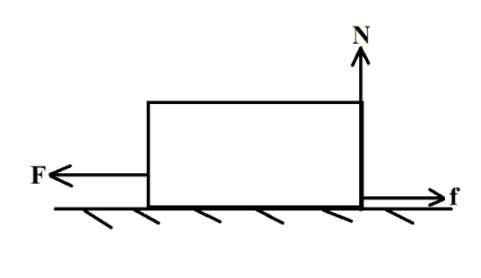
We are given that Iqbal has to push a lighter box and Seema has to push a heavier box. As the friction force arises due to the interlocking of irregularities between the body and the ground. For a heavier mass, the interlocking would be stronger because the two surfaces are pressed together harder while for a lighter mass, the interlocking will be weak.
We can solve this question using the equation of frictional force also,
As we know $f=\mu N$
The more the normal force, the more friction will be generated between two surfaces. As the boxes are to be dragged on the plane floor, it means that the only forces acting in the vertical direction would be gravitational force and the normal force. For a greater mass, ground will offer a greater amount of normal force on that body, resulting in more friction. As Seema has to push the heavier mass, she will need more force to be applied on the box to push it while Iqbal will need comparatively less force to be applied on the box.
Note: As this was a simple case of a box resting on the floor, we could easily find the normal force acting on the boxes. In case of complex situations such as inclined planes, we need to be very careful while calculating the normal force. Normal force on an inclined plane is equal and opposite to the perpendicular gravity component.
Formula used:
$f=\mu N$
Complete step by step answer:
Friction is the force that opposes the motion of two objects sliding on each other. Frictional force acts in a direction opposite to the direction of motion of the body. Here, the motion is actually relative motion. Friction always tends to oppose the relative motion between two objects or bodies. There are four types of friction – Static friction, Sliding friction, Rolling friction, and Fluid friction.
Expression for frictional force:
$f=\mu N$
$\begin{align}
& f=\text{frictional force} \\
& \mu \text{= coefficient of friction} \\
& N=\text{normal force} \\
\end{align}$
We are given that Iqbal has to push a lighter box and Seema has to push a heavier box. As the friction force arises due to the interlocking of irregularities between the body and the ground. For a heavier mass, the interlocking would be stronger because the two surfaces are pressed together harder while for a lighter mass, the interlocking will be weak.
We can solve this question using the equation of frictional force also,
As we know $f=\mu N$
The more the normal force, the more friction will be generated between two surfaces. As the boxes are to be dragged on the plane floor, it means that the only forces acting in the vertical direction would be gravitational force and the normal force. For a greater mass, ground will offer a greater amount of normal force on that body, resulting in more friction. As Seema has to push the heavier mass, she will need more force to be applied on the box to push it while Iqbal will need comparatively less force to be applied on the box.
Note: As this was a simple case of a box resting on the floor, we could easily find the normal force acting on the boxes. In case of complex situations such as inclined planes, we need to be very careful while calculating the normal force. Normal force on an inclined plane is equal and opposite to the perpendicular gravity component.
Recently Updated Pages
Master Class 11 Social Science: Engaging Questions & Answers for Success

Master Class 11 English: Engaging Questions & Answers for Success
Master Class 11 Maths: Engaging Questions & Answers for Success
Master Class 11 Chemistry: Engaging Questions & Answers for Success
Master Class 11 Biology: Engaging Questions & Answers for Success
Master Class 11 Physics: Engaging Questions & Answers for Success
Trending doubts
One Metric ton is equal to kg A 10000 B 1000 C 100 class 11 physics CBSE
Difference Between Prokaryotic Cells and Eukaryotic Cells
There are 720 permutations of the digits 1 2 3 4 5 class 11 maths CBSE
Draw a diagram of a plant cell and label at least eight class 11 biology CBSE
Two of the body parts which do not appear in MRI are class 11 biology CBSE
Which gas is abundant in air class 11 chemistry CBSE