



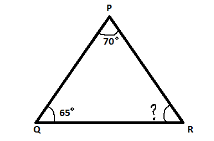
In\[\vartriangle PQR,\angle P = {70^ \circ },\angle Q = {65^ \circ }\] then find $\angle R$?
Answer
 Verified
612.3k+ views
Hint: We solve for the angle by substituting the given angles in the property of sum of interior angles of a triangle. Add the values of given angles and subtract from total sum of angles.
* Sum of interior angles of a triangle is $ = {180^ \circ }$
Complete step-by-step answer:
We have a triangle whose two angles are given and we have to find the third angle.
In\[\vartriangle PQR,\angle P = {70^ \circ },\angle Q = {65^ \circ }\]
We know from the property of sum of interior angles,
\[ \Rightarrow \angle P + \angle Q + \angle R = {180^ \circ }\]
Substitute the values of\[\angle P = {70^ \circ },\angle Q = {65^ \circ }\]in LHS of the equation.
$ \Rightarrow {70^ \circ } + {65^ \circ } + \angle R = {180^ \circ }$
Add the angles on LHS of the equation
$ \Rightarrow {135^ \circ } + \angle R = {180^ \circ }$
Shift all the constant values in degrees to one side of the equation.
$ \Rightarrow \angle R = {180^ \circ } - {135^ \circ }$
$ \Rightarrow \angle R = {45^ \circ }$
Therefore $\angle R = {45^ \circ }$
Note: Many times we will be given the measure of one angle and we have to find the other two angles, in these kinds of questions look if the triangle is given to be isosceles (having two angles equal ) or is given to be right angled ( one angle is right angle), then we can use the sum of interior angles property and find the remaining angles.
Students many times make mistakes when they don’t change the sign of the value while shifting the value from one side of the equation to another side of the equation. Keep in mind the sign changes from positive to negative and vice-versa when shifting a value from one side of the equation to the other side of the equation.
* Sum of interior angles of a triangle is $ = {180^ \circ }$
Complete step-by-step answer:
We have a triangle whose two angles are given and we have to find the third angle.
In\[\vartriangle PQR,\angle P = {70^ \circ },\angle Q = {65^ \circ }\]
We know from the property of sum of interior angles,
\[ \Rightarrow \angle P + \angle Q + \angle R = {180^ \circ }\]
Substitute the values of\[\angle P = {70^ \circ },\angle Q = {65^ \circ }\]in LHS of the equation.
$ \Rightarrow {70^ \circ } + {65^ \circ } + \angle R = {180^ \circ }$
Add the angles on LHS of the equation
$ \Rightarrow {135^ \circ } + \angle R = {180^ \circ }$
Shift all the constant values in degrees to one side of the equation.
$ \Rightarrow \angle R = {180^ \circ } - {135^ \circ }$
$ \Rightarrow \angle R = {45^ \circ }$
Therefore $\angle R = {45^ \circ }$
Note: Many times we will be given the measure of one angle and we have to find the other two angles, in these kinds of questions look if the triangle is given to be isosceles (having two angles equal ) or is given to be right angled ( one angle is right angle), then we can use the sum of interior angles property and find the remaining angles.
Students many times make mistakes when they don’t change the sign of the value while shifting the value from one side of the equation to another side of the equation. Keep in mind the sign changes from positive to negative and vice-versa when shifting a value from one side of the equation to the other side of the equation.
Recently Updated Pages
Master Class 11 Social Science: Engaging Questions & Answers for Success

Master Class 11 Chemistry: Engaging Questions & Answers for Success
Master Class 12 Business Studies: Engaging Questions & Answers for Success
Master Class 12 Chemistry: Engaging Questions & Answers for Success
Master Class 12 Biology: Engaging Questions & Answers for Success
Class 12 Question and Answer - Your Ultimate Solutions Guide
Trending doubts
What is BLO What is the full form of BLO class 8 social science CBSE
Citizens of India can vote at the age of A 18 years class 8 social science CBSE
Right to vote is a AFundamental Right BFundamental class 8 social science CBSE
Give me the opposite gender of Duck class 8 english CBSE
Full form of STD, ISD and PCO
Explain land use pattern in India and why has the land class 8 social science CBSE