




Intermolecular Hydrogen bond is present in which of the following pair of molecules?
Option-
A.$Si{H_4}$ and $Si{F_4}$
B.$C{H_3}COC{H_3}$ and $CHC{l_3}$
C.$HCOOH$ and $C{H_3}COOH$
D.$C{H_3}OC{H_3}$ and ${H_2}{O_2}$
Answer
 Verified
548.1k+ views
Hint: Hydrogen bond is formed between the hydrogen atom and any highly electronegative element. Generally, fluorine, oxygen and nitrogen atoms frequently form hydrogen bonding. Intermolecular and intramolecular hydrogen bonding are two different types of hydrogen bonding.
Complete answer:
Intermolecular hydrogen bond is usually formed between the two different molecules. Hydrogen atoms from one molecule interact with highly electronegative elements like fluorine, oxygen or nitrogen atoms of different molecules. Therefore, at least two molecules are required to form intermolecular hydrogen bonding.
In the case of $Si{H_4}$and $Si{F_4}$ molecules, silicone tetrahydride and silicon tetrafluoride are hydrides of group \[\left( {IV} \right)\]. All the hydrides of this group are non-polar in nature and therefore they are not capable of forming hydrogen bonds. If under certain circumstances they form the hydrogen bond it is very weak in nature.
In the case of $C{H_3}COC{H_3}$ and $CHC{l_3}$, acetone is polar molecule because two methyl group are electron donor and impart partial positive charge on oxygen atom, which further forms hydrogen bonding but due to large size atom of chlorine atom in chloroform molecule it is not able to interact with oxygen atom of acetone to form intermolecular hydrogen bonding. Therefore, due to the large size of chlorine atoms it does not participate in intermolecular hydrogen bonding.
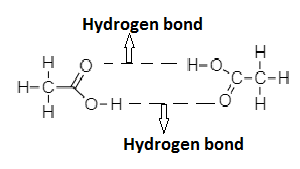
In the case of $HCOOH$ and $C{H_3}COOH$, the carbonyl oxygen atom of acid interacts with the hydrogen atom of the hydroxyl group of other molecules. This will result in formation of two hydrogen bonds between $HCOOH$ and $C{H_3}COOH$. Due to formation of intermolecular hydrogen bonding between acid molecules, it is capable of existing as a dimer even in the gaseous state.
In the case of $C{H_3}OC{H_3}$ and ${H_2}{O_2}$ molecules, dimethyl ether is non polar molecule and do not have any dipole moment and it does not have sufficient electronegativity to form hydrogen bond with the oxygen atom present in hydrogen peroxide molecule. Therefore, they do not participate in the formation of intermolecular hydrogen bonding.
$ \Rightarrow $$HCOOH$ and $C{H_3}COOH$ molecules form intermolecular hydrogen bonding.
Therefore, option $\left( C \right)$ is the correct option.
Note:
Intramolecular hydrogen bonding is usually formed within the same molecule between the hydrogen atom and any highly electronegative element. Intramolecular hydrogen bonding is observed in the molecule of ortho nitrophenol and ortho nitrobenzoic acid.
Complete answer:
Intermolecular hydrogen bond is usually formed between the two different molecules. Hydrogen atoms from one molecule interact with highly electronegative elements like fluorine, oxygen or nitrogen atoms of different molecules. Therefore, at least two molecules are required to form intermolecular hydrogen bonding.
In the case of $Si{H_4}$and $Si{F_4}$ molecules, silicone tetrahydride and silicon tetrafluoride are hydrides of group \[\left( {IV} \right)\]. All the hydrides of this group are non-polar in nature and therefore they are not capable of forming hydrogen bonds. If under certain circumstances they form the hydrogen bond it is very weak in nature.
In the case of $C{H_3}COC{H_3}$ and $CHC{l_3}$, acetone is polar molecule because two methyl group are electron donor and impart partial positive charge on oxygen atom, which further forms hydrogen bonding but due to large size atom of chlorine atom in chloroform molecule it is not able to interact with oxygen atom of acetone to form intermolecular hydrogen bonding. Therefore, due to the large size of chlorine atoms it does not participate in intermolecular hydrogen bonding.
In the case of $HCOOH$ and $C{H_3}COOH$, the carbonyl oxygen atom of acid interacts with the hydrogen atom of the hydroxyl group of other molecules. This will result in formation of two hydrogen bonds between $HCOOH$ and $C{H_3}COOH$. Due to formation of intermolecular hydrogen bonding between acid molecules, it is capable of existing as a dimer even in the gaseous state.
In the case of $C{H_3}OC{H_3}$ and ${H_2}{O_2}$ molecules, dimethyl ether is non polar molecule and do not have any dipole moment and it does not have sufficient electronegativity to form hydrogen bond with the oxygen atom present in hydrogen peroxide molecule. Therefore, they do not participate in the formation of intermolecular hydrogen bonding.
$ \Rightarrow $$HCOOH$ and $C{H_3}COOH$ molecules form intermolecular hydrogen bonding.
Therefore, option $\left( C \right)$ is the correct option.
Note:
Intramolecular hydrogen bonding is usually formed within the same molecule between the hydrogen atom and any highly electronegative element. Intramolecular hydrogen bonding is observed in the molecule of ortho nitrophenol and ortho nitrobenzoic acid.
Recently Updated Pages
Master Class 11 English: Engaging Questions & Answers for Success

Master Class 11 Physics: Engaging Questions & Answers for Success
Master Class 11 Computer Science: Engaging Questions & Answers for Success
Master Class 11 Chemistry: Engaging Questions & Answers for Success
Master Class 11 Social Science: Engaging Questions & Answers for Success
Master Class 11 Accountancy: Engaging Questions & Answers for Success
Trending doubts
Difference Between Prokaryotic Cells and Eukaryotic Cells
Two of the body parts which do not appear in MRI are class 11 biology CBSE
One Metric ton is equal to kg A 10000 B 1000 C 100 class 11 physics CBSE
10 examples of friction in our daily life
Draw a diagram of nephron and explain its structur class 11 biology CBSE
Draw a diagram of a plant cell and label at least eight class 11 biology CBSE