




How do you integrate \[\int {\dfrac{1}{{{x^2}\sqrt {4 + {x^2}} }}} \] trigonometric substitution?
Answer
 Verified
548.4k+ views
Hint: The given question involves the arithmetic operations like addition/ subtraction/ multiplication/ division. We need to know the basic trigonometric formulae and conditions to make an easy calculation. Also, we need to know the basic integration formulae with the involvement of trigonometric components. We need to know how to perform integral functions.
Complete step by step solution:
The given expression is shown below,
\[\int {\dfrac{1}{{{x^2}\sqrt {4 + {x^2}} }}} dx = ? \to \left( 1 \right)\]
Let’s take \[x = 2\tan u\]
So, we get \[dx = 2{\sec ^2}udu\]
Let’s substitute these values in the equation \[\left( 1 \right)\] , we get
\[
\int {\dfrac{1}{{{x^2}\sqrt {4 + {x^2}} }}} dx = \int {\dfrac{{2{{\sec }^2}udu}}{{{{\left( {2\tan u} \right)}^2}\sqrt {4 + {{\left( {2\tan u} \right)}^2}} }}} \\
\int {\dfrac{1}{{{x^2}\sqrt {4 + {x^2}} }}} dx \\
= \int {\dfrac{{2{{\sec }^2}udu}}{{4{{\tan }^2}u\sqrt {4 + 4{{\tan }^2}u} }}} \\
= \int {\dfrac{{2{{\sec }^2}udu}}{{2 \times 4{{\tan }^2}u\sqrt {1 + {{\tan }^2}u} }}} \\
= \int {\dfrac{{{{\sec }^2}udu}}{{4{{\tan }^2}u\sqrt {1 + {{\tan }^2}u} }}} \;
\]
So, we get
\[\int {\dfrac{1}{{{x^2}\sqrt {4 + {x^2}} }}} dx \\
= \dfrac{1}{4}\int {\dfrac{{{{\sec }^2}udu}}{{{{\tan }^2}u\sqrt {1 + {{\tan }^2}u} }}} \to \left( 2 \right)\]
We know that,
\[
{\tan ^2}u = \dfrac{{{{\sin }^2}u}}{{{{\cos }^2}u}} \\
\sqrt {1 + {{\tan }^2}u} = \sqrt {1 + \dfrac{{{{\sin }^2}u}}{{{{\cos }^2}u}}} \\
= \sqrt {\dfrac{{{{\cos }^2}u + {{\sin }^2}u}}{{{{\cos }^2}u}}} \;
\]
We know that \[{\sin ^2}u + {\cos ^2}u = 1\]
So, we get
\[\sqrt {1 + {{\tan }^2}u} = \sqrt {\dfrac{{{{\cos }^2}u + {{\sin }^2}u}}{{{{\cos }^2}u}}}
= \sqrt {\dfrac{1}{{{{\cos }^2}u}}}
= \sqrt {{{\sec }^2}u} = \sec u\]
[ We know that \[\dfrac{1}{{\cos \theta }} = \sec \theta \] ]
So, the equation \[\left( 2 \right)\] becomes,
\[\left( 2 \right) \to \int {\dfrac{1}{{{x^2}\sqrt {4 + {x^2}} }}} dx
= \dfrac{1}{4}\int {\dfrac{{{{\sec }^2}udu}}{{{{\tan }^2}u\sqrt {1 + {{\tan }^2}u} }}} \]
\[\int {\dfrac{1}{{{x^2}\sqrt {4 + {x^2}} }}} dx \\
= \dfrac{1}{4}\int {\dfrac{{{{\sec }^2}udu}}{{{{\tan }^2}u \cdot \sec u}}} = \dfrac{1}{4}\int {\dfrac{{\sec udu}}{{{{\tan }^2}u}}} \]
We know that \[\sec u = \dfrac{1}{{\cos u}}\] and \[\dfrac{1}{{{{\tan }^2}u}}= \dfrac{{{{\cos }^2}u}}{{{{\sin }^2}u}}\] .
So, the above equation can be written as,
\[\int {\dfrac{1}{{{x^2}\sqrt {4 + {x^2}} }}} dx
= \dfrac{1}{4}\int {\dfrac{{\sec udu}}{{{{\tan }^2}u}}} \\
= \dfrac{1}{4}\int {\dfrac{1}{{\cos u}}} \cdot \dfrac{{{{\cos }^2}u}}{{{{\sin }^2}u}}du \\
= \dfrac{1}{4}\int {\dfrac{{\cos u}}{{{{\sin }^2}u}}du} \]
\[\int {\dfrac{1}{{{x^2}\sqrt {4 + {x^2}} }}} dx = \dfrac{1}{4}\int {\dfrac{{\cos u}}{{{{\sin }^2}u}}du} \] \[ \to \left( 3 \right)\]
Let’s take \[v = \sin u\]
So, we get \[dv = \cos udu\]
So, the equation \[\left( 3 \right)\] becomes,
\[\left( 3 \right) \to \int {\dfrac{1}{{{x^2}\sqrt {4 + {x^2}} }}} dx = \dfrac{1}{4}\int {\dfrac{{\cos u}}{{{{\sin }^2}u}}du} \]
\[I = \dfrac{1}{4}\int {\dfrac{1}{{{v^2}}}} dv\]
The above equation can also be written as,
\[I = \dfrac{1}{4}\int {{v^{ - 2}}} dv\]
We know that,
\[\int {{x^n}} = \dfrac{{{x^{n + 1}}}}{{n + 1}}\]
So, we get
\[I = \dfrac{1}{4}\left( {\dfrac{{{v^{ - 2 + 1}}}}{{ - 2 + 1}}} \right) + c = \dfrac{1}{4} \times \dfrac{{ - 1}}{v} + c\]
We know that \[v = \sin u\]
So, we get
\[I = \dfrac{{ - 1}}{{4\sin u}} + c\] \[ \to \left( 4 \right)\]
We know that
\[x = 2\tan u\]
The above equation can also be written as,
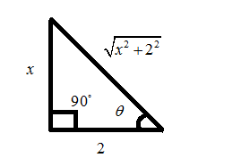
\[\tan u = \dfrac{x}{2}\]
\[\tan u = \dfrac{{opposite}}{{adjacant}}\]
So, we get
\[\sin u = \dfrac{{opposite}}{{hypotenuse}} = \dfrac{x}{{\sqrt {{x^2} + {2^2}} }} = \dfrac{x}{{\sqrt {{x^2} + 4} }}\]
By using these value the equation \[\left( 4 \right)\] becomes,
\[\left( 4 \right) \to I = \dfrac{{ - 1}}{{4\sin u}} + c\]
\[I = \dfrac{{ - 1}}{{4\left( {\dfrac{x}{{\sqrt {{x^2} + 4} }}} \right)}} + c\]
The above equation can also be written as,
\[I = \dfrac{{ - \sqrt {{x^2} + 4} }}{{4x}} + c\]
So, the final answer is,
\[\int {\dfrac{1}{{{x^2}\sqrt {4 + {x^2}} }}} dx = \dfrac{{ - \sqrt {{x^2} + 4} }}{{4x}} + c\]
So, the correct answer is “$\dfrac{{ - \sqrt {{x^2} + 4} }}{{4x}} + c$”.
Note: To solve these types of questions we would remember the basic trigonometric formula and conditions. Note that if a constant term is present inside the integral functions, we can take the constant term to the outside of the integral. Also, note that \[\sin \theta \] is defined as the opposite side value divided by hypotenuse side value in the rectangular triangle, \[\cos \theta \] is defined as the adjacent side value divided by hypotenuse side value in the rectangular triangle, and \[\tan \theta \] is defined as the opposite side value divided by the adjacent side value in a rectangular triangle.
Complete step by step solution:
The given expression is shown below,
\[\int {\dfrac{1}{{{x^2}\sqrt {4 + {x^2}} }}} dx = ? \to \left( 1 \right)\]
Let’s take \[x = 2\tan u\]
So, we get \[dx = 2{\sec ^2}udu\]
Let’s substitute these values in the equation \[\left( 1 \right)\] , we get
\[
\int {\dfrac{1}{{{x^2}\sqrt {4 + {x^2}} }}} dx = \int {\dfrac{{2{{\sec }^2}udu}}{{{{\left( {2\tan u} \right)}^2}\sqrt {4 + {{\left( {2\tan u} \right)}^2}} }}} \\
\int {\dfrac{1}{{{x^2}\sqrt {4 + {x^2}} }}} dx \\
= \int {\dfrac{{2{{\sec }^2}udu}}{{4{{\tan }^2}u\sqrt {4 + 4{{\tan }^2}u} }}} \\
= \int {\dfrac{{2{{\sec }^2}udu}}{{2 \times 4{{\tan }^2}u\sqrt {1 + {{\tan }^2}u} }}} \\
= \int {\dfrac{{{{\sec }^2}udu}}{{4{{\tan }^2}u\sqrt {1 + {{\tan }^2}u} }}} \;
\]
So, we get
\[\int {\dfrac{1}{{{x^2}\sqrt {4 + {x^2}} }}} dx \\
= \dfrac{1}{4}\int {\dfrac{{{{\sec }^2}udu}}{{{{\tan }^2}u\sqrt {1 + {{\tan }^2}u} }}} \to \left( 2 \right)\]
We know that,
\[
{\tan ^2}u = \dfrac{{{{\sin }^2}u}}{{{{\cos }^2}u}} \\
\sqrt {1 + {{\tan }^2}u} = \sqrt {1 + \dfrac{{{{\sin }^2}u}}{{{{\cos }^2}u}}} \\
= \sqrt {\dfrac{{{{\cos }^2}u + {{\sin }^2}u}}{{{{\cos }^2}u}}} \;
\]
We know that \[{\sin ^2}u + {\cos ^2}u = 1\]
So, we get
\[\sqrt {1 + {{\tan }^2}u} = \sqrt {\dfrac{{{{\cos }^2}u + {{\sin }^2}u}}{{{{\cos }^2}u}}}
= \sqrt {\dfrac{1}{{{{\cos }^2}u}}}
= \sqrt {{{\sec }^2}u} = \sec u\]
[ We know that \[\dfrac{1}{{\cos \theta }} = \sec \theta \] ]
So, the equation \[\left( 2 \right)\] becomes,
\[\left( 2 \right) \to \int {\dfrac{1}{{{x^2}\sqrt {4 + {x^2}} }}} dx
= \dfrac{1}{4}\int {\dfrac{{{{\sec }^2}udu}}{{{{\tan }^2}u\sqrt {1 + {{\tan }^2}u} }}} \]
\[\int {\dfrac{1}{{{x^2}\sqrt {4 + {x^2}} }}} dx \\
= \dfrac{1}{4}\int {\dfrac{{{{\sec }^2}udu}}{{{{\tan }^2}u \cdot \sec u}}} = \dfrac{1}{4}\int {\dfrac{{\sec udu}}{{{{\tan }^2}u}}} \]
We know that \[\sec u = \dfrac{1}{{\cos u}}\] and \[\dfrac{1}{{{{\tan }^2}u}}= \dfrac{{{{\cos }^2}u}}{{{{\sin }^2}u}}\] .
So, the above equation can be written as,
\[\int {\dfrac{1}{{{x^2}\sqrt {4 + {x^2}} }}} dx
= \dfrac{1}{4}\int {\dfrac{{\sec udu}}{{{{\tan }^2}u}}} \\
= \dfrac{1}{4}\int {\dfrac{1}{{\cos u}}} \cdot \dfrac{{{{\cos }^2}u}}{{{{\sin }^2}u}}du \\
= \dfrac{1}{4}\int {\dfrac{{\cos u}}{{{{\sin }^2}u}}du} \]
\[\int {\dfrac{1}{{{x^2}\sqrt {4 + {x^2}} }}} dx = \dfrac{1}{4}\int {\dfrac{{\cos u}}{{{{\sin }^2}u}}du} \] \[ \to \left( 3 \right)\]
Let’s take \[v = \sin u\]
So, we get \[dv = \cos udu\]
So, the equation \[\left( 3 \right)\] becomes,
\[\left( 3 \right) \to \int {\dfrac{1}{{{x^2}\sqrt {4 + {x^2}} }}} dx = \dfrac{1}{4}\int {\dfrac{{\cos u}}{{{{\sin }^2}u}}du} \]
\[I = \dfrac{1}{4}\int {\dfrac{1}{{{v^2}}}} dv\]
The above equation can also be written as,
\[I = \dfrac{1}{4}\int {{v^{ - 2}}} dv\]
We know that,
\[\int {{x^n}} = \dfrac{{{x^{n + 1}}}}{{n + 1}}\]
So, we get
\[I = \dfrac{1}{4}\left( {\dfrac{{{v^{ - 2 + 1}}}}{{ - 2 + 1}}} \right) + c = \dfrac{1}{4} \times \dfrac{{ - 1}}{v} + c\]
We know that \[v = \sin u\]
So, we get
\[I = \dfrac{{ - 1}}{{4\sin u}} + c\] \[ \to \left( 4 \right)\]
We know that
\[x = 2\tan u\]
The above equation can also be written as,
\[\tan u = \dfrac{x}{2}\]
\[\tan u = \dfrac{{opposite}}{{adjacant}}\]
So, we get
\[\sin u = \dfrac{{opposite}}{{hypotenuse}} = \dfrac{x}{{\sqrt {{x^2} + {2^2}} }} = \dfrac{x}{{\sqrt {{x^2} + 4} }}\]
By using these value the equation \[\left( 4 \right)\] becomes,
\[\left( 4 \right) \to I = \dfrac{{ - 1}}{{4\sin u}} + c\]
\[I = \dfrac{{ - 1}}{{4\left( {\dfrac{x}{{\sqrt {{x^2} + 4} }}} \right)}} + c\]
The above equation can also be written as,
\[I = \dfrac{{ - \sqrt {{x^2} + 4} }}{{4x}} + c\]
So, the final answer is,
\[\int {\dfrac{1}{{{x^2}\sqrt {4 + {x^2}} }}} dx = \dfrac{{ - \sqrt {{x^2} + 4} }}{{4x}} + c\]
So, the correct answer is “$\dfrac{{ - \sqrt {{x^2} + 4} }}{{4x}} + c$”.
Note: To solve these types of questions we would remember the basic trigonometric formula and conditions. Note that if a constant term is present inside the integral functions, we can take the constant term to the outside of the integral. Also, note that \[\sin \theta \] is defined as the opposite side value divided by hypotenuse side value in the rectangular triangle, \[\cos \theta \] is defined as the adjacent side value divided by hypotenuse side value in the rectangular triangle, and \[\tan \theta \] is defined as the opposite side value divided by the adjacent side value in a rectangular triangle.
Recently Updated Pages
Master Class 12 Economics: Engaging Questions & Answers for Success

Master Class 12 Physics: Engaging Questions & Answers for Success
Master Class 12 English: Engaging Questions & Answers for Success
Master Class 12 Social Science: Engaging Questions & Answers for Success
Master Class 12 Maths: Engaging Questions & Answers for Success
Master Class 12 Business Studies: Engaging Questions & Answers for Success
Trending doubts
Which are the Top 10 Largest Countries of the World?
What are the major means of transport Explain each class 12 social science CBSE
Draw a labelled sketch of the human eye class 12 physics CBSE
Differentiate between insitu conservation and exsitu class 12 biology CBSE
Draw a neat and well labeled diagram of TS of ovary class 12 biology CBSE
Give 10 examples of unisexual and bisexual flowers