




Integral \[\int\limits_{0}^{1}{\left| \sin \left( 2\pi x \right) \right|dx}\] is equal to
A. 0,
B. \[-\dfrac{1}{\pi }\],
C. \[\dfrac{1}{\pi }\],
D. \[\dfrac{2}{\pi }\].
Answer
 Verified
603.3k+ views
Hint: We start solving the problem by taking \[2\pi x=t\] and converting $dx$ in terms of $dt$. We then substitute the obtained results and use the properties of modulus functions in place of integrand to proceed through the problem. We then use the results $\int{\sin xdx=-\cos x+C}$, $\int\limits_{a}^{b}{{{f}^{'}}\left( x \right)dx=\left[ f\left( x \right) \right]_{a}^{b}=f\left( b \right)-f\left( a \right)}$ and make necessary calculations to get the required result.
Complete step by step answer:
As mentioned in the question, we have to find the value of the definite integral \[\int\limits_{0}^{1}{\left| \sin \left( 2\pi x \right) \right|dx}\].
Now, first we will substitute the integrand as follows
\[2\pi x=t\].
Differentiating on both sides, we get.
\[d\left( 2\pi x \right)=dt\].
\[\Rightarrow 2\pi dx=dt\].
\[\Rightarrow dx=\dfrac{dt}{2\pi }\].
Now, on doing these changes, the integral transforms into the following \[\int\limits_{0}^{2\pi }{\left| \sin \left( t \right) \right|\dfrac{dt}{2\pi }}\].
We know the property of modulus function as $\left| x \right|=\left\{ \begin{matrix}
x\text{, if }x>0 \\
0\text{, if }x=0 \\
-x\text{, if }x<0 \\
\end{matrix} \right.$. We use this property for the integrand.
We know that the sine function becomes positive from 0 to \[\pi \] negative from \[\pi \] to \[2\pi \].
So, now, the value of this integral can be evaluated as follows
\[=\int\limits_{0}^{\pi }{\left| \sin \left( t \right) \right|\dfrac{dt}{2\pi }}+\int\limits_{\pi }^{2\pi }{\left| \sin \left( t \right) \right|\dfrac{dt}{2\pi }}\].
\[=\dfrac{1}{2\pi }\times \left( \int\limits_{0}^{\pi }{\sin tdt}+\int\limits_{\pi }^{2\pi }{\left( -\sin t \right)dt} \right)\].
\[=\dfrac{1}{2\pi }\times \left( \int\limits_{0}^{\pi }{\sin tdt}-\int\limits_{\pi }^{2\pi }{\sin tdt} \right)\] ---(1).
We know that $\int{\sin xdx=-\cos x+C}$ and $\int\limits_{a}^{b}{{{f}^{'}}\left( x \right)dx=\left[ f\left( x \right) \right]_{a}^{b}=f\left( b \right)-f\left( a \right)}$. We use this result in equation (1).
\[=\dfrac{1}{2\pi }\times \left( \left[ -\cos t \right]_{0}^{\pi }-\left[ -\cos t \right]_{\pi }^{2\pi } \right)\].
\[=\dfrac{1}{2\pi }\times \left( \left[ -\cos \pi -\left( -\cos 0 \right) \right]-\left[ -\cos 2\pi -\left( -\cos \pi \right) \right] \right)\].
\[=\dfrac{1}{2\pi }\times \left( \left[ -\left( -1 \right)-\left( -1 \right) \right]-\left[ -1-\left( -\left( -1 \right) \right) \right] \right)\].
\[=\dfrac{1}{2\pi }\times \left( \left[ 1+1 \right]-\left[ -1-1 \right] \right)\].
\[=\dfrac{1}{2\pi }\times \left( \left[ 2 \right]-\left[ -2 \right] \right)\].
\[=\dfrac{1}{2\pi }\times \left( 4 \right)\].
\[=\dfrac{2}{\pi }\].
∴ The value of \[\int\limits_{0}^{1}{\left| \sin \left( 2\pi x \right) \right|dx}\] is \[\dfrac{2}{\pi }\].
So, the correct answer is “Option D”.
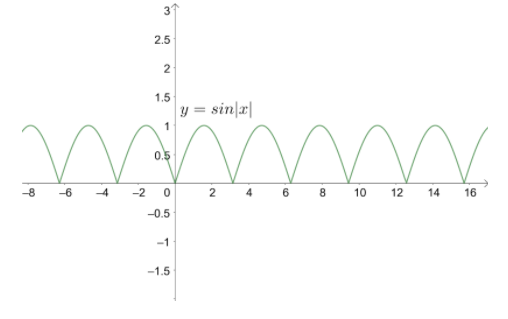
Note: We can also solve the problem by using the property of the periodic function. From the graph of $\left| \sin x \right|$, we can see that the repetition in the values of y in the curve. So, we can take limits from 0 to $\pi $ for getting the result. We know that for a periodic function f of period P with $n=kP$ is $\int\limits_{o}^{n}{f\left( x \right)dx=k\int\limits_{0}^{p}{f\left( x \right)dx}}$ to use for the integrand.
Complete step by step answer:
As mentioned in the question, we have to find the value of the definite integral \[\int\limits_{0}^{1}{\left| \sin \left( 2\pi x \right) \right|dx}\].
Now, first we will substitute the integrand as follows
\[2\pi x=t\].
Differentiating on both sides, we get.
\[d\left( 2\pi x \right)=dt\].
\[\Rightarrow 2\pi dx=dt\].
\[\Rightarrow dx=\dfrac{dt}{2\pi }\].
Now, on doing these changes, the integral transforms into the following \[\int\limits_{0}^{2\pi }{\left| \sin \left( t \right) \right|\dfrac{dt}{2\pi }}\].
We know the property of modulus function as $\left| x \right|=\left\{ \begin{matrix}
x\text{, if }x>0 \\
0\text{, if }x=0 \\
-x\text{, if }x<0 \\
\end{matrix} \right.$. We use this property for the integrand.
We know that the sine function becomes positive from 0 to \[\pi \] negative from \[\pi \] to \[2\pi \].
So, now, the value of this integral can be evaluated as follows
\[=\int\limits_{0}^{\pi }{\left| \sin \left( t \right) \right|\dfrac{dt}{2\pi }}+\int\limits_{\pi }^{2\pi }{\left| \sin \left( t \right) \right|\dfrac{dt}{2\pi }}\].
\[=\dfrac{1}{2\pi }\times \left( \int\limits_{0}^{\pi }{\sin tdt}+\int\limits_{\pi }^{2\pi }{\left( -\sin t \right)dt} \right)\].
\[=\dfrac{1}{2\pi }\times \left( \int\limits_{0}^{\pi }{\sin tdt}-\int\limits_{\pi }^{2\pi }{\sin tdt} \right)\] ---(1).
We know that $\int{\sin xdx=-\cos x+C}$ and $\int\limits_{a}^{b}{{{f}^{'}}\left( x \right)dx=\left[ f\left( x \right) \right]_{a}^{b}=f\left( b \right)-f\left( a \right)}$. We use this result in equation (1).
\[=\dfrac{1}{2\pi }\times \left( \left[ -\cos t \right]_{0}^{\pi }-\left[ -\cos t \right]_{\pi }^{2\pi } \right)\].
\[=\dfrac{1}{2\pi }\times \left( \left[ -\cos \pi -\left( -\cos 0 \right) \right]-\left[ -\cos 2\pi -\left( -\cos \pi \right) \right] \right)\].
\[=\dfrac{1}{2\pi }\times \left( \left[ -\left( -1 \right)-\left( -1 \right) \right]-\left[ -1-\left( -\left( -1 \right) \right) \right] \right)\].
\[=\dfrac{1}{2\pi }\times \left( \left[ 1+1 \right]-\left[ -1-1 \right] \right)\].
\[=\dfrac{1}{2\pi }\times \left( \left[ 2 \right]-\left[ -2 \right] \right)\].
\[=\dfrac{1}{2\pi }\times \left( 4 \right)\].
\[=\dfrac{2}{\pi }\].
∴ The value of \[\int\limits_{0}^{1}{\left| \sin \left( 2\pi x \right) \right|dx}\] is \[\dfrac{2}{\pi }\].
So, the correct answer is “Option D”.
Note: We can also solve the problem by using the property of the periodic function. From the graph of $\left| \sin x \right|$, we can see that the repetition in the values of y in the curve. So, we can take limits from 0 to $\pi $ for getting the result. We know that for a periodic function f of period P with $n=kP$ is $\int\limits_{o}^{n}{f\left( x \right)dx=k\int\limits_{0}^{p}{f\left( x \right)dx}}$ to use for the integrand.
Recently Updated Pages
Master Class 12 Business Studies: Engaging Questions & Answers for Success

Master Class 12 Chemistry: Engaging Questions & Answers for Success
Master Class 12 Biology: Engaging Questions & Answers for Success
Class 12 Question and Answer - Your Ultimate Solutions Guide
Master Class 11 Social Science: Engaging Questions & Answers for Success
Master Class 11 Chemistry: Engaging Questions & Answers for Success
Trending doubts
Which are the Top 10 Largest Countries of the World?
Draw a labelled sketch of the human eye class 12 physics CBSE
Name the crygenes that control cotton bollworm and class 12 biology CBSE
Differentiate between homogeneous and heterogeneous class 12 chemistry CBSE
Ribosomal RNA is actively synthesised in A Nucleoplasm class 12 biology CBSE
How many molecules of ATP and NADPH are required information class 12 biology CBSE