




Inside a triangular garden, there is a flower bed in the form of a similar triangle. Around the flowerbed runs a uniform path of such a width that the sides of the garden are double of the corresponding sides of the flower bed. The area of the paths and the flower beds are in the ratio-
A. 1 : 1
B. 1 : 2
C. 1 : 3
D. 3 : 1
Answer
 Verified
602.4k+ views
Hint:In this problem, the concept of similar triangles will be applied. It has been given that the triangular flower bed inside the garden is similar to the triangular garden. We will use the property that the square of ratio of the sides of similar triangles is proportional to the ratio of their areas. This will give us the ratio of areas of the two triangles. We will use that to find the ratio of area of the paths and the flower beds.
Complete step-by-step answer:
We have been given that the garden has a triangular flower bed such that the two triangles are similar. So, we can draw their figure as-
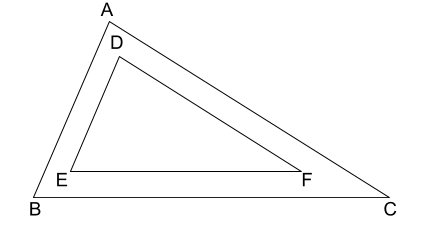
Let the triangle ABC represent the garden, and the triangle DEF represent the flower bed. It has been given that the two triangles are similar such that the length of the sides of the garden are double to that of the sides of the flower bed. We will now use the formula that the ratio of the areas of similar triangles are proportional to the square of the ratio of their sides.
$ \dfrac{{ar\left( {\vartriangle ABC} \right)}}{{ar\left( {\vartriangle DEF} \right)}} = {\left( {\dfrac{{AB}}{{DE}}} \right)^2} = {\left( {\dfrac{{BC}}{{EF}}} \right)^2} = {\left( {\dfrac{{AC}}{{DF}}} \right)^2} $
We have been given that the sides of the garden are double, so the ratio is 2 : 1. Substituting these values we can write that-
$ \dfrac{{ar\left( {\vartriangle ABC} \right)}}{{ar\left( {\vartriangle DEF} \right)}} = {\left( {\dfrac{2}{1}} \right)^2} = \dfrac{4}{1} $
But, we need to find the ratio of areas of the path and the flower bed. We know that-
$ \begin{align}
&ar\left( {\vartriangle ABC} \right) = ar\left( {\vartriangle DEF} \right) + ar\left( {path} \right) \\
&\dfrac{{ar\left( {\vartriangle ABC} \right)}}{{ar\left( {\vartriangle DEF} \right)}} = \dfrac{4}{1} = \dfrac{{ar\left( {\vartriangle DEF} \right) + ar\left( {path} \right)}}{{ar\left( {\vartriangle DEF} \right)}} \\
&1 + \dfrac{{ar\left( {path} \right)}}{{ar\left( {\vartriangle DEF} \right)}} = \dfrac{4}{1} \\
&\dfrac{{ar\left( {path} \right)}}{{ar\left( {\vartriangle DEF} \right)}} = 4 - 1 = \dfrac{3}{1} \\
\end{align} $
Hence, the required ratio is 3 : 1. The correct option is D.
Note: In such types of questions, the common mistake by students is that they usually find and mark the wrong ratio as the option. They usually find the ratio of areas of the outer and inner triangles, which is incorrect. Hence, we should always read the question carefully to correctly find the answer. The ratios of area of similar triangles are given by square of ratios of corresponding sides, not just ratios of sides,this is very important else we may end up getting wrong answers.
Complete step-by-step answer:
We have been given that the garden has a triangular flower bed such that the two triangles are similar. So, we can draw their figure as-
Let the triangle ABC represent the garden, and the triangle DEF represent the flower bed. It has been given that the two triangles are similar such that the length of the sides of the garden are double to that of the sides of the flower bed. We will now use the formula that the ratio of the areas of similar triangles are proportional to the square of the ratio of their sides.
$ \dfrac{{ar\left( {\vartriangle ABC} \right)}}{{ar\left( {\vartriangle DEF} \right)}} = {\left( {\dfrac{{AB}}{{DE}}} \right)^2} = {\left( {\dfrac{{BC}}{{EF}}} \right)^2} = {\left( {\dfrac{{AC}}{{DF}}} \right)^2} $
We have been given that the sides of the garden are double, so the ratio is 2 : 1. Substituting these values we can write that-
$ \dfrac{{ar\left( {\vartriangle ABC} \right)}}{{ar\left( {\vartriangle DEF} \right)}} = {\left( {\dfrac{2}{1}} \right)^2} = \dfrac{4}{1} $
But, we need to find the ratio of areas of the path and the flower bed. We know that-
$ \begin{align}
&ar\left( {\vartriangle ABC} \right) = ar\left( {\vartriangle DEF} \right) + ar\left( {path} \right) \\
&\dfrac{{ar\left( {\vartriangle ABC} \right)}}{{ar\left( {\vartriangle DEF} \right)}} = \dfrac{4}{1} = \dfrac{{ar\left( {\vartriangle DEF} \right) + ar\left( {path} \right)}}{{ar\left( {\vartriangle DEF} \right)}} \\
&1 + \dfrac{{ar\left( {path} \right)}}{{ar\left( {\vartriangle DEF} \right)}} = \dfrac{4}{1} \\
&\dfrac{{ar\left( {path} \right)}}{{ar\left( {\vartriangle DEF} \right)}} = 4 - 1 = \dfrac{3}{1} \\
\end{align} $
Hence, the required ratio is 3 : 1. The correct option is D.
Note: In such types of questions, the common mistake by students is that they usually find and mark the wrong ratio as the option. They usually find the ratio of areas of the outer and inner triangles, which is incorrect. Hence, we should always read the question carefully to correctly find the answer. The ratios of area of similar triangles are given by square of ratios of corresponding sides, not just ratios of sides,this is very important else we may end up getting wrong answers.
Recently Updated Pages
Master Class 9 General Knowledge: Engaging Questions & Answers for Success

Master Class 9 Social Science: Engaging Questions & Answers for Success
Master Class 9 English: Engaging Questions & Answers for Success
Master Class 9 Maths: Engaging Questions & Answers for Success
Master Class 9 Science: Engaging Questions & Answers for Success
Class 9 Question and Answer - Your Ultimate Solutions Guide
Trending doubts
Difference Between Plant Cell and Animal Cell
Fill the blanks with the suitable prepositions 1 The class 9 english CBSE
Who is eligible for RTE class 9 social science CBSE
Which places in India experience sunrise first and class 9 social science CBSE
What is pollution? How many types of pollution? Define it
Name 10 Living and Non living things class 9 biology CBSE