




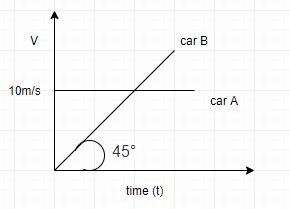
Initially, the car A is 10.5 m ahead of the car B. Both start moving at time t=0 in the same direction along a straight line. The velocity-time graph of two cars is shown in the figure. The time when the car B will catch the car A, will be
A: 21 sec
B: $2\sqrt{5}$ sec
C: 20 sec
D: None of the above.
Answer
 Verified
580.2k+ views
Hint: We’re given the one dimensional motion of two bodies. We can find the answer using the basic equations of motion, by substituting the given values in the formulas.
$s=ut+\dfrac{1}{2}a{{t}^{2}}$: The second equation of motion, where s is the total distance travelled by the body, u is the initial velocity, a is the acceleration of the body and t is the time taken to travel the distance.
Complete step by step answer:
We are given two cars A and B.
Car A is 10.5m ahead of car B.
Let us assume that car B crosses car A at point C, as per the diagram.
From graph, we can say that velocity of car A ${{V}_{A}}=10m/s$
If the time taken for car A to reach C is t seconds,
Distance $x=10t$
Considering Car B,
From graph, the acceleration of B is $\tan {{45}^{\circ }}=1$
Its initial velocity is zero
Hence ${{S}_{B}}=0+\dfrac{1}{2}a{{t}^{2}}=\dfrac{{{t}^{2}}}{2}$
Since A is 10.5m ahead of B,
$\begin{align}
& 10.5+x={{S}_{B}}=\dfrac{{{t}^{2}}}{2} \\
& \Rightarrow 21+2x={{t}^{2}} \\
\end{align}$
But we have proved that $x=10t$
Hence
$\begin{align}
& 21+2(10t)={{t}^{2}} \\
& \Rightarrow 21+20t={{t}^{2}} \\
& \Rightarrow {{t}^{2}}-20t-21=0 \\
\end{align}$
Therefore $t=\dfrac{20\pm \sqrt{400+84}}{2}=21s$
Hence, time taken for B to cross A is 21 seconds.
So, the correct answer is “Option A”.
Note:
Equations of motion elaborate the basic concepts of the motion of objects like position, velocity or the acceleration of an object at different times. These three equations of motion help to study the motion of an object in 1D, 2D and 3D.
First Equation of Motion : $v=u+at$, Second Equation of Motion : $s=ut+\dfrac{1}{2}a{{t}^{2}}$
Third Equation of Motion : ${{v}^{2}}={{u}^{2}}+2as$
$s=ut+\dfrac{1}{2}a{{t}^{2}}$: The second equation of motion, where s is the total distance travelled by the body, u is the initial velocity, a is the acceleration of the body and t is the time taken to travel the distance.
Complete step by step answer:
We are given two cars A and B.
Car A is 10.5m ahead of car B.
Let us assume that car B crosses car A at point C, as per the diagram.
From graph, we can say that velocity of car A ${{V}_{A}}=10m/s$
If the time taken for car A to reach C is t seconds,
Distance $x=10t$
Considering Car B,
From graph, the acceleration of B is $\tan {{45}^{\circ }}=1$
Its initial velocity is zero
Hence ${{S}_{B}}=0+\dfrac{1}{2}a{{t}^{2}}=\dfrac{{{t}^{2}}}{2}$
Since A is 10.5m ahead of B,
$\begin{align}
& 10.5+x={{S}_{B}}=\dfrac{{{t}^{2}}}{2} \\
& \Rightarrow 21+2x={{t}^{2}} \\
\end{align}$
But we have proved that $x=10t$
Hence
$\begin{align}
& 21+2(10t)={{t}^{2}} \\
& \Rightarrow 21+20t={{t}^{2}} \\
& \Rightarrow {{t}^{2}}-20t-21=0 \\
\end{align}$
Therefore $t=\dfrac{20\pm \sqrt{400+84}}{2}=21s$
Hence, time taken for B to cross A is 21 seconds.
So, the correct answer is “Option A”.
Note:
Equations of motion elaborate the basic concepts of the motion of objects like position, velocity or the acceleration of an object at different times. These three equations of motion help to study the motion of an object in 1D, 2D and 3D.
First Equation of Motion : $v=u+at$, Second Equation of Motion : $s=ut+\dfrac{1}{2}a{{t}^{2}}$
Third Equation of Motion : ${{v}^{2}}={{u}^{2}}+2as$
Recently Updated Pages
Master Class 11 Computer Science: Engaging Questions & Answers for Success

Master Class 11 Business Studies: Engaging Questions & Answers for Success
Master Class 11 Economics: Engaging Questions & Answers for Success
Master Class 11 English: Engaging Questions & Answers for Success
Master Class 11 Maths: Engaging Questions & Answers for Success
Master Class 11 Biology: Engaging Questions & Answers for Success
Trending doubts
One Metric ton is equal to kg A 10000 B 1000 C 100 class 11 physics CBSE
There are 720 permutations of the digits 1 2 3 4 5 class 11 maths CBSE
Discuss the various forms of bacteria class 11 biology CBSE
Draw a diagram of a plant cell and label at least eight class 11 biology CBSE
State the laws of reflection of light
Explain zero factorial class 11 maths CBSE