




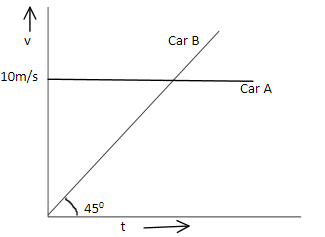
Initially car A is $ 10.5 $ m ahead of car B. Both start moving at time $ t = 0 $ in the same direction along a straight line. The velocity time graph of two cars is shown in figure. The time when the car B catches the car A will be:
(A) $ t = 21 $
(B) $ t = \dfrac{2}{5} $
(C) $ t = 20 $
(D) None of the above.
Answer
 Verified
576.6k+ views
Hint :Here, study the given diagram. Use the kinematic equations to find out distance of car B, also use $ a=tan45^0 $ as this is the way to find acceleration. If needed use basic formulas of velocity, distance and time.
Complete Step By Step Answer:
velocity of car A, $ {v_A} = 10.5m{s^{ - 1}} $
Let us now find out the distance travelled by Car A in $ t $ sec, $ {s_A} $ be the distance travelled by car A.
Therefore, $ {s_A} = 10t $
Distance travelled by Car B, distance be $ {s_B} $
$ {s_B} = \dfrac{1}{2}{t^2} $ (Using formula of kinematic equation, $ s = ut + \dfrac{1}{2}a{t^2} $ and $ a = \tan {45^0} $ )
Now, as per the given condition that the Car A is $ 10.5 $ m ahead of Car B, we have
$ {s_A} + 10.5 = \dfrac{1}{2}{t^2} $
$ \Rightarrow 10.5 + 10t = \dfrac{1}{2}{t^2} $
$ \Rightarrow {t^2} - 20t - 21 = 0 $
$ \Rightarrow t = \dfrac{{20 \pm \sqrt {{{(20)}^2} - 4( - 21)} }}{2} $ (using, $ \dfrac{{ - b \pm \sqrt {{b^2} - 4ac} }}{{2a}} $ )
$ \Rightarrow t = 21 $ sec
Thus the time taken by car B to catch car A is $ 21 $ seconds.
Option A is the correct answer.
Note :
As we know that velocity of any body is the result of distance travelled by the boy with respect to time. Here, car A is running forward of car B to catch car A, it has to cover the difference between them in seconds. Finding out distance travelled by car B is not necessary as we have to use a kinematical equation to find time taken.
Complete Step By Step Answer:
velocity of car A, $ {v_A} = 10.5m{s^{ - 1}} $
Let us now find out the distance travelled by Car A in $ t $ sec, $ {s_A} $ be the distance travelled by car A.
Therefore, $ {s_A} = 10t $
Distance travelled by Car B, distance be $ {s_B} $
$ {s_B} = \dfrac{1}{2}{t^2} $ (Using formula of kinematic equation, $ s = ut + \dfrac{1}{2}a{t^2} $ and $ a = \tan {45^0} $ )
Now, as per the given condition that the Car A is $ 10.5 $ m ahead of Car B, we have
$ {s_A} + 10.5 = \dfrac{1}{2}{t^2} $
$ \Rightarrow 10.5 + 10t = \dfrac{1}{2}{t^2} $
$ \Rightarrow {t^2} - 20t - 21 = 0 $
$ \Rightarrow t = \dfrac{{20 \pm \sqrt {{{(20)}^2} - 4( - 21)} }}{2} $ (using, $ \dfrac{{ - b \pm \sqrt {{b^2} - 4ac} }}{{2a}} $ )
$ \Rightarrow t = 21 $ sec
Thus the time taken by car B to catch car A is $ 21 $ seconds.
Option A is the correct answer.
Note :
As we know that velocity of any body is the result of distance travelled by the boy with respect to time. Here, car A is running forward of car B to catch car A, it has to cover the difference between them in seconds. Finding out distance travelled by car B is not necessary as we have to use a kinematical equation to find time taken.
Recently Updated Pages
Master Class 11 English: Engaging Questions & Answers for Success

Master Class 11 Social Science: Engaging Questions & Answers for Success
Master Class 11 Maths: Engaging Questions & Answers for Success
Master Class 11 Biology: Engaging Questions & Answers for Success
Master Class 11 Physics: Engaging Questions & Answers for Success
Master Class 11 Chemistry: Engaging Questions & Answers for Success
Trending doubts
One Metric ton is equal to kg A 10000 B 1000 C 100 class 11 physics CBSE
Difference Between Prokaryotic Cells and Eukaryotic Cells
Find the value of the expression given below sin 30circ class 11 maths CBSE
Difference between physical and chemical change class 11 chemistry CBSE
Two of the body parts which do not appear in MRI are class 11 biology CBSE
Draw a diagram of a plant cell and label at least eight class 11 biology CBSE