




Where is information received in the nerve cell?
Answer
 Verified
568.5k+ views
Hint: Nerve cells are also called neurons. Neurons are made up of cell bodies called soma, axon, dendrites, axon, and axon terminals. The information is received by the neuron through a tree-like structure and is passed down towards the axon.
Complete answer: Human nervous system consists of specialized excitable cells called neurons. They are also called nerve cells. They conduct information from one cell to another cell through a junction called a synapse. In all animals, it is the main component of nervous tissue. Neurons consist of three main parts. They are the cell body which is otherwise called soma, dendrites, and the axon. The size of soma is usually compact whereas dendrites and axons are filament-like structures that extrude from the cell body. The branched protoplasmic extension of the nerve cell is called dendrites. Dendrites are the part of the neuron where the information is received in form of an electrical impulse and the information is further carried by the soma or the cell body down to the axon. The role of dendrites is to integrate the synaptic inputs and to determine the extent to which action potentials are produced by the nerve cell. The pathway of electrical impulse or chemical impulse from the axon of one neuron to the dendrite of another neuron takes place through the synapses.
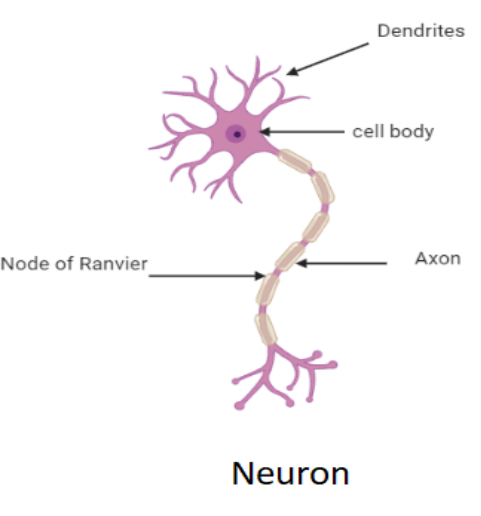
Note: Any damage to the dendrites can lead to the low processing of electrical impulses in nerve cells. Autism, schizophrenia, depression, anxiety, and Down syndrome are some of the disorders associated with the malformation of dendrites. Impaired nervous systems are also a result of malformation of dendrites.
Complete answer: Human nervous system consists of specialized excitable cells called neurons. They are also called nerve cells. They conduct information from one cell to another cell through a junction called a synapse. In all animals, it is the main component of nervous tissue. Neurons consist of three main parts. They are the cell body which is otherwise called soma, dendrites, and the axon. The size of soma is usually compact whereas dendrites and axons are filament-like structures that extrude from the cell body. The branched protoplasmic extension of the nerve cell is called dendrites. Dendrites are the part of the neuron where the information is received in form of an electrical impulse and the information is further carried by the soma or the cell body down to the axon. The role of dendrites is to integrate the synaptic inputs and to determine the extent to which action potentials are produced by the nerve cell. The pathway of electrical impulse or chemical impulse from the axon of one neuron to the dendrite of another neuron takes place through the synapses.
Note: Any damage to the dendrites can lead to the low processing of electrical impulses in nerve cells. Autism, schizophrenia, depression, anxiety, and Down syndrome are some of the disorders associated with the malformation of dendrites. Impaired nervous systems are also a result of malformation of dendrites.
Recently Updated Pages
Master Class 11 Computer Science: Engaging Questions & Answers for Success

Master Class 11 Business Studies: Engaging Questions & Answers for Success
Master Class 11 Economics: Engaging Questions & Answers for Success
Master Class 11 English: Engaging Questions & Answers for Success
Master Class 11 Maths: Engaging Questions & Answers for Success
Master Class 11 Biology: Engaging Questions & Answers for Success
Trending doubts
One Metric ton is equal to kg A 10000 B 1000 C 100 class 11 physics CBSE
There are 720 permutations of the digits 1 2 3 4 5 class 11 maths CBSE
Discuss the various forms of bacteria class 11 biology CBSE
Draw a diagram of a plant cell and label at least eight class 11 biology CBSE
State the laws of reflection of light
Explain zero factorial class 11 maths CBSE