




How do inflection points differ from critical points?
Answer
 Verified
590.4k+ views
Hint: These types of theoretical questions are very easy to solve. We just need to understand the main underlying concept. In this question we first need to understand what inflection points and critical points are. Inflection points are those which determine the nature of the curve. Critical points are those which are generally used to determine the points of maxima or minima of the graph which will be given.
Complete step by step answer:
Now we start off the solution by saying that,
Let us assume that \[y=f\left( x \right)\] is a given function to any problem. Now, on doing \[\dfrac{dy}{dx}=0\] , the first derivative of ‘y’ with respect to ‘x’ to zero, we find out all the values of ‘x’ and these corresponding values of ‘x’ implies all the critical points, which are basically the points of local maxima or local minima. In other words we can say that these are the points of extremum. On finding the second derivative of the given function, and putting the values of ‘x’ as obtained, we find the exact points which form the maxima or minima. We have the law that, if,
\[\dfrac{{{d}^{2}}y}{d{{x}^{2}}}<0\] , then this point is a point of local maxima and if
\[\dfrac{{{d}^{2}}y}{d{{x}^{2}}}>0\] , then this point is a point of local minima.
Suppose we don’t find any critical points, then we have to find the second derivative and equating it to zero, \[\dfrac{{{d}^{2}}y}{d{{x}^{2}}}=0\] , we solve for ‘x’. The value of ‘x’ which we get, is the point of inflection, and at this point there is one possible vertical tangent.
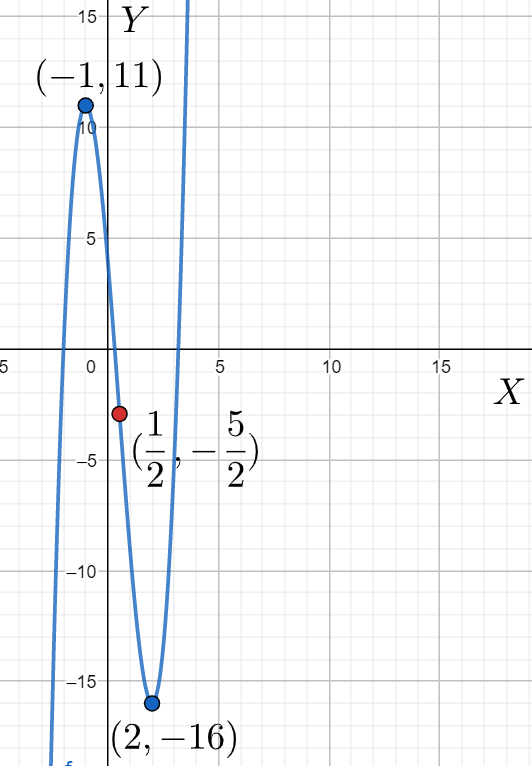
Suppose we consider an equation, \[y=2{{x}^{3}}-3{{x}^{2}}-12x+4\] , we find \[\dfrac{dy}{dx}=0\] to find the critical points, which come out to be, \[\left( -1,11 \right)\] and \[\left( 2,-16 \right)\] . We then do \[\dfrac{{{d}^{2}}y}{d{{x}^{2}}}=0\], to find the point of inflection. It comes out to be, \[\left( \dfrac{1}{2},-\dfrac{5}{2} \right)\] .
Note:For any given problem, we first have to read the problem very carefully to find what has been asked, to find the critical points of the inflection point. Whatever asked to find, we must follow the above steps serially to get the correct answer. We should also remember that the odd derivatives of a function always give us the critical points and the even derivatives give the inflection points.
Complete step by step answer:
Now we start off the solution by saying that,
Let us assume that \[y=f\left( x \right)\] is a given function to any problem. Now, on doing \[\dfrac{dy}{dx}=0\] , the first derivative of ‘y’ with respect to ‘x’ to zero, we find out all the values of ‘x’ and these corresponding values of ‘x’ implies all the critical points, which are basically the points of local maxima or local minima. In other words we can say that these are the points of extremum. On finding the second derivative of the given function, and putting the values of ‘x’ as obtained, we find the exact points which form the maxima or minima. We have the law that, if,
\[\dfrac{{{d}^{2}}y}{d{{x}^{2}}}<0\] , then this point is a point of local maxima and if
\[\dfrac{{{d}^{2}}y}{d{{x}^{2}}}>0\] , then this point is a point of local minima.
Suppose we don’t find any critical points, then we have to find the second derivative and equating it to zero, \[\dfrac{{{d}^{2}}y}{d{{x}^{2}}}=0\] , we solve for ‘x’. The value of ‘x’ which we get, is the point of inflection, and at this point there is one possible vertical tangent.
Suppose we consider an equation, \[y=2{{x}^{3}}-3{{x}^{2}}-12x+4\] , we find \[\dfrac{dy}{dx}=0\] to find the critical points, which come out to be, \[\left( -1,11 \right)\] and \[\left( 2,-16 \right)\] . We then do \[\dfrac{{{d}^{2}}y}{d{{x}^{2}}}=0\], to find the point of inflection. It comes out to be, \[\left( \dfrac{1}{2},-\dfrac{5}{2} \right)\] .
Note:For any given problem, we first have to read the problem very carefully to find what has been asked, to find the critical points of the inflection point. Whatever asked to find, we must follow the above steps serially to get the correct answer. We should also remember that the odd derivatives of a function always give us the critical points and the even derivatives give the inflection points.
Recently Updated Pages
Master Class 12 Economics: Engaging Questions & Answers for Success

Master Class 12 English: Engaging Questions & Answers for Success
Master Class 12 Social Science: Engaging Questions & Answers for Success
Master Class 12 Maths: Engaging Questions & Answers for Success
Master Class 12 Physics: Engaging Questions & Answers for Success
Master Class 12 Business Studies: Engaging Questions & Answers for Success
Trending doubts
Which are the Top 10 Largest Countries of the World?
Draw a labelled sketch of the human eye class 12 physics CBSE
Differentiate between homogeneous and heterogeneous class 12 chemistry CBSE
Why is the cell called the structural and functional class 12 biology CBSE
Draw ray diagrams each showing i myopic eye and ii class 12 physics CBSE
Which is the correct genotypic ratio of mendel dihybrid class 12 biology CBSE