




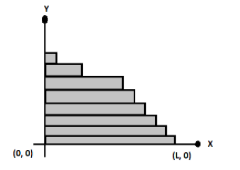
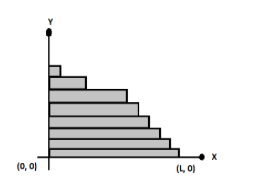
Infinite rods of uniform mass density and length \[{\text{L, }}\dfrac{{\text{L}}}{2},{\text{ }}\dfrac{{\text{L}}}{4}......\]are placed one upon another up to infinite as shown in the figure. Find the x-coordinate of the center of mass.
$A.{\text{ 0}}$
\[B.{\text{ }}\dfrac{{\text{L}}}{3}\]
\[C.{\text{ }}\dfrac{{\text{L}}}{2}\]
\[D.{\text{ }}\dfrac{{{\text{2L}}}}{3}\]
Answer
 Verified
576k+ views
Hint: The point at which the whole mass of the system is concentrated is defined as the center of mass of a particle. If we have the data of the masses and the coordinates of the particles of an n-particle system.
Formulas used:
The coordinates of the center of mass of this system can be expressed as:
-\[{{\text{X}}_{COM}} = \dfrac{{\sum\limits_{i = 1}^n {{m_i}{x_i}} }}{{\sum {{m_i}} }}\]
-\[{Y_{COM}} = \dfrac{{\sum\limits_{i = 1}^n {{m_i}{y_i}} }}{{\sum {{m_i}} }}\]
Complete step by step answer:
\[x\] coordinate of Centre of mass is given by
\[{{\text{X}}_{COM}} = \dfrac{{\sum\limits_{i = 1}^n {{m_i}{x_i}} }}{{\sum {{m_i}} }}\]
The numerator is
\[\sum\limits_{i = 1}^n {{m_i}{x_i}} = m\dfrac{L}{2} + \dfrac{m}{2}\left( {\dfrac{L}{4}} \right) + ......\]
The denominator is,
\[\sum {{m_i}} = m + \dfrac{m}{2} + \dfrac{m}{4} + ......\]
So, \[{{\text{X}}_{COM}} = \dfrac{{\sum\limits_{i = 1}^n {{m_i}{x_i}} }}{{\sum {{m_i}} }} = \dfrac{{m\dfrac{L}{2} + \dfrac{m}{2}\left( {\dfrac{L}{4}} \right) + ......}}{{m + \dfrac{m}{2} + \dfrac{m}{4} + ......}}\]
\[{X_{COM}} = \dfrac{{mL\left( {\dfrac{1}{2} + \dfrac{1}{8} + \dfrac{1}{{32}} + ....} \right)}}{{m\left( {1 + \dfrac{1}{2} + \dfrac{1}{4} + ......} \right)}}\]
\[{X_{COM}} = \dfrac{{L\left( {\dfrac{{\dfrac{1}{2}}}{{1 - \dfrac{1}{4}}}} \right)}}{{\dfrac{1}{{\left( {1 - \dfrac{1}{2}} \right)}}}}\]
\[{X_{COM}} = \dfrac{{L\left( {\dfrac{4}{6}} \right)}}{2} = \dfrac{L}{3}\]
Hence, B option is correct
Additional information:
A large number of problems involving extended bodies or real bodies of finite size can be solved by taking them as Rigid Bodies. We define a rigid body as a body having a definite and unchanging shape.
Rigid body: It is a rigid assembly of particles with a fixed inter-particle distance.
Centre of mass for some bodies:
-A plane lamina - Point of intersection of diagonals
-Triangular plane lamina - Point of intersection of medians
-Rectangular or cubical block - Points of intersection of diagonals
-Hollow cylinder - Middle point of the axis of a cylinder
Note:
-The center of mass and center of gravity both are different.
-Centre of a mass of a body in which the total mass of the body is concentrated at one point.
-Where the center of gravity is the point at which the resultant of all gravitational forces on all the particles of the body acts.
-But for many objects, these two points are exactly in the same place when the gravitational field is uniform across the object.
Formulas used:
The coordinates of the center of mass of this system can be expressed as:
-\[{{\text{X}}_{COM}} = \dfrac{{\sum\limits_{i = 1}^n {{m_i}{x_i}} }}{{\sum {{m_i}} }}\]
-\[{Y_{COM}} = \dfrac{{\sum\limits_{i = 1}^n {{m_i}{y_i}} }}{{\sum {{m_i}} }}\]
Complete step by step answer:
\[x\] coordinate of Centre of mass is given by
\[{{\text{X}}_{COM}} = \dfrac{{\sum\limits_{i = 1}^n {{m_i}{x_i}} }}{{\sum {{m_i}} }}\]
The numerator is
\[\sum\limits_{i = 1}^n {{m_i}{x_i}} = m\dfrac{L}{2} + \dfrac{m}{2}\left( {\dfrac{L}{4}} \right) + ......\]
The denominator is,
\[\sum {{m_i}} = m + \dfrac{m}{2} + \dfrac{m}{4} + ......\]
So, \[{{\text{X}}_{COM}} = \dfrac{{\sum\limits_{i = 1}^n {{m_i}{x_i}} }}{{\sum {{m_i}} }} = \dfrac{{m\dfrac{L}{2} + \dfrac{m}{2}\left( {\dfrac{L}{4}} \right) + ......}}{{m + \dfrac{m}{2} + \dfrac{m}{4} + ......}}\]
\[{X_{COM}} = \dfrac{{mL\left( {\dfrac{1}{2} + \dfrac{1}{8} + \dfrac{1}{{32}} + ....} \right)}}{{m\left( {1 + \dfrac{1}{2} + \dfrac{1}{4} + ......} \right)}}\]
\[{X_{COM}} = \dfrac{{L\left( {\dfrac{{\dfrac{1}{2}}}{{1 - \dfrac{1}{4}}}} \right)}}{{\dfrac{1}{{\left( {1 - \dfrac{1}{2}} \right)}}}}\]
\[{X_{COM}} = \dfrac{{L\left( {\dfrac{4}{6}} \right)}}{2} = \dfrac{L}{3}\]
Hence, B option is correct
Additional information:
A large number of problems involving extended bodies or real bodies of finite size can be solved by taking them as Rigid Bodies. We define a rigid body as a body having a definite and unchanging shape.
Rigid body: It is a rigid assembly of particles with a fixed inter-particle distance.
Centre of mass for some bodies:
-A plane lamina - Point of intersection of diagonals
-Triangular plane lamina - Point of intersection of medians
-Rectangular or cubical block - Points of intersection of diagonals
-Hollow cylinder - Middle point of the axis of a cylinder
Note:
-The center of mass and center of gravity both are different.
-Centre of a mass of a body in which the total mass of the body is concentrated at one point.
-Where the center of gravity is the point at which the resultant of all gravitational forces on all the particles of the body acts.
-But for many objects, these two points are exactly in the same place when the gravitational field is uniform across the object.
Recently Updated Pages
Master Class 11 Computer Science: Engaging Questions & Answers for Success

Master Class 11 Business Studies: Engaging Questions & Answers for Success
Master Class 11 Economics: Engaging Questions & Answers for Success
Master Class 11 English: Engaging Questions & Answers for Success
Master Class 11 Maths: Engaging Questions & Answers for Success
Master Class 11 Biology: Engaging Questions & Answers for Success
Trending doubts
There are 720 permutations of the digits 1 2 3 4 5 class 11 maths CBSE
Discuss the various forms of bacteria class 11 biology CBSE
Explain zero factorial class 11 maths CBSE
What organs are located on the left side of your body class 11 biology CBSE
Draw a diagram of nephron and explain its structur class 11 biology CBSE
How do I convert ms to kmh Give an example class 11 physics CBSE