




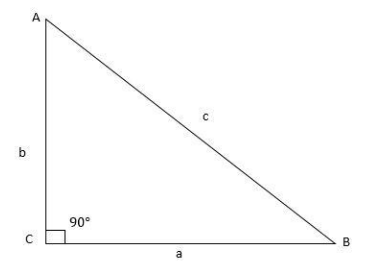
In$\Delta ABC$,$\angle C = 90^\circ $
If $BC = a,AC = b$and$AB = c$, find
(i)$c$when $a = 8cm$and $b = 6cm$
(ii) $a$when $c = 25cm$and $b = 7cm$
(iii) $b$when $c = 13cm$and $a = 5cm$
Answer
 Verified
582.3k+ views
Hint: Take each of the above cases, then use Pythagoras theorem to find the missing value in that case. Repeat the same procedure to find the missing value in all the cases.
Complete step-by-step answer:
Using Pythagoras theorem,
Hypotenuse2=Perpendicular2+base2
(i) $c$when, $a = 8cm$and $b = 6cm$
Here,
$AC = b = 6cm$
$BC = a = 8cm$
$AB = c = ?$
Applying Pythagoras theorem,
$\Rightarrow A{B^2} = A{C^2} + B{C^2}$
$\Rightarrow {c^2} = {b^2} + {a^2}$
Putting the values,
$\Rightarrow {c^2} = {6^2} + {8^2}$
$\Rightarrow {c^2} = 64 + 36$
$\Rightarrow c = 10$
ii) Find $a$when $c = 25cm$ and $b = 7cm$
$AC = b = 7cm$
$BC = a = ?$
$AB = c = 25cm$
Applying Pythagoras theorem,
$\Rightarrow A{C^2} = A{B^2} + B{C^2}$
$\Rightarrow {c^2} = {b^2} + {a^2}$
$\Rightarrow {25^2} = {7^2} + {a^2}$
$\Rightarrow {a^2} = {25^2} - {7^2}$
$\Rightarrow {a^2} = 625 - 49$
$\Rightarrow {a^2} = 576$
$\Rightarrow a = 24$
(iii) $b$when $c = 13cm$and $a = 5cm$
Here,
$ AC = b = ?$
$ BC = a = 5cm$
$ AB = c = 13cm$
Applying Pythagoras theorem,
$\Rightarrow A{C^2} = A{B^2} + B{C^2}$
$\Rightarrow {c^2} = {b^2} + {a^2}$
$\Rightarrow {13^2} = {b^2} + {5^2}$
$\Rightarrow {b^2} = 169 - 25$
$\Rightarrow {b^2} = \sqrt {144} $
$\Rightarrow b = 12$
Note: A triangle having 90 Degree is a right angled triangle. The Pythagoras theorem is useful to calculate the values asked to find in a question.
Complete step-by-step answer:
Using Pythagoras theorem,
Hypotenuse2=Perpendicular2+base2
(i) $c$when, $a = 8cm$and $b = 6cm$
Here,
$AC = b = 6cm$
$BC = a = 8cm$
$AB = c = ?$
Applying Pythagoras theorem,
$\Rightarrow A{B^2} = A{C^2} + B{C^2}$
$\Rightarrow {c^2} = {b^2} + {a^2}$
Putting the values,
$\Rightarrow {c^2} = {6^2} + {8^2}$
$\Rightarrow {c^2} = 64 + 36$
$\Rightarrow c = 10$
ii) Find $a$when $c = 25cm$ and $b = 7cm$
$AC = b = 7cm$
$BC = a = ?$
$AB = c = 25cm$
Applying Pythagoras theorem,
$\Rightarrow A{C^2} = A{B^2} + B{C^2}$
$\Rightarrow {c^2} = {b^2} + {a^2}$
$\Rightarrow {25^2} = {7^2} + {a^2}$
$\Rightarrow {a^2} = {25^2} - {7^2}$
$\Rightarrow {a^2} = 625 - 49$
$\Rightarrow {a^2} = 576$
$\Rightarrow a = 24$
(iii) $b$when $c = 13cm$and $a = 5cm$
Here,
$ AC = b = ?$
$ BC = a = 5cm$
$ AB = c = 13cm$
Applying Pythagoras theorem,
$\Rightarrow A{C^2} = A{B^2} + B{C^2}$
$\Rightarrow {c^2} = {b^2} + {a^2}$
$\Rightarrow {13^2} = {b^2} + {5^2}$
$\Rightarrow {b^2} = 169 - 25$
$\Rightarrow {b^2} = \sqrt {144} $
$\Rightarrow b = 12$
Note: A triangle having 90 Degree is a right angled triangle. The Pythagoras theorem is useful to calculate the values asked to find in a question.

Recently Updated Pages
Master Class 8 Social Science: Engaging Questions & Answers for Success

Master Class 8 English: Engaging Questions & Answers for Success
Class 8 Question and Answer - Your Ultimate Solutions Guide
Master Class 8 Maths: Engaging Questions & Answers for Success
Master Class 8 Science: Engaging Questions & Answers for Success
Master Class 7 English: Engaging Questions & Answers for Success
Trending doubts
What is BLO What is the full form of BLO class 8 social science CBSE
Citizens of India can vote at the age of A 18 years class 8 social science CBSE
Full form of STD, ISD and PCO
Advantages and disadvantages of science
Right to vote is a AFundamental Right BFundamental class 8 social science CBSE
What are the 12 elements of nature class 8 chemistry CBSE