




In Young's double slit experiment, the interference pattern obtained with white light will be?
Answer
 Verified
519.3k+ views
Hint: This question will begin with an explanation of Young's Double Slit Experiment, followed by a discussion of what would happen if we used white light instead of monochromatic light, and finally the required response.
Complete answer:
Thomas young performed an experiment in which he projected the light beams emerging from the slits onto another screen, using monochromatic light diffracted through the small slits as a source of coherent lighting. When the slits were large, placed far apart, and close to the screen, two overlapping patches of light formed on the screen, according to Young. The light traveling through the slits and onto the screen generated distinct bands of colour separated by black regions in a serial order when he reduced the size of the slits and moved them closer together. To characterize the bands, Young developed the term interference fringes and discovered that they could only be created if light behaved like a wave.
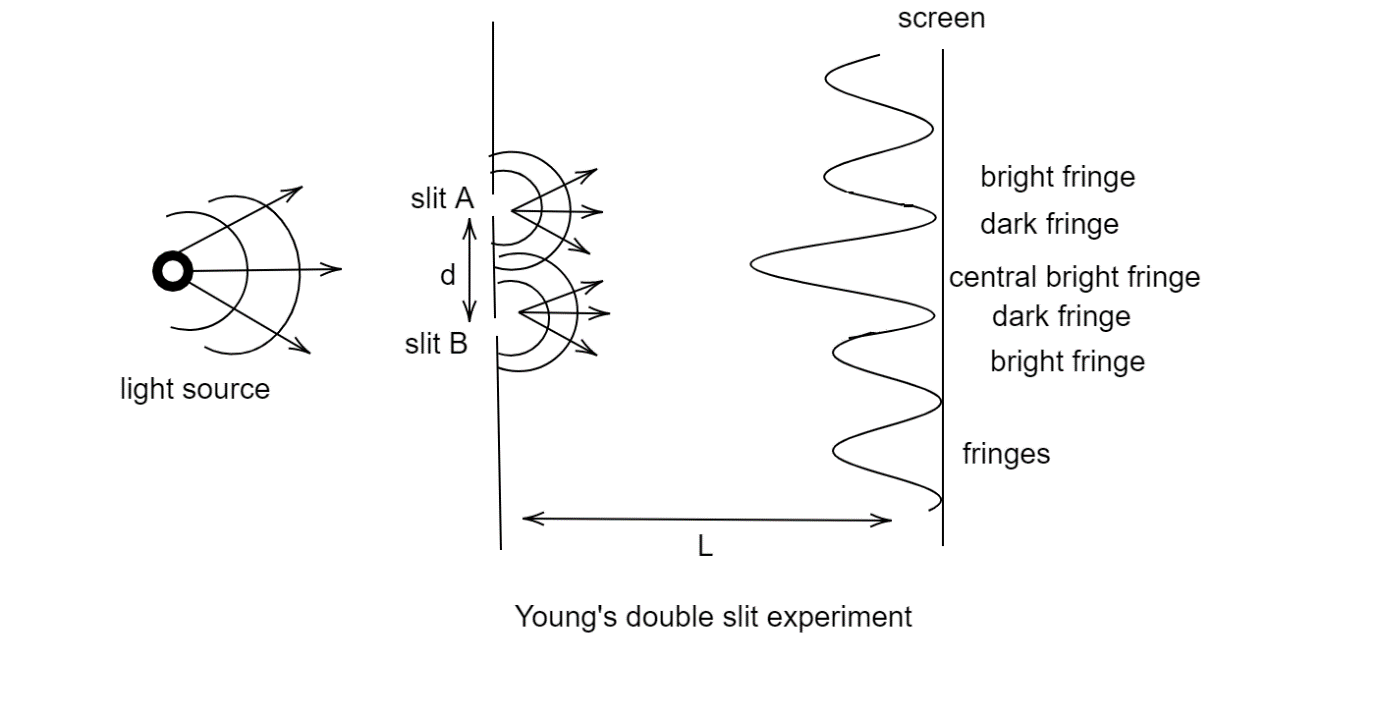
White light is made up of waves with a variety of wavelengths ranging from violet to red. When monochromatic light is replaced with white light in Young's interference experiment, the waves of each wavelength generate their own interference patterns. As a result, all of the other fringes have coloured edges, with the blue one being closer to the centre. The fringes eventually converge, resulting in a homogeneous white light.
Note:
When two light waves of the same frequency and phase difference move in the same direction and superpose, the intensity in the superposition zone is redistributed, becoming highest at some spots and minimum at others. Interference of light is the name given to this phenomena. Light sources that emit waves with a zero or constant phase difference and the same frequency are known as coherent sources.
Complete answer:
Thomas young performed an experiment in which he projected the light beams emerging from the slits onto another screen, using monochromatic light diffracted through the small slits as a source of coherent lighting. When the slits were large, placed far apart, and close to the screen, two overlapping patches of light formed on the screen, according to Young. The light traveling through the slits and onto the screen generated distinct bands of colour separated by black regions in a serial order when he reduced the size of the slits and moved them closer together. To characterize the bands, Young developed the term interference fringes and discovered that they could only be created if light behaved like a wave.
White light is made up of waves with a variety of wavelengths ranging from violet to red. When monochromatic light is replaced with white light in Young's interference experiment, the waves of each wavelength generate their own interference patterns. As a result, all of the other fringes have coloured edges, with the blue one being closer to the centre. The fringes eventually converge, resulting in a homogeneous white light.
Note:
When two light waves of the same frequency and phase difference move in the same direction and superpose, the intensity in the superposition zone is redistributed, becoming highest at some spots and minimum at others. Interference of light is the name given to this phenomena. Light sources that emit waves with a zero or constant phase difference and the same frequency are known as coherent sources.
Recently Updated Pages
Master Class 5 English: Engaging Questions & Answers for Success

Master Class 5 Maths: Engaging Questions & Answers for Success
Master Class 5 Social Science: Engaging Questions & Answers for Success
Master Class 5 Science: Engaging Questions & Answers for Success
Class 5 Question and Answer - Your Ultimate Solutions Guide
Master Class 9 General Knowledge: Engaging Questions & Answers for Success
Trending doubts
Which are the Top 10 Largest Countries of the World?
The total number of vertebrae in man is a30 b31 c32 class 12 biology CBSE
Draw a labelled sketch of the human eye class 12 physics CBSE
The number of cranial nerves in a frog is A 10 pairs class 12 biology CBSE
Differentiate between homogeneous and heterogeneous class 12 chemistry CBSE
Antibodies present in colostrum which protect the new class 12 biology CBSE