




In which of the following respects the photosynthetic adaptations of ${ C }_{ 4 }$ plants and CAM plants are similar?
(a) In both cases, stomata normally close during the day.
(b) Both types of plants make their sugar without the Calvin cycle.
(c) In both cases, an enzyme other than rubisco carries out the first step in carbon fixation.
(d) Neither ${ C }_{ 4 }$ plants nor CAM plants have grana in their chloroplasts.
Answer
 Verified
541.5k+ views
Hint: CAM pathway was first observed in the Crassulaceae plants and it stands for Crassulacean Acid Metabolism. They undergo CAM photosynthesis to adapt to arid climatic conditions. While the ${ C }_{ 4 }$ plants enter into the Calvin cycle by producing four carbon sugar through carbon dioxide.
Complete answer
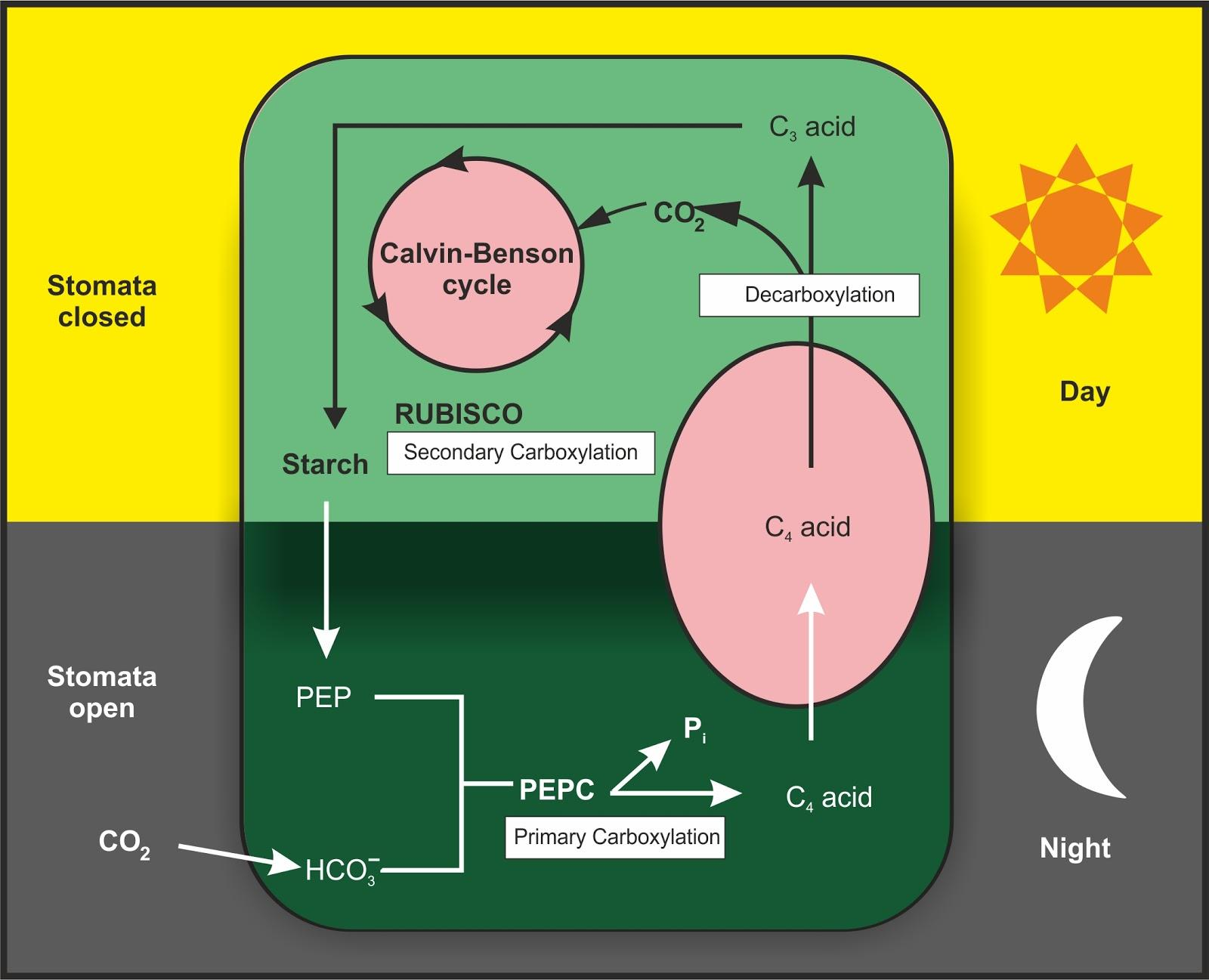
-The carbon fixation in the CAM plants occurs during the night while the stomata of the leaves close themselves during the daytime to stop the evaporation of water that causes transpiration. PEP stands for phosphoenolpyruvate which is the three-carbon compound. This compound is the primary ${ CO }_{ 2 }$ acceptor in ${ C }_{ 4 }$ and CAM plants.
-In CAM, after carbon dioxide is fixed at night, it is stored as the four-carbon compound malate. The light-dependent reactions of photosynthesis occur during daylight and then the carbon dioxide is released. During the night, carbon dioxide enters through the open stomata and is fixed by PEPc as oxaloacetate. This is again converted to malate which accumulates in cell vacuoles.
-In ${ C }_{ 4 }$ plants, in the mesophyll cells, the conversion of carbon dioxide into bicarbonate occurs and with the help of the PEPc enzyme, it is added to phosphoenolpyruvate. The carbon fixation in these plants is termed the Hatch and Slack pathway.
- The enzyme carries out carbon fixation in CAM and ${ C }_{ 4 }$ plants. Both pathways concentrate ${ CO }_{ 2 }$ around the RuBisCO enzyme.
So, the correct answer is ‘In both cases, an enzyme other than rubisco carries out the first step in carbon fixation’.
Note:
These plants generally have thick cuticles and finely divided leaves or no leaves and also the reduced stomata. The leaves of these plants are mostly covered with wax, color, hair, or spines and are succulents that help them in their water storage adaptations. The plants increase the amount of water intake to adapt to xerophytic conditions and lessen their usage.
Complete answer
-The carbon fixation in the CAM plants occurs during the night while the stomata of the leaves close themselves during the daytime to stop the evaporation of water that causes transpiration. PEP stands for phosphoenolpyruvate which is the three-carbon compound. This compound is the primary ${ CO }_{ 2 }$ acceptor in ${ C }_{ 4 }$ and CAM plants.
-In CAM, after carbon dioxide is fixed at night, it is stored as the four-carbon compound malate. The light-dependent reactions of photosynthesis occur during daylight and then the carbon dioxide is released. During the night, carbon dioxide enters through the open stomata and is fixed by PEPc as oxaloacetate. This is again converted to malate which accumulates in cell vacuoles.
-In ${ C }_{ 4 }$ plants, in the mesophyll cells, the conversion of carbon dioxide into bicarbonate occurs and with the help of the PEPc enzyme, it is added to phosphoenolpyruvate. The carbon fixation in these plants is termed the Hatch and Slack pathway.
- The enzyme carries out carbon fixation in CAM and ${ C }_{ 4 }$ plants. Both pathways concentrate ${ CO }_{ 2 }$ around the RuBisCO enzyme.
So, the correct answer is ‘In both cases, an enzyme other than rubisco carries out the first step in carbon fixation’.
Note:
These plants generally have thick cuticles and finely divided leaves or no leaves and also the reduced stomata. The leaves of these plants are mostly covered with wax, color, hair, or spines and are succulents that help them in their water storage adaptations. The plants increase the amount of water intake to adapt to xerophytic conditions and lessen their usage.
Recently Updated Pages
Master Class 12 Economics: Engaging Questions & Answers for Success

Master Class 12 English: Engaging Questions & Answers for Success
Master Class 12 Social Science: Engaging Questions & Answers for Success
Master Class 12 Maths: Engaging Questions & Answers for Success
Master Class 12 Physics: Engaging Questions & Answers for Success
Master Class 11 Social Science: Engaging Questions & Answers for Success
Trending doubts
One Metric ton is equal to kg A 10000 B 1000 C 100 class 11 physics CBSE
Difference Between Prokaryotic Cells and Eukaryotic Cells
Two of the body parts which do not appear in MRI are class 11 biology CBSE
1 ton equals to A 100 kg B 1000 kg C 10 kg D 10000 class 11 physics CBSE
Draw a diagram of nephron and explain its structur class 11 biology CBSE
10 examples of friction in our daily life