




In which kingdom would you include archaea and nitrogen-fixing organisms in the five-kingdom classification?
(a) Plantae
(b) Fungi
(c) Protista
(d) Monera
Answer
 Verified
608.7k+ views
Hint: Archaea and organisms that fix nitrogen are part of the kingdom, which includes prokaryotes that are unicellular organisms that are not nucleated. Their name comes from a Greek word which means single or solitary. The sole members of this group are bacteria.
Complete step by step answer:
Whittaker's classification provides a classification scheme of five kingdoms. Monera, Protista, Fungi, Plantae, and Animalia form the classification scheme of the five kingdoms. The Archaebacteria and the Eubacteria are grouped into the Kingdom of Monera. Prokaryotes that are classified under Monera are bacteria. All the archaea that are primitive prokaryotes are included in the Archaebacteria group. The nitrogen-fixing bacterium is part of the Eubacteria community. These species, then, are placed in the Monera group.
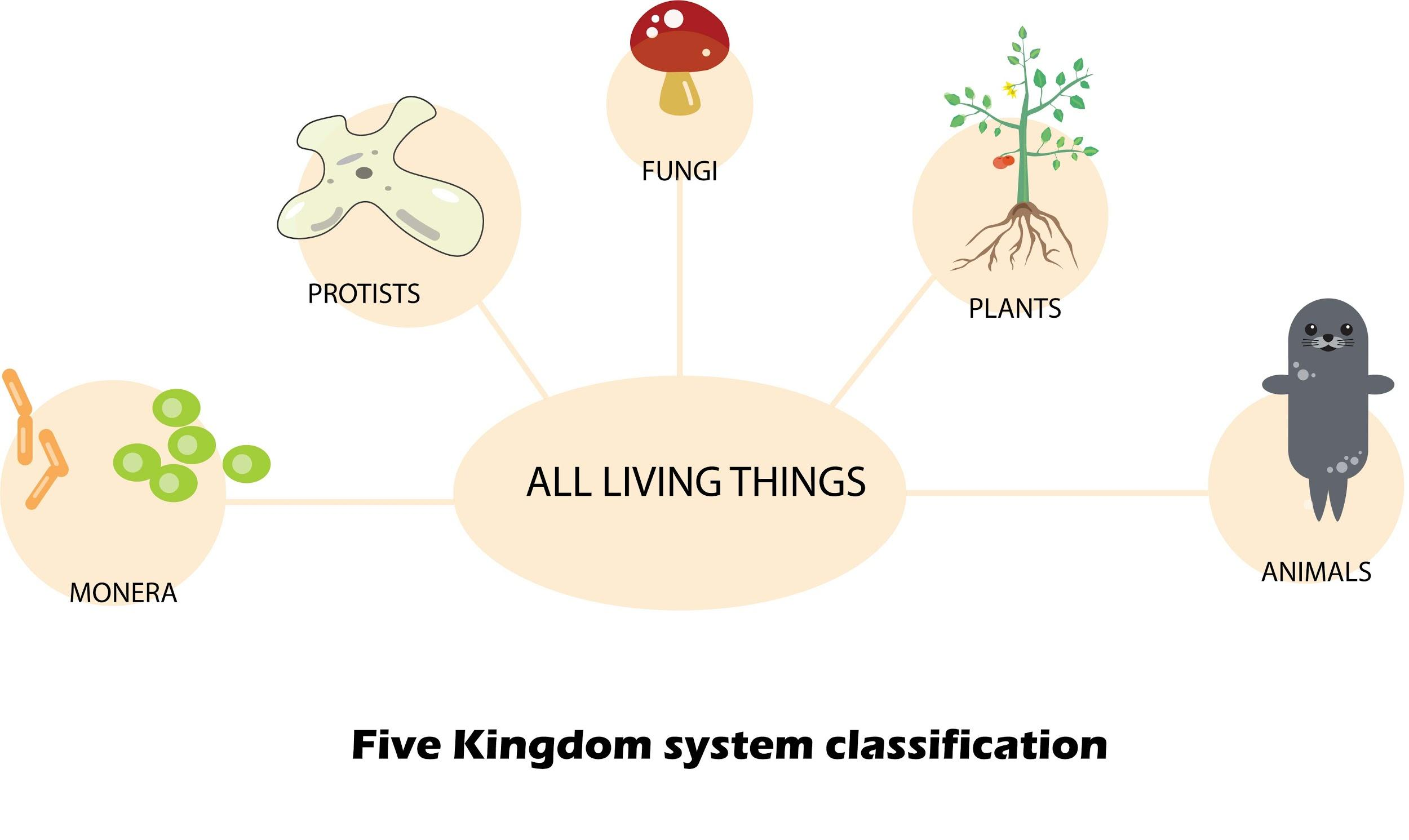
Archaea is a category of single-celled species. Cell nuclei are absent from these microorganisms that are prokaryotes.
Microorganisms that are capable of converting atmospheric nitrogen into fixed nitrogen (inorganic plant-usable compounds) are nitrogen-fixing bacteria. Rhizobium, which is associated with plants in the pea family, and different Azospirillum species, which are associated with cereal grasses, are examples of symbiotic nitrogen-fixing bacteria. The cyanobacteria Anabaena and Nostoc and genera such as Azotobacter, Beijerinckia, and Clostridium contain free-living nitrogen-fixers.
Protista is a kingdom of eukaryotes that are unicellular. Fungi are a kingdom of eukaryotes containing multicellular spores. Plantae is eukaryotes that are photosynthetic.
The sole members of the Kingdom Monera are bacteria. The cell wall is present in bacteria. They have no organelles attached to membranes and no real nucleus. They produce ribosomes of the 70S. They are the microorganisms that are most plentiful.
So, the correct answer is, ‘(d) Monera’.
Note: Monera is basically a biological kingdom that consists of prokaryotes (particularly bacteria) . As such, it is made up of species that are single-celled and lack a true nucleus. Based on previous classifications, the kingdom Monera includes blue-green algae and Schizopyta along with archaea. Bacteria are present almost everywhere. A handful of soil contains hundreds of bacteria. They also live in extreme environments where very few other life forms can exist, such as hot springs, deserts, snow, and deep oceans. As parasites, many of them reside in or on other species.
Complete step by step answer:
Whittaker's classification provides a classification scheme of five kingdoms. Monera, Protista, Fungi, Plantae, and Animalia form the classification scheme of the five kingdoms. The Archaebacteria and the Eubacteria are grouped into the Kingdom of Monera. Prokaryotes that are classified under Monera are bacteria. All the archaea that are primitive prokaryotes are included in the Archaebacteria group. The nitrogen-fixing bacterium is part of the Eubacteria community. These species, then, are placed in the Monera group.
Archaea is a category of single-celled species. Cell nuclei are absent from these microorganisms that are prokaryotes.
Microorganisms that are capable of converting atmospheric nitrogen into fixed nitrogen (inorganic plant-usable compounds) are nitrogen-fixing bacteria. Rhizobium, which is associated with plants in the pea family, and different Azospirillum species, which are associated with cereal grasses, are examples of symbiotic nitrogen-fixing bacteria. The cyanobacteria Anabaena and Nostoc and genera such as Azotobacter, Beijerinckia, and Clostridium contain free-living nitrogen-fixers.
Protista is a kingdom of eukaryotes that are unicellular. Fungi are a kingdom of eukaryotes containing multicellular spores. Plantae is eukaryotes that are photosynthetic.
The sole members of the Kingdom Monera are bacteria. The cell wall is present in bacteria. They have no organelles attached to membranes and no real nucleus. They produce ribosomes of the 70S. They are the microorganisms that are most plentiful.
So, the correct answer is, ‘(d) Monera’.
Note: Monera is basically a biological kingdom that consists of prokaryotes (particularly bacteria) . As such, it is made up of species that are single-celled and lack a true nucleus. Based on previous classifications, the kingdom Monera includes blue-green algae and Schizopyta along with archaea. Bacteria are present almost everywhere. A handful of soil contains hundreds of bacteria. They also live in extreme environments where very few other life forms can exist, such as hot springs, deserts, snow, and deep oceans. As parasites, many of them reside in or on other species.
Recently Updated Pages
Master Class 11 English: Engaging Questions & Answers for Success

Master Class 11 Maths: Engaging Questions & Answers for Success
Class 11 Question and Answer - Your Ultimate Solutions Guide
Master Class 11 Biology: Engaging Questions & Answers for Success
Master Class 11 Physics: Engaging Questions & Answers for Success
Master Class 11 Accountancy: Engaging Questions & Answers for Success
Trending doubts
Differentiate between an exothermic and an endothermic class 11 chemistry CBSE
One Metric ton is equal to kg A 10000 B 1000 C 100 class 11 physics CBSE
There are 720 permutations of the digits 1 2 3 4 5 class 11 maths CBSE
In what year Guru Nanak Dev ji was born A15 April 1469 class 11 social science CBSE
Difference Between Prokaryotic Cells and Eukaryotic Cells
Draw a diagram of a plant cell and label at least eight class 11 biology CBSE