




In which compartment of a cell does the process of glycolysis take place?
(A) Golgi Complex
(B) Mitochondria
(C) Cytoplasm
(D) Ribosomes
Answer
 Verified
625.2k+ views
Hint: The process of glycolysis takes place in that compartment of a cell which is semi-viscous fluid i.e matrix which is present in the cell and is surrounded by the cell membrane. This fluid contains many enzymes, proteins, nutrients, and other cell organelles.
Complete step by step answer:
Glycolysis is an oxygen-independent metabolic pathway that occurs in the cytosol also known as cytoplasm. It is a metabolic process by which a single molecule of glucose is broken down into two pyruvate compounds. The main reason for glycolysis to take place in the cytoplasm is that this is where the enzymes are located that are involved in glycolysis.
So, the correct answer is ‘Cytoplasm’.
Additional Information: The word Glycolysis is derived from the word “glycan” for sugar and “lysis” for splitting simply means splitting up of sugar.
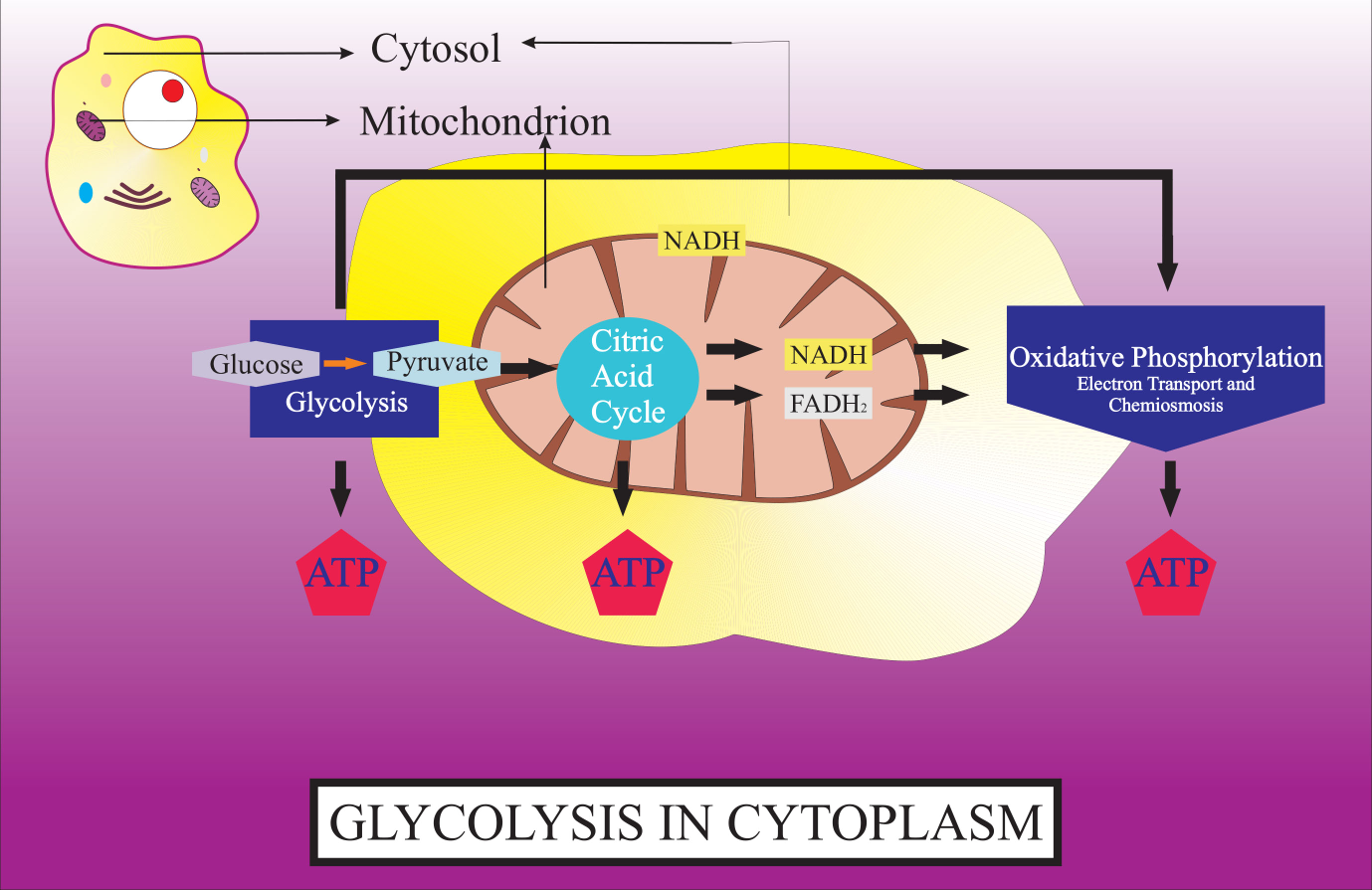
The glycolysis pathway is usually e separated into two different phases which are as follows:
- The Preparatory (or Investment) Phase. In this phase, ATP is consumed.
- The Pay Off Phase - In this phase, the ATP is produced.
The cytoplasm has three elements in it. The major elements of the cytoplasm are the cytosol, organelles, and inclusions.
- The cytosol is that portion of the cytoplasm which is not contained within membrane-bound organelles. Cytosol makes up about the majority of the cell volume and is a complex mixture of cytoskeleton filaments, dissolved molecules, and water.
- Organelles are usually membrane- bound structures present inside the cell in the cytoplasm that has specific functions. For example mitochondria, ribosomes, etc.
- Cytoplasmic inclusions- These inclusions are small particles of insoluble substances suspended in the cytosol.
Note: The process of glycolysis was first described in 1918 by three scientists which are Gustav Embden, Otto Meyerhoff, and Jakub Karol Parnas, and therefore the glycolysis is also referred to as the EMP pathway. EMP stands for the first letter of the name of the Scientists.
Complete step by step answer:
Glycolysis is an oxygen-independent metabolic pathway that occurs in the cytosol also known as cytoplasm. It is a metabolic process by which a single molecule of glucose is broken down into two pyruvate compounds. The main reason for glycolysis to take place in the cytoplasm is that this is where the enzymes are located that are involved in glycolysis.
So, the correct answer is ‘Cytoplasm’.
Additional Information: The word Glycolysis is derived from the word “glycan” for sugar and “lysis” for splitting simply means splitting up of sugar.
The glycolysis pathway is usually e separated into two different phases which are as follows:
- The Preparatory (or Investment) Phase. In this phase, ATP is consumed.
- The Pay Off Phase - In this phase, the ATP is produced.
The cytoplasm has three elements in it. The major elements of the cytoplasm are the cytosol, organelles, and inclusions.
- The cytosol is that portion of the cytoplasm which is not contained within membrane-bound organelles. Cytosol makes up about the majority of the cell volume and is a complex mixture of cytoskeleton filaments, dissolved molecules, and water.
- Organelles are usually membrane- bound structures present inside the cell in the cytoplasm that has specific functions. For example mitochondria, ribosomes, etc.
- Cytoplasmic inclusions- These inclusions are small particles of insoluble substances suspended in the cytosol.
Note: The process of glycolysis was first described in 1918 by three scientists which are Gustav Embden, Otto Meyerhoff, and Jakub Karol Parnas, and therefore the glycolysis is also referred to as the EMP pathway. EMP stands for the first letter of the name of the Scientists.
Recently Updated Pages
The given figure shows two endocrine glands marked class 11 biology NEET_UG

Match columnI with columnII and select the correct class 11 biology NEET
Match column I with column II and select the correct class 11 biology NEET_UG
Which floral family has left 9 right + 1 arrangement class 11 biology NEET_UG
Which is not a variety of sheep A Lohi B Beetal C Nellore class 11 biology NEET_UG
Match column I with column II and select the correct class 11 biology NEET_UG
Trending doubts
One Metric ton is equal to kg A 10000 B 1000 C 100 class 11 physics CBSE
Draw a diagram of a plant cell and label at least eight class 11 biology CBSE
Difference Between Prokaryotic Cells and Eukaryotic Cells
Draw a well labelled diagram of reflex arc and explain class 11 biology CBSE
Two of the body parts which do not appear in MRI are class 11 biology CBSE
1 ton equals to A 100 kg B 1000 kg C 10 kg D 10000 class 11 physics CBSE