




In what respect do you consider bacteria as simple organisms?
Answer
 Verified
552k+ views
Hint: Bacteria are simple unicellular organisms that occur freely as a single entity or form colonies. The bacteria is present in almost every kind of environment and also inside the organism, for example the intestines of humans. Some of the bacteria can make their own food.
Complete answer:
The bacteria are the smallest known microorganisms whose size ranges from 0.3 to 0.5 micrometre. They are the prokaryotic unicellular organism whose body is not differentiated. They do not contain a definite nucleus, rather their genetic material is found floating in the cytoplasm.
Some of the characteristics of bacteria are-
- Definite nucleus is absent.
- They do not have membrane-bound organelles like mitochondria, chloroplast etc.
- The cell wall if present is made up of peptidoglycan.
- Some bacteria are motile and exhibit movement through cilia and flagella.
- The genetic material is circular DNA.
- They have 70S ribosomes which produce all the essential proteins for its physiology.
- Asexual reproduction mainly occurs by the means of spore formation, budding. Sexual reproduction takes place by conjugation.
- They exist in various shapes like rods, coccus, vibrio, spiral etc.
- They can thrive in any environment whether it is high temperature, salinity etc.
- Some bacteria are pathogenic and can cause various diseases to both plants and animals.
- From the below structure and characteristics we can say that bacteria are the simplest organism.
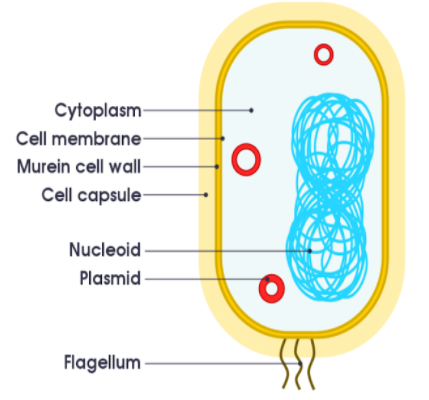
Note: The bacteria are omnipresent. Some examples of bacteria living in extreme environments are-
- The Halobacterium can survive in extreme saline environments.
- The thermophilic bacteria can survive at high temperatures.
- Blue green algae can live in anaerobic conditions.
- Methanogenic bacteria are present in the gut of the ruminants.
Complete answer:
The bacteria are the smallest known microorganisms whose size ranges from 0.3 to 0.5 micrometre. They are the prokaryotic unicellular organism whose body is not differentiated. They do not contain a definite nucleus, rather their genetic material is found floating in the cytoplasm.
Some of the characteristics of bacteria are-
- Definite nucleus is absent.
- They do not have membrane-bound organelles like mitochondria, chloroplast etc.
- The cell wall if present is made up of peptidoglycan.
- Some bacteria are motile and exhibit movement through cilia and flagella.
- The genetic material is circular DNA.
- They have 70S ribosomes which produce all the essential proteins for its physiology.
- Asexual reproduction mainly occurs by the means of spore formation, budding. Sexual reproduction takes place by conjugation.
- They exist in various shapes like rods, coccus, vibrio, spiral etc.
- They can thrive in any environment whether it is high temperature, salinity etc.
- Some bacteria are pathogenic and can cause various diseases to both plants and animals.
- From the below structure and characteristics we can say that bacteria are the simplest organism.
Note: The bacteria are omnipresent. Some examples of bacteria living in extreme environments are-
- The Halobacterium can survive in extreme saline environments.
- The thermophilic bacteria can survive at high temperatures.
- Blue green algae can live in anaerobic conditions.
- Methanogenic bacteria are present in the gut of the ruminants.
Recently Updated Pages
Basicity of sulphurous acid and sulphuric acid are

Master Class 10 Computer Science: Engaging Questions & Answers for Success
Master Class 10 Social Science: Engaging Questions & Answers for Success
Master Class 10 Science: Engaging Questions & Answers for Success
Class 10 Question and Answer - Your Ultimate Solutions Guide
Master Class 10 Maths: Engaging Questions & Answers for Success
Trending doubts
What is the Total Duration of Football Match?
Explain the Treaty of Vienna of 1815 class 10 social science CBSE
In football, which nation is called "La Roja"?
Why is there a time difference of about 5 hours between class 10 social science CBSE
10 examples of evaporation in daily life with explanations
What is the full form of POSCO class 10 social science CBSE