




In what ratio is the line joining $\text{A}\left( 8,9 \right)$ and $\text{B}\left( -7,4 \right)$ is divided by
(a). The point $\left( 2,7 \right)$
(b). The x-axis
(c). The y-axis
Answer
 Verified
636.3k+ views
Hint: suppose, the ratio in all cases lying on the line joining given as \[k:1\]. Use sectional formula given for calculating a point which divides the line segment joining the points $\left( {{x}_{1}},{{y}_{1}} \right)$ and $\left( {{x}_{2}},{{y}_{2}} \right)$in the ratio \[m:n\]; point given as \[\left( \dfrac{m{{x}_{2}}+n{{x}_{1}}}{m+n},\dfrac{m{{y}_{2}}+n{{y}_{1}}}{m+n} \right)\] any point on x-axis has y-coordinates as 0 and vice-versa is also true. Use this logic to solve the problem.
Complete step-by-step answer:
We know the point which divides the line joining the points $\left( {{x}_{1}},{{y}_{1}} \right)$ and $\left( {{x}_{2}},{{y}_{2}} \right)$ in ratio of \[m:n\], is given by sectional formula as:-
\[\text{R}\ =\ \left( \dfrac{m{{x}_{2}}+n{{x}_{1}}}{m+n},\dfrac{m{{y}_{2}}+n{{y}_{1}}}{m+n} \right)\] …………………………………………(i)
Now, coming to the question, we need to find the ratio by which line joining $\text{A}\left( 8,9 \right)$ and $\text{B}\left( -7,4 \right)$ would be divided by the given points in the axis.
(a). The point $\left( 2,7 \right)$
Let us suppose $\left( 2,7 \right)$ divides the line joining $\left( 8,9 \right)$and $\left( -7,4 \right)$ in ratio of \[k:1\].

Now, we can get coordinates of c with the help of equation (i), where
\[m=k\], \[n=1\] and \[\left( {{x}_{1}},{{y}_{1}} \right)\ =\ \left( 8,9 \right)\], \[\left( {{x}_{2}},{{y}_{2}} \right)\ =\ \left( -7,4 \right)\]
So, we get coordinated of c as
\[c\ =\ \left( \dfrac{-7k+8}{k+1},\dfrac{4k+9}{k+1} \right)\]
Now, it is given that coordinates of point c is $\left( 2,7 \right)$, So, we get,
\[\dfrac{-7k+8}{k+1}\ =\ 2\] and \[\dfrac{4k+9}{k+1}\ =\ 7\]
\[-7k+8\ =\ 2k+2\] and \[4k+9\ =\ 7k+7\]
\[9k\ =\ 6\] and \[3k\ =\ 2\]
\[k\ =\ \dfrac{6}{9}\ =\ \dfrac{2}{3}\] and \[k\ =\ \dfrac{2}{3}\]
Hence, ratio \[k:1\]is given as \[2:3\].
So, point $\left( 2,7 \right)$ will divide the line joining the given points in ratio of \[2:3\].
(b). The x- axis
Let us suppose that any coordinate on the x-axis will divide the line joining the given points in ratio \[k:1\].
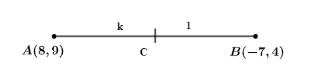
Let us suppose the point on the x-axis is represented by ‘c’.
So, coordinates of c can be given with the help of equation (i) as
\[c\ =\ \left( \dfrac{-7k+8}{k+1},\dfrac{4k+9}{k+1} \right)\]
As, the point c is lying on the x-axis, so y-coordinate of this point should be 0 because y-coordinate of any point at x-axis is 0.
So, put the y-coordinate of point c to 0, to get the value of k.
So, we get
\[\dfrac{4k+9}{k+1}\ =\ 0\]
Or \[4k+9\ =\ 0\]
\[k\ =\ -\dfrac{9}{4}\]
Hence, line joining by the point given points will be divided by x-axis in ratio of \[9:4\] externally as the value of k is negative.
(c). The y-axis
So, we can use the previous coordinate of ‘c’. and put the x-coordinate of point c to 0, as x-coordinate on y-axis will be 0.
Hence, we get
\[\dfrac{-7k+8}{k+1}\ =\ 0\]
\[-7k+8\ =\ 0\]
\[7k\ =\ 8\]
\[k\ =\ \dfrac{8}{7}\]
So, the y-axis will divide the line joining the given points in ratio of \[8:7\].
Note: please take care with the positions of $\left( {{x}_{1}},{{y}_{1}} \right)$, $\left( {{x}_{2}},{{y}_{2}} \right)$ and m and n in the sectional formula. One may go wrong if he/she applies this formula as \[\left( \dfrac{m{{x}_{2}}+n{{x}_{1}}}{m+n},\dfrac{m{{y}_{2}}+n{{y}_{1}}}{m+n} \right)\] using the concept that x-coordinate of any point on y-axis is 0 and y-coordinate of any point on x-axis is 0 are the key points with the second and third party of the question.
Negative value of k suggests that the point dividing it in \[k:1\] will not lie in between the line segments, it will divide the line externally, not internally.
Complete step-by-step answer:
We know the point which divides the line joining the points $\left( {{x}_{1}},{{y}_{1}} \right)$ and $\left( {{x}_{2}},{{y}_{2}} \right)$ in ratio of \[m:n\], is given by sectional formula as:-
\[\text{R}\ =\ \left( \dfrac{m{{x}_{2}}+n{{x}_{1}}}{m+n},\dfrac{m{{y}_{2}}+n{{y}_{1}}}{m+n} \right)\] …………………………………………(i)
Now, coming to the question, we need to find the ratio by which line joining $\text{A}\left( 8,9 \right)$ and $\text{B}\left( -7,4 \right)$ would be divided by the given points in the axis.
(a). The point $\left( 2,7 \right)$
Let us suppose $\left( 2,7 \right)$ divides the line joining $\left( 8,9 \right)$and $\left( -7,4 \right)$ in ratio of \[k:1\].
Now, we can get coordinates of c with the help of equation (i), where
\[m=k\], \[n=1\] and \[\left( {{x}_{1}},{{y}_{1}} \right)\ =\ \left( 8,9 \right)\], \[\left( {{x}_{2}},{{y}_{2}} \right)\ =\ \left( -7,4 \right)\]
So, we get coordinated of c as
\[c\ =\ \left( \dfrac{-7k+8}{k+1},\dfrac{4k+9}{k+1} \right)\]
Now, it is given that coordinates of point c is $\left( 2,7 \right)$, So, we get,
\[\dfrac{-7k+8}{k+1}\ =\ 2\] and \[\dfrac{4k+9}{k+1}\ =\ 7\]
\[-7k+8\ =\ 2k+2\] and \[4k+9\ =\ 7k+7\]
\[9k\ =\ 6\] and \[3k\ =\ 2\]
\[k\ =\ \dfrac{6}{9}\ =\ \dfrac{2}{3}\] and \[k\ =\ \dfrac{2}{3}\]
Hence, ratio \[k:1\]is given as \[2:3\].
So, point $\left( 2,7 \right)$ will divide the line joining the given points in ratio of \[2:3\].
(b). The x- axis
Let us suppose that any coordinate on the x-axis will divide the line joining the given points in ratio \[k:1\].
Let us suppose the point on the x-axis is represented by ‘c’.
So, coordinates of c can be given with the help of equation (i) as
\[c\ =\ \left( \dfrac{-7k+8}{k+1},\dfrac{4k+9}{k+1} \right)\]
As, the point c is lying on the x-axis, so y-coordinate of this point should be 0 because y-coordinate of any point at x-axis is 0.
So, put the y-coordinate of point c to 0, to get the value of k.
So, we get
\[\dfrac{4k+9}{k+1}\ =\ 0\]
Or \[4k+9\ =\ 0\]
\[k\ =\ -\dfrac{9}{4}\]
Hence, line joining by the point given points will be divided by x-axis in ratio of \[9:4\] externally as the value of k is negative.
(c). The y-axis
So, we can use the previous coordinate of ‘c’. and put the x-coordinate of point c to 0, as x-coordinate on y-axis will be 0.
Hence, we get
\[\dfrac{-7k+8}{k+1}\ =\ 0\]
\[-7k+8\ =\ 0\]
\[7k\ =\ 8\]
\[k\ =\ \dfrac{8}{7}\]
So, the y-axis will divide the line joining the given points in ratio of \[8:7\].
Note: please take care with the positions of $\left( {{x}_{1}},{{y}_{1}} \right)$, $\left( {{x}_{2}},{{y}_{2}} \right)$ and m and n in the sectional formula. One may go wrong if he/she applies this formula as \[\left( \dfrac{m{{x}_{2}}+n{{x}_{1}}}{m+n},\dfrac{m{{y}_{2}}+n{{y}_{1}}}{m+n} \right)\] using the concept that x-coordinate of any point on y-axis is 0 and y-coordinate of any point on x-axis is 0 are the key points with the second and third party of the question.
Negative value of k suggests that the point dividing it in \[k:1\] will not lie in between the line segments, it will divide the line externally, not internally.
Recently Updated Pages
Master Class 11 Social Science: Engaging Questions & Answers for Success

Master Class 11 Chemistry: Engaging Questions & Answers for Success
Master Class 12 Business Studies: Engaging Questions & Answers for Success
Master Class 12 Chemistry: Engaging Questions & Answers for Success
Master Class 12 Biology: Engaging Questions & Answers for Success
Class 12 Question and Answer - Your Ultimate Solutions Guide
Trending doubts
One Metric ton is equal to kg A 10000 B 1000 C 100 class 11 physics CBSE
Difference Between Prokaryotic Cells and Eukaryotic Cells
How many of the following diseases can be studied with class 11 biology CBSE
Two of the body parts which do not appear in MRI are class 11 biology CBSE
Which of the following enzymes is used for carboxylation class 11 biology CBSE
Explain zero factorial class 11 maths CBSE