




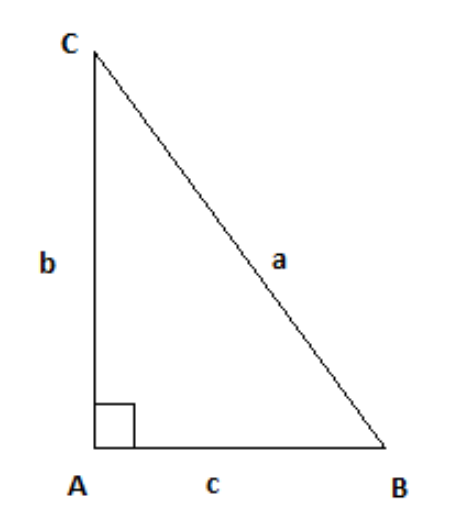
In $\vartriangle ABC$,$\angle A = 90^\circ $, find${\tan ^{ - 1}}\dfrac{b}{{a + c}} + {\tan ^{ - 1}}\dfrac{c}{{a + b}}$
Answer
 Verified
661.8k+ views
Hint: Consider a, b, c as lengths of the sides of $\vartriangle ABC$such that a is the length of the side opposite to$\angle A = 90^\circ $. Let$x = \dfrac{b}{{a + c}}$and$y = \dfrac{c}{{a + b}}$ . Then substitute for x and y in the inverse trigonometric formula${\tan ^{ - 1}}x + {\tan ^{ - 1}}y = {\tan ^{ - 1}}(\dfrac{{x + y}}{{1 - xy}})$. Simplify the expression using the Pythagoras’ theorem such that we get ${\tan ^{ - 1}}\dfrac{b}{{a + c}} + {\tan ^{ - 1}}\dfrac{c}{{a + b}} = {\tan ^{ - 1}}(1)$which gives us the required answer.
Complete step by step answer:
Consider$\vartriangle ABC$, where$\angle A = 90^\circ $. Therefore, $B + C = {90^ \circ }$
Let,
a = length of side BC
b = length of side AC
c = length of side AB
Since$\angle A = 90^\circ $, we can use the Pythagoras’ theorem.
According to the Pythagoras’ theorem, the square of the length of the hypotenuse is equal to the sum of the squares of the lengths of the other two sides of the right angled triangle where hypotenuse is the side opposite to the right angle.
Therefore, we have${a^2} = {b^2} + {c^2}..........(1)$
We will use the inverse trigonometric formula${\tan ^{ - 1}}x + {\tan ^{ - 1}}y = {\tan ^{ - 1}}(\dfrac{{x + y}}{{1 - xy}})$to compute the value of${\tan ^{ - 1}}\dfrac{b}{{a + c}} + {\tan ^{ - 1}}\dfrac{c}{{a + b}}$.
Let$x = \dfrac{b}{{a + c}}$and$y = \dfrac{c}{{a + b}}$.
Then after substituting the values of$x$and$y$, we get
$
{\tan ^{ - 1}}\dfrac{b}{{a + c}} + {\tan ^{ - 1}}\dfrac{c}{{a + b}} \\
= {\tan ^{ - 1}}(\dfrac{{\dfrac{b}{{a + c}} + \dfrac{c}{{a + b}}}}{{1 - (\dfrac{b}{{a + c}})(\dfrac{c}{{a + b}})}}) \\
= {\tan ^{ - 1}}(\dfrac{{\dfrac{b}{{a + c}} + \dfrac{c}{{a + b}}}}{{1 - (\dfrac{b}{{a + c}})(\dfrac{c}{{a + b}})}}) \\
= {\tan ^{ - 1}}(\dfrac{{\dfrac{{b(a + b) + c(a + c)}}{{(a + c)(a + b)}}}}{{1 - (\dfrac{{bc}}{{(a + c)(a + b)}})}}) \\
= {\tan ^{ - 1}}(\dfrac{{\dfrac{{b(a + b) + c(a + c)}}{{(a + c)(a + b)}}}}{{(\dfrac{{(a + c)(a + b) - bc}}{{(a + c)(a + b)}})}}) \\
$
We have fractions in the numerator and the denominator. Moreover, these fractions have the same denominator.
Therefore, we can cancel these common denominators out in order to simplify our expression further.
Now, we are left with
$
{\tan ^{ - 1}}\dfrac{b}{{a + c}} + {\tan ^{ - 1}}\dfrac{c}{{a + b}} \\
= {\tan ^{ - 1}}(\dfrac{{b(a + b) + c(a + c)}}{{(a + c)(a + b) - bc}}) \\
$
We can now apply the identity$(x + a)(x + b) = {x^2} + (a + b)x + ab$in the denominator.
$
{\tan ^{ - 1}}\dfrac{b}{{a + c}} + {\tan ^{ - 1}}\dfrac{c}{{a + b}} \\
= {\tan ^{ - 1}}(\dfrac{{ba + {b^2} + ca + {c^2})}}{{{a^2} + (c + b)a + cb - bc}}) \\
= {\tan ^{ - 1}}(\dfrac{{ba + {b^2} + ca + {c^2})}}{{{a^2} + ca + ba + cb - bc}}) \\
= {\tan ^{ - 1}}(\dfrac{{ba + {b^2} + ca + {c^2})}}{{{a^2} + ca + ba}}) \\
$
We can use equation$(1)$in the numerator of the above expression. It can be seen that the numerator becomes equal to the denominator after the substitution.
$
{\tan ^{ - 1}}\dfrac{b}{{a + c}} + {\tan ^{ - 1}}\dfrac{c}{{a + b}} \\
= {\tan ^{ - 1}}(\dfrac{{ba + {a^2} + ca)}}{{{a^2} + ca + ba}}) \\
$
a, b, and c are the lengths of the sides of triangle ABC and hence each of them is a positive real number. Therefore, the denominator contains a non-zero real number.
This implies that we can divide the numerator by the denominator to obtain 1 as follows:
$
{\tan ^{ - 1}}\dfrac{b}{{a + c}} + {\tan ^{ - 1}}\dfrac{c}{{a + b}} \\
= {\tan ^{ - 1}}(1) \\
$
Since${\tan ^{ - 1}}(1) = \dfrac{\pi }{4}$, we get${\tan ^{ - 1}}\dfrac{b}{{a + c}} + {\tan ^{ - 1}}\dfrac{c}{{a + b}} = \dfrac{\pi }{4}$
Hence the required answer is$\dfrac{\pi }{4}$.
Note: We can use the formula ${\tan ^{ - 1}}x + {\tan ^{ - 1}}y = {\tan ^{ - 1}}(\dfrac{{x + y}}{{1 - xy}})$to solve such a problem only if xy < 1.
This condition holds true for the above problem because a, b, and c are lengths of sides and the sum of the lengths of two sides is always greater than the third side. Therefore, $x = \dfrac{b}{{a + c}}$and$y = \dfrac{c}{{a + b}}$both have numerator < denominator. Thus, we can see x, y < 1 and so is their product.
Complete step by step answer:
Consider$\vartriangle ABC$, where$\angle A = 90^\circ $. Therefore, $B + C = {90^ \circ }$
Let,
a = length of side BC
b = length of side AC
c = length of side AB
Since$\angle A = 90^\circ $, we can use the Pythagoras’ theorem.
According to the Pythagoras’ theorem, the square of the length of the hypotenuse is equal to the sum of the squares of the lengths of the other two sides of the right angled triangle where hypotenuse is the side opposite to the right angle.
Therefore, we have${a^2} = {b^2} + {c^2}..........(1)$
We will use the inverse trigonometric formula${\tan ^{ - 1}}x + {\tan ^{ - 1}}y = {\tan ^{ - 1}}(\dfrac{{x + y}}{{1 - xy}})$to compute the value of${\tan ^{ - 1}}\dfrac{b}{{a + c}} + {\tan ^{ - 1}}\dfrac{c}{{a + b}}$.
Let$x = \dfrac{b}{{a + c}}$and$y = \dfrac{c}{{a + b}}$.
Then after substituting the values of$x$and$y$, we get
$
{\tan ^{ - 1}}\dfrac{b}{{a + c}} + {\tan ^{ - 1}}\dfrac{c}{{a + b}} \\
= {\tan ^{ - 1}}(\dfrac{{\dfrac{b}{{a + c}} + \dfrac{c}{{a + b}}}}{{1 - (\dfrac{b}{{a + c}})(\dfrac{c}{{a + b}})}}) \\
= {\tan ^{ - 1}}(\dfrac{{\dfrac{b}{{a + c}} + \dfrac{c}{{a + b}}}}{{1 - (\dfrac{b}{{a + c}})(\dfrac{c}{{a + b}})}}) \\
= {\tan ^{ - 1}}(\dfrac{{\dfrac{{b(a + b) + c(a + c)}}{{(a + c)(a + b)}}}}{{1 - (\dfrac{{bc}}{{(a + c)(a + b)}})}}) \\
= {\tan ^{ - 1}}(\dfrac{{\dfrac{{b(a + b) + c(a + c)}}{{(a + c)(a + b)}}}}{{(\dfrac{{(a + c)(a + b) - bc}}{{(a + c)(a + b)}})}}) \\
$
We have fractions in the numerator and the denominator. Moreover, these fractions have the same denominator.
Therefore, we can cancel these common denominators out in order to simplify our expression further.
Now, we are left with
$
{\tan ^{ - 1}}\dfrac{b}{{a + c}} + {\tan ^{ - 1}}\dfrac{c}{{a + b}} \\
= {\tan ^{ - 1}}(\dfrac{{b(a + b) + c(a + c)}}{{(a + c)(a + b) - bc}}) \\
$
We can now apply the identity$(x + a)(x + b) = {x^2} + (a + b)x + ab$in the denominator.
$
{\tan ^{ - 1}}\dfrac{b}{{a + c}} + {\tan ^{ - 1}}\dfrac{c}{{a + b}} \\
= {\tan ^{ - 1}}(\dfrac{{ba + {b^2} + ca + {c^2})}}{{{a^2} + (c + b)a + cb - bc}}) \\
= {\tan ^{ - 1}}(\dfrac{{ba + {b^2} + ca + {c^2})}}{{{a^2} + ca + ba + cb - bc}}) \\
= {\tan ^{ - 1}}(\dfrac{{ba + {b^2} + ca + {c^2})}}{{{a^2} + ca + ba}}) \\
$
We can use equation$(1)$in the numerator of the above expression. It can be seen that the numerator becomes equal to the denominator after the substitution.
$
{\tan ^{ - 1}}\dfrac{b}{{a + c}} + {\tan ^{ - 1}}\dfrac{c}{{a + b}} \\
= {\tan ^{ - 1}}(\dfrac{{ba + {a^2} + ca)}}{{{a^2} + ca + ba}}) \\
$
a, b, and c are the lengths of the sides of triangle ABC and hence each of them is a positive real number. Therefore, the denominator contains a non-zero real number.
This implies that we can divide the numerator by the denominator to obtain 1 as follows:
$
{\tan ^{ - 1}}\dfrac{b}{{a + c}} + {\tan ^{ - 1}}\dfrac{c}{{a + b}} \\
= {\tan ^{ - 1}}(1) \\
$
Since${\tan ^{ - 1}}(1) = \dfrac{\pi }{4}$, we get${\tan ^{ - 1}}\dfrac{b}{{a + c}} + {\tan ^{ - 1}}\dfrac{c}{{a + b}} = \dfrac{\pi }{4}$
Hence the required answer is$\dfrac{\pi }{4}$.
Note: We can use the formula ${\tan ^{ - 1}}x + {\tan ^{ - 1}}y = {\tan ^{ - 1}}(\dfrac{{x + y}}{{1 - xy}})$to solve such a problem only if xy < 1.
This condition holds true for the above problem because a, b, and c are lengths of sides and the sum of the lengths of two sides is always greater than the third side. Therefore, $x = \dfrac{b}{{a + c}}$and$y = \dfrac{c}{{a + b}}$both have numerator < denominator. Thus, we can see x, y < 1 and so is their product.
Recently Updated Pages
If x a + bt + ct2 where x is in meters and t is in class 11 physics CBSE

A car covers the first half distance between two places class 11 physics CBSE
The resultant of two vectors overrightarrow P and overrightarrow class 11 physics CBSE
Find the value of cos 135 class 11 maths CBSE
A mass M is held in place by an applied force F and class 11 physics CBSE
A solution of glucose in water is labelled as 10 dfracwv class 11 chemistry CBSE
Trending doubts
Find the value of the expression given below sin 30circ class 11 maths CBSE
What is the maximum height of a projectile class 11 physics CBSE
Derive an expression for maximum height and range of class 11 physics CBSE
Describe various types of epithelial tissues with the class 11 biology CBSE
Lysosomes are known as suicidal bags of cell why class 11 biology CBSE
State and derive law of conservation of momentum class 11 physics CBSE