




In $\vartriangle ABC$, M is the mid point of side QR. If PQ is $11cm$, PR is $17cm$ and QR is $12cm$, find PM.
Answer
 Verified
595.5k+ views
Hint: For a better understanding always draw a figure first. This question can be easily solved by applying Apollonius theorem, $P{Q^2} + P{R^2} = 2P{M^2} + 2Q{M^2}$, and substituting the values.
Complete step-by-step answer:
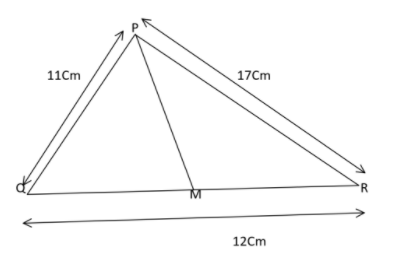
Given that M is the mid point of the side QR, i.e., PM is the median of the triangle.
Applying Apollonius theorem, which states that the sum of the squares of any two sides of a triangle equals twice the square on half the third side, together with twice the square on the median bisecting the third side. Hence, here it can be applied as:
$P{Q^2} + P{R^2} = 2P{M^2} + 2Q{M^2}$ (1)
Given that:
$
PQ = 11cm \\
PR = 17cm \\
QR = 12cm \\
QM + MR = QR \\
QM = MR \\
$
(PM is the median)
$
QM + QM = QR \\
QM = \dfrac{{QR}}{2} \\
QM = \dfrac{{12}}{2} = 6cm \\
$
Substituting the values of PQ, PR, QM in equation (1)
$
{11^2} + {17^2} = 2P{M^2} + 2{\left( 6 \right)^2} \\
121 + 289 = 2P{M^2} + 72 \\
410 = 2P{M^2} + 72 \\
2P{M^2} = 338 \\
P{M^2} = 169 \\
PM = 13cm \\
$
Note: The first approach to this type of problem is to always draw the figure first for a better and clear understanding. Then write down the things given and remember all the theorems you could apply to obtain the desired result.
Complete step-by-step answer:
Given that M is the mid point of the side QR, i.e., PM is the median of the triangle.
Applying Apollonius theorem, which states that the sum of the squares of any two sides of a triangle equals twice the square on half the third side, together with twice the square on the median bisecting the third side. Hence, here it can be applied as:
$P{Q^2} + P{R^2} = 2P{M^2} + 2Q{M^2}$ (1)
Given that:
$
PQ = 11cm \\
PR = 17cm \\
QR = 12cm \\
QM + MR = QR \\
QM = MR \\
$
(PM is the median)
$
QM + QM = QR \\
QM = \dfrac{{QR}}{2} \\
QM = \dfrac{{12}}{2} = 6cm \\
$
Substituting the values of PQ, PR, QM in equation (1)
$
{11^2} + {17^2} = 2P{M^2} + 2{\left( 6 \right)^2} \\
121 + 289 = 2P{M^2} + 72 \\
410 = 2P{M^2} + 72 \\
2P{M^2} = 338 \\
P{M^2} = 169 \\
PM = 13cm \\
$
Note: The first approach to this type of problem is to always draw the figure first for a better and clear understanding. Then write down the things given and remember all the theorems you could apply to obtain the desired result.
Recently Updated Pages
Master Class 11 Computer Science: Engaging Questions & Answers for Success

Master Class 11 Business Studies: Engaging Questions & Answers for Success
Master Class 11 Economics: Engaging Questions & Answers for Success
Master Class 11 English: Engaging Questions & Answers for Success
Master Class 11 Maths: Engaging Questions & Answers for Success
Master Class 11 Biology: Engaging Questions & Answers for Success
Trending doubts
One Metric ton is equal to kg A 10000 B 1000 C 100 class 11 physics CBSE
There are 720 permutations of the digits 1 2 3 4 5 class 11 maths CBSE
Discuss the various forms of bacteria class 11 biology CBSE
Draw a diagram of a plant cell and label at least eight class 11 biology CBSE
State the laws of reflection of light
Explain zero factorial class 11 maths CBSE