



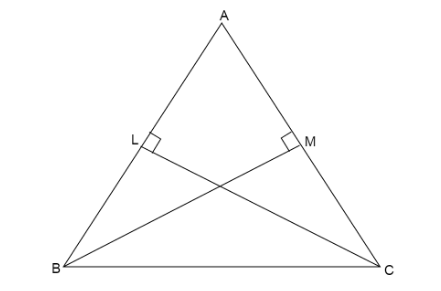
In \[\vartriangle ABC\], if \[BM = CL\], then \[\vartriangle ABC\] is
A. Equilateral
B. Isosceles
C. Scalene
D. Right angled
Answer
 Verified
585.3k+ views
Hint: Here we use the concept of altitudes drawn from one vertex to the side of a triangle. We use the formula of area of a triangle and write the two equations for area using two altitudes. Equate the area in the end. Using the definitions of kinds of triangles stated in the options we find the correct option.
* Equilateral triangle has all the sides equal in length and all angles of equal measure i.e. \[{60^ \circ }\].
* Isosceles triangle has two sides equal and the angles opposite to equal sides are equal.
* Scalene triangle has all three sides of unequal lengths.
* Right angled triangle is a triangle which has one angle as right angle i.e. \[{90^ \circ }\]
* Area of a triangle is given by the formula \[\dfrac{1}{2} \times \]Base\[ \times \] altitude.
Complete step-by-step answer:
We are given a triangle ABC,
Altitude from vertex B is BM
Then we can find the area of triangle ABC using the altitude BM and base AC.
\[ \Rightarrow \]Area\[ = \dfrac{1}{2} \times BM \times AC\] … (1)
Altitude from vertex C is CL
Then we can find the area of triangle ABC using the altitude CL and base AB.
\[ \Rightarrow \]Area\[ = \dfrac{1}{2} \times CL \times AB\] … (2)
Since the triangle in both the equations is the same i.e. \[\vartriangle ABC\]. So the area has to be equal.
Equate the area obtained from equations (1) and (2)
\[ \Rightarrow \dfrac{1}{2} \times BM \times AC = \dfrac{1}{2} \times CL \times AB\]
Cancel the same factor from both sides of the equation.
\[ \Rightarrow BM \times AC = CL \times AB\]
Since, we know\[BM = CL\], substitute the value of \[BM = CL\]in LHS of the equation
\[ \Rightarrow CL \times AC = CL \times AB\]
Cancel the same factor from both sides of the equation.
\[ \Rightarrow AC = AB\]
So, we have two sides of the triangle equal to each other.
From the definitions we can say that triangle ABC is an isosceles triangle.
So, option B is correct
Note: Students might try to prove this triangle by using Pythagoras theorem in each of the right triangles formed in the triangle ABC. But this will not yield any solution as we are not given anything about the sides of the triangle and we don’t know what kind of triangle it is so we cannot say if altitude bisects the sides or not.
* Equilateral triangle has all the sides equal in length and all angles of equal measure i.e. \[{60^ \circ }\].
* Isosceles triangle has two sides equal and the angles opposite to equal sides are equal.
* Scalene triangle has all three sides of unequal lengths.
* Right angled triangle is a triangle which has one angle as right angle i.e. \[{90^ \circ }\]
* Area of a triangle is given by the formula \[\dfrac{1}{2} \times \]Base\[ \times \] altitude.
Complete step-by-step answer:
We are given a triangle ABC,
Altitude from vertex B is BM
Then we can find the area of triangle ABC using the altitude BM and base AC.
\[ \Rightarrow \]Area\[ = \dfrac{1}{2} \times BM \times AC\] … (1)
Altitude from vertex C is CL
Then we can find the area of triangle ABC using the altitude CL and base AB.
\[ \Rightarrow \]Area\[ = \dfrac{1}{2} \times CL \times AB\] … (2)
Since the triangle in both the equations is the same i.e. \[\vartriangle ABC\]. So the area has to be equal.
Equate the area obtained from equations (1) and (2)
\[ \Rightarrow \dfrac{1}{2} \times BM \times AC = \dfrac{1}{2} \times CL \times AB\]
Cancel the same factor from both sides of the equation.
\[ \Rightarrow BM \times AC = CL \times AB\]
Since, we know\[BM = CL\], substitute the value of \[BM = CL\]in LHS of the equation
\[ \Rightarrow CL \times AC = CL \times AB\]
Cancel the same factor from both sides of the equation.
\[ \Rightarrow AC = AB\]
So, we have two sides of the triangle equal to each other.
From the definitions we can say that triangle ABC is an isosceles triangle.
So, option B is correct
Note: Students might try to prove this triangle by using Pythagoras theorem in each of the right triangles formed in the triangle ABC. But this will not yield any solution as we are not given anything about the sides of the triangle and we don’t know what kind of triangle it is so we cannot say if altitude bisects the sides or not.
Recently Updated Pages
Master Class 11 English: Engaging Questions & Answers for Success

Master Class 11 Maths: Engaging Questions & Answers for Success
Master Class 11 Biology: Engaging Questions & Answers for Success
Master Class 11 Social Science: Engaging Questions & Answers for Success
Master Class 11 Physics: Engaging Questions & Answers for Success
Master Class 11 Accountancy: Engaging Questions & Answers for Success
Trending doubts
Difference Between Plant Cell and Animal Cell
Fill the blanks with the suitable prepositions 1 The class 9 english CBSE
Which places in India experience sunrise first and class 9 social science CBSE
Who is eligible for RTE class 9 social science CBSE
What is pollution? How many types of pollution? Define it
Name 10 Living and Non living things class 9 biology CBSE