



In $\vartriangle ABC$, $\angle A = {90^0}$, AB= 5 cm and AC = 12 cm. If $AD \bot BC$, then AD=
(1) $\dfrac{{60}}{{13}}$cm
(2) $\dfrac{{11}}{2}$cm
(3) $\dfrac{{13}}{{60}}$cm
(4) $\dfrac{{2\sqrt {15} }}{{13}}$cm
Answer
 Verified
617.1k+ views
Hint: Here we will use the law of similarity for two triangles. This law will establish the ratio of corresponding sides. This helps to find the length of AD. Also make use of the pythagoras theorem to find the lengths of the sides.
Complete step-by-step answer:
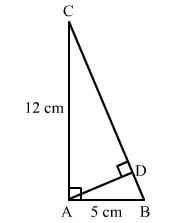
In the above diagram first we will compute the length of BC by using Pythagoras theorem.
AB= 5 cm and AC = 12 cm
BC = ?
According to the Pythagoras theorem for right angled triangle ABC, we have,
\[
B{C^2} = A{B^2} + A{C^2} \\
\Rightarrow B{C^2} = {5^2} + {12^2} \\
\Rightarrow BC = \sqrt {169} \\
\Rightarrow BC = 13cm \\
\]
Now in $\vartriangle ABC and \vartriangle ADC$
$\angle C$ is a common angle.
And $\angle A = \angle D = {90^0}$ (AD is perpendicular to BC)
Therefore, $\vartriangle ABC \sim \vartriangle ADC$ means both triangles are similar by AA similarity criterion.
Therefore, the property of similar triangles ratio of the corresponding sides of the two triangles will be equal. Thus in other words, we can write,
$
\dfrac{{AD}}{{AB}} = \dfrac{{AC}}{{BC}} \\
\Rightarrow AD = \dfrac{{AB \times AC}}{{BC}} \\
\Rightarrow AD = \dfrac{{12 \times 5}}{{13}} \\
\Rightarrow AD = \dfrac{{60}}{{13}} \\
$(Transforming by algebra rules and putting the known values.)
Thus the length of AD will be $\dfrac{{60}}{{13}}$cm.
Therefore, the correct answer is option (1).
Note: This question is a simple application of the law of similarity in the triangles. Furthermore many problems of geometry can be solved by using these laws. Not only can this one find the missing angles of any triangle. One interesting fact about the similar triangles that their areas are also in the ratio of their altitudes also.
Complete step-by-step answer:
In the above diagram first we will compute the length of BC by using Pythagoras theorem.
AB= 5 cm and AC = 12 cm
BC = ?
According to the Pythagoras theorem for right angled triangle ABC, we have,
\[
B{C^2} = A{B^2} + A{C^2} \\
\Rightarrow B{C^2} = {5^2} + {12^2} \\
\Rightarrow BC = \sqrt {169} \\
\Rightarrow BC = 13cm \\
\]
Now in $\vartriangle ABC and \vartriangle ADC$
$\angle C$ is a common angle.
And $\angle A = \angle D = {90^0}$ (AD is perpendicular to BC)
Therefore, $\vartriangle ABC \sim \vartriangle ADC$ means both triangles are similar by AA similarity criterion.
Therefore, the property of similar triangles ratio of the corresponding sides of the two triangles will be equal. Thus in other words, we can write,
$
\dfrac{{AD}}{{AB}} = \dfrac{{AC}}{{BC}} \\
\Rightarrow AD = \dfrac{{AB \times AC}}{{BC}} \\
\Rightarrow AD = \dfrac{{12 \times 5}}{{13}} \\
\Rightarrow AD = \dfrac{{60}}{{13}} \\
$(Transforming by algebra rules and putting the known values.)
Thus the length of AD will be $\dfrac{{60}}{{13}}$cm.
Therefore, the correct answer is option (1).
Note: This question is a simple application of the law of similarity in the triangles. Furthermore many problems of geometry can be solved by using these laws. Not only can this one find the missing angles of any triangle. One interesting fact about the similar triangles that their areas are also in the ratio of their altitudes also.
Recently Updated Pages
Master Class 12 Business Studies: Engaging Questions & Answers for Success

Master Class 12 Biology: Engaging Questions & Answers for Success
Master Class 12 Chemistry: Engaging Questions & Answers for Success
Class 12 Question and Answer - Your Ultimate Solutions Guide
Master Class 11 Social Science: Engaging Questions & Answers for Success
Master Class 11 English: Engaging Questions & Answers for Success
Trending doubts
Find the sum of series 1 + 2 + 3 + 4 + 5 + + 100 class 9 maths CBSE
Fill the blanks with the suitable prepositions 1 The class 9 english CBSE
Difference Between Plant Cell and Animal Cell
How many hours before the closure of election must class 9 social science CBSE
What is pollution? How many types of pollution? Define it
Name 10 Living and Non living things class 9 biology CBSE