




In uniform circular motion, the centripetal acceleration is:
A. Towards the center of the circular path and perpendicular to the instantaneous velocity.
B. A constant acceleration.
C. Away from the center of the circular path and perpendicular to the instantaneous velocity.
D. A variable acceleration making 45 degrees with instantaneous velocity.
E. A variable acceleration parallel to instantaneous velocity.
Answer
 Verified
642k+ views
Hint: In order to get the right options you need to draw the diagram and analyze the direction of centripetal acceleration and the angle it is making with instantaneous velocity. As the circular motion is uniform it is an important information to get the correct options.
Complete step-by-step answer:
The diagram to solve this problem of centripetal acceleration in uniform circular motion can be drawn as:
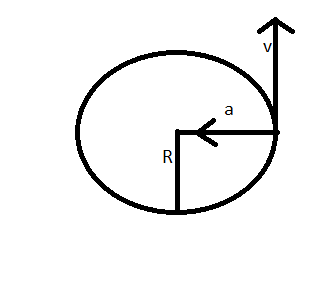
R is the radius of the circle. v is the instantaneous velocity. a is the centripetal acceleration.
In this problem we will discuss each and every option to get a clear view of UCM uniform circular motion.
In option A it is said that the direct of a is toward the center and is perpendicular to v always.
So, yes it is true. Since centripetal acceleration generates a force due to which circular motion happens and its direction is always towards the center of the circle and it is perpendicular to velocity because the direction of velocity is tangential to the circle, so it will always perpendicular to the instantaneous velocity.
Option B says here it is constant.
So, the answer is yes it is constant because it is uniform circular motion and in UCM speed is constant and if the speed is constant in circular motion the centripetal acceleration is constant because centripetal acceleration is ${\text{a = }}\dfrac{{{\text{m}}{{\text{v}}^{\text{2}}}}}{{\text{r}}}$. In this term if speed is constant then every term is a constant itself so the centripetal acceleration is constant as whole.
Option C is a contradiction of option A so it is not true.
Option D is any other angle told in option B so it is also not true.
Option E is also not true since it is against the definition of UCM.
So, the correct options are A and B.
Note – When you need to solve such problems always draw the diagram and recall the concept of UCM. As in UCM centripetal acceleration is constant while translational acceleration is variable since the direction is changing. While in non UCM both the accelerations are variable.
Complete step-by-step answer:
The diagram to solve this problem of centripetal acceleration in uniform circular motion can be drawn as:
R is the radius of the circle. v is the instantaneous velocity. a is the centripetal acceleration.
In this problem we will discuss each and every option to get a clear view of UCM uniform circular motion.
In option A it is said that the direct of a is toward the center and is perpendicular to v always.
So, yes it is true. Since centripetal acceleration generates a force due to which circular motion happens and its direction is always towards the center of the circle and it is perpendicular to velocity because the direction of velocity is tangential to the circle, so it will always perpendicular to the instantaneous velocity.
Option B says here it is constant.
So, the answer is yes it is constant because it is uniform circular motion and in UCM speed is constant and if the speed is constant in circular motion the centripetal acceleration is constant because centripetal acceleration is ${\text{a = }}\dfrac{{{\text{m}}{{\text{v}}^{\text{2}}}}}{{\text{r}}}$. In this term if speed is constant then every term is a constant itself so the centripetal acceleration is constant as whole.
Option C is a contradiction of option A so it is not true.
Option D is any other angle told in option B so it is also not true.
Option E is also not true since it is against the definition of UCM.
So, the correct options are A and B.
Note – When you need to solve such problems always draw the diagram and recall the concept of UCM. As in UCM centripetal acceleration is constant while translational acceleration is variable since the direction is changing. While in non UCM both the accelerations are variable.
Recently Updated Pages
Master Class 11 English: Engaging Questions & Answers for Success

Master Class 11 Social Science: Engaging Questions & Answers for Success
Master Class 11 Maths: Engaging Questions & Answers for Success
Master Class 11 Biology: Engaging Questions & Answers for Success
Master Class 11 Physics: Engaging Questions & Answers for Success
Master Class 11 Chemistry: Engaging Questions & Answers for Success
Trending doubts
One Metric ton is equal to kg A 10000 B 1000 C 100 class 11 physics CBSE
Difference Between Prokaryotic Cells and Eukaryotic Cells
Find the value of the expression given below sin 30circ class 11 maths CBSE
Difference between physical and chemical change class 11 chemistry CBSE
Two of the body parts which do not appear in MRI are class 11 biology CBSE
Draw a diagram of a plant cell and label at least eight class 11 biology CBSE