



In $\triangle\mathrm{ABC}\;,\;\mathrm{AC}=4\mathrm x,\;\mathrm{BC}=6\mathrm x-6,\;\mathrm{AB}=5\mathrm x-8\;\mathrm{and}\;\angle\mathrm A=\angle\mathrm B.\;$ Find the perimeter of $\triangle\mathrm{ABC}$.
Answer
 Verified
615.9k+ views
Hint: The perimeter of a triangle is equal to the sum of its sides. Also, the knowledge of an isosceles triangle is required to solve this problem. The given triangle is an isosceles triangle as two of its angles are equal. In an isosceles triangle, the sides opposite to equal angles are also equal.
Complete step by step answer:
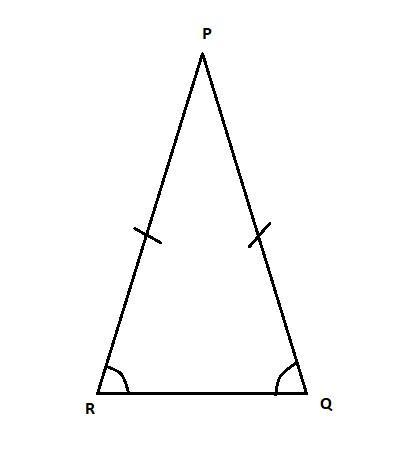
This is an example of isosceles triangle with $\angle\mathrm Q=\angle\mathrm R$ and PR=PQ
We have been given the sides of a triangle ABC which is isosceles. The figure for the triangle is given below-
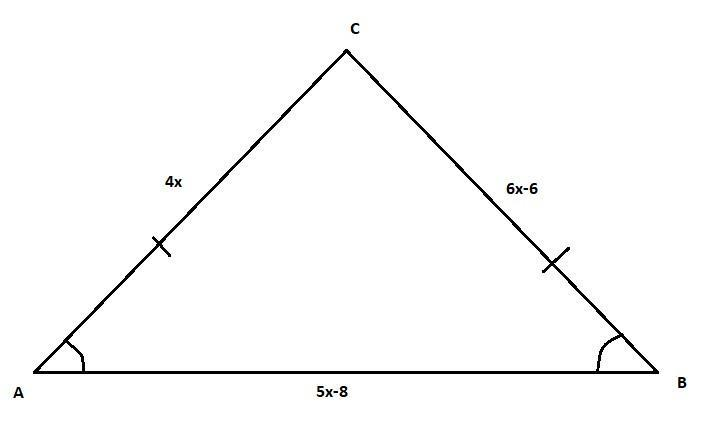
Using the properties of the isosceles triangle, since$\angle\mathrm A=\angle\mathrm B$, the opposite sides AC and BC will be equal. Hence, we can equate the length of the two sides and find the value of x.
AC = BC
4x = 6x - 6
2x = 6
x = 3 units …(1)
With the value of x, the sides of the triangle can be calculated using equation (1) -
AB = 5x - 8 = 15 - 8 = 7 units ….(2)
BC = 6x - 6 = 18 - 6 = 12 units ……(3)
AC = 4x = 12 units …….(4)
The perimeter of a triangle is defined as the sum of its sides. So the perimeter P wil be-
P = AB + BC + AC
Substituting the values using equations (2), (3) and (4)-
P = 7 + 12 + 12
P = 31 units
This is the required answer.
Note: Students often do not write the units if they are not mentioned. So, the units should be written even if they are not mentioned in the question. In geometry questions of such type, a diagram should be drawn with proper labellings to explain the answer.
Complete step by step answer:
This is an example of isosceles triangle with $\angle\mathrm Q=\angle\mathrm R$ and PR=PQ
We have been given the sides of a triangle ABC which is isosceles. The figure for the triangle is given below-
Using the properties of the isosceles triangle, since$\angle\mathrm A=\angle\mathrm B$, the opposite sides AC and BC will be equal. Hence, we can equate the length of the two sides and find the value of x.
AC = BC
4x = 6x - 6
2x = 6
x = 3 units …(1)
With the value of x, the sides of the triangle can be calculated using equation (1) -
AB = 5x - 8 = 15 - 8 = 7 units ….(2)
BC = 6x - 6 = 18 - 6 = 12 units ……(3)
AC = 4x = 12 units …….(4)
The perimeter of a triangle is defined as the sum of its sides. So the perimeter P wil be-
P = AB + BC + AC
Substituting the values using equations (2), (3) and (4)-
P = 7 + 12 + 12
P = 31 units
This is the required answer.
Note: Students often do not write the units if they are not mentioned. So, the units should be written even if they are not mentioned in the question. In geometry questions of such type, a diagram should be drawn with proper labellings to explain the answer.

Recently Updated Pages
Basicity of sulphurous acid and sulphuric acid are

Master Class 11 Business Studies: Engaging Questions & Answers for Success
Master Class 11 Computer Science: Engaging Questions & Answers for Success
Master Class 11 Economics: Engaging Questions & Answers for Success
Master Class 12 English: Engaging Questions & Answers for Success
Master Class 12 Social Science: Engaging Questions & Answers for Success
Trending doubts
Fill the blanks with the suitable prepositions 1 The class 9 english CBSE
Difference Between Plant Cell and Animal Cell
Find the greatest fivedigit number which is a perfect class 9 maths CBSE
Find the mode and median of the data 13 16 12 14 1-class-9-maths-CBSE
What is pollution? How many types of pollution? Define it
Find the sum of series 1 + 2 + 3 + 4 + 5 + + 100 class 9 maths CBSE