




In triangle ABC, AB = AC = 10 cm. $\angle ABC = 50^\circ $.
(a).Find the length of BC
(b).Find the diameter of the circle.
$\left[ {\sin 50^\circ = 0.77,{\text{ }}\cos 50^\circ = 0.64,{\text{ }}\tan 50^\circ = 1.19} \right]$

Answer
 Verified
675k+ views
Hint: As the given triangle is an isosceles triangle, using angle sum property we can determine all the angles in the triangle. Using the trigonometric ratios we can determine the value of BC. And to determine the diameter of the circle, we need to find the circumradius using Area=$\dfrac{{abc}}{{4R}}$, where a, b, c are sides of the triangle. Where Area can be determined using the formula, Area ($\vartriangle ABC$) =$$\dfrac{1}{2} \times $$base$ \times $height.
Complete step by step answer:
Consider the given figure:
Since, AB = AC = 10 cm, $\vartriangle ABC$is an isosceles triangle and hence the base angles are equal.
i.e. $\angle B = \angle C = 50^\circ $… (1)
Angle sum property of triangle states that the sum of interior angles of a triangle is $180^\circ $.
By angle sum property, we have$\angle A + \angle B + \angle C = 180^\circ $
$ \Rightarrow \angle A + 50^\circ + 50^\circ = 180^\circ $ [From (1)]
$ \Rightarrow \angle A + 100^\circ = 180^\circ $
$$ \Rightarrow \angle A = 180^\circ - 100^\circ = 80^\circ $$
The perpendicular from the vertex of an isosceles triangle to the base bisects the base.
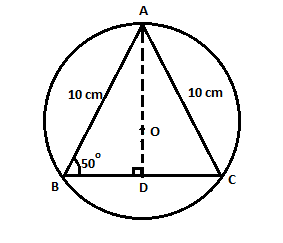
(a).Consider the right triangle$\vartriangle ABD$:
$\cos 50^\circ $=$\dfrac{{BD}}{{AB}} \Rightarrow 0.64 = \dfrac{{BD}}{{10}}$ (Since$\cos \theta = \dfrac{{adj.side}}{{hyp}}$)
$ \Rightarrow BD = 6.4cm$
We have, BC = BD + DC = $2 \times BD$=$2 \times 6.4$=12.8 cm
(b).From the figure, it is clear that OA = OB = OC is the circumradius of$\vartriangle ABC$.
Let A be the area of$\vartriangle ABC$and let R be the circumradius.
Let a, b, c denote the triangle’s three sides and let A denote the area of the triangle. The measure of the circumradius of the triangle is simply R =$\dfrac{{abc}}{{4A}}$. This can be rewritten as A =$\dfrac{{abc}}{{4R}}$
We know that A =$\dfrac{{abc}}{{4R}}$, where a, b, c are the sides of the triangle.
From$\vartriangle ABC$,
$\tan 50^\circ = \dfrac{{AD}}{{BD}} \Rightarrow 1.19 = \dfrac{{AD}}{{6.4}}$
$ \Rightarrow AD = 1.19 \times 6.4 = 7.616{\text{ cm}}$
Area ($\vartriangle ABC$) = $$\dfrac{1}{2} \times $$base$ \times $height
$ \Rightarrow \dfrac{1}{2} \times {\text{BC}} \times {\rm A}{\text{D}}$
$ \Rightarrow \dfrac{1}{2} \times 12.8 \times 7.616 = 48.7424$sq.cm
Since, A =$\dfrac{{abc}}{{4R}}$, we have R =$\dfrac{{abc}}{{4A}}$
$ \Rightarrow \dfrac{{10 \times 10 \times 12.8}}{{4 \times 48.7424}} = 6.57 {\text{cm}}$
Thus, diameter of the circle = 2R = 2$ \times $6.57 = 13.14 cm
Note: Formula for Circumradius can be given by R =$\dfrac{{abc}}{{4rs}}$where R is the circumradius, r is the inradius, and a, b, and c are the respective sides of the triangle and s =$\dfrac{{\left( {a + b + c} \right)}}{2}$is the semi perimeter. To find the area of the triangle by Heron’s formula: A =$\sqrt {s\left( {s - a} \right)\left( {s - b} \right)\left( {s - c} \right)} $
Complete step by step answer:
Consider the given figure:
Since, AB = AC = 10 cm, $\vartriangle ABC$is an isosceles triangle and hence the base angles are equal.
i.e. $\angle B = \angle C = 50^\circ $… (1)
Angle sum property of triangle states that the sum of interior angles of a triangle is $180^\circ $.
By angle sum property, we have$\angle A + \angle B + \angle C = 180^\circ $
$ \Rightarrow \angle A + 50^\circ + 50^\circ = 180^\circ $ [From (1)]
$ \Rightarrow \angle A + 100^\circ = 180^\circ $
$$ \Rightarrow \angle A = 180^\circ - 100^\circ = 80^\circ $$
The perpendicular from the vertex of an isosceles triangle to the base bisects the base.
(a).Consider the right triangle$\vartriangle ABD$:
$\cos 50^\circ $=$\dfrac{{BD}}{{AB}} \Rightarrow 0.64 = \dfrac{{BD}}{{10}}$ (Since$\cos \theta = \dfrac{{adj.side}}{{hyp}}$)
$ \Rightarrow BD = 6.4cm$
We have, BC = BD + DC = $2 \times BD$=$2 \times 6.4$=12.8 cm
(b).From the figure, it is clear that OA = OB = OC is the circumradius of$\vartriangle ABC$.
Let A be the area of$\vartriangle ABC$and let R be the circumradius.
Let a, b, c denote the triangle’s three sides and let A denote the area of the triangle. The measure of the circumradius of the triangle is simply R =$\dfrac{{abc}}{{4A}}$. This can be rewritten as A =$\dfrac{{abc}}{{4R}}$
We know that A =$\dfrac{{abc}}{{4R}}$, where a, b, c are the sides of the triangle.
From$\vartriangle ABC$,
$\tan 50^\circ = \dfrac{{AD}}{{BD}} \Rightarrow 1.19 = \dfrac{{AD}}{{6.4}}$
$ \Rightarrow AD = 1.19 \times 6.4 = 7.616{\text{ cm}}$
Area ($\vartriangle ABC$) = $$\dfrac{1}{2} \times $$base$ \times $height
$ \Rightarrow \dfrac{1}{2} \times {\text{BC}} \times {\rm A}{\text{D}}$
$ \Rightarrow \dfrac{1}{2} \times 12.8 \times 7.616 = 48.7424$sq.cm
Since, A =$\dfrac{{abc}}{{4R}}$, we have R =$\dfrac{{abc}}{{4A}}$
$ \Rightarrow \dfrac{{10 \times 10 \times 12.8}}{{4 \times 48.7424}} = 6.57 {\text{cm}}$
Thus, diameter of the circle = 2R = 2$ \times $6.57 = 13.14 cm
Note: Formula for Circumradius can be given by R =$\dfrac{{abc}}{{4rs}}$where R is the circumradius, r is the inradius, and a, b, and c are the respective sides of the triangle and s =$\dfrac{{\left( {a + b + c} \right)}}{2}$is the semi perimeter. To find the area of the triangle by Heron’s formula: A =$\sqrt {s\left( {s - a} \right)\left( {s - b} \right)\left( {s - c} \right)} $
Recently Updated Pages
Master Class 10 Computer Science: Engaging Questions & Answers for Success

Differentiate between voluntary action and reflex class 10 biology CBSE
The uses of bleaching powder are A It is used bleaching class 10 chemistry CBSE
Fill in the blanks with abstract nouns of the words class 10 english CBSE
How many threedigit numbers are there class 10 maths CBSE
What is a reflex arc class 10 biology CBSE
Trending doubts
Explain the Treaty of Vienna of 1815 class 10 social science CBSE
10 examples of evaporation in daily life with explanations
Which country is known as "The land of Fire and Ice"?
What is the full form of POSCO class 10 social science CBSE
Make a sketch of the human nerve cell What function class 10 biology CBSE
In which year voting age was reduced from 21 to 18?