




In trapezium PQRS, given that $ QR\parallel PS $ and $ 2QR = PS $ . If $ \overrightarrow {PQ} = \overrightarrow a $ , $ \overrightarrow {QR} = \overrightarrow b $ and $ \overrightarrow {RS} = \overrightarrow c $ , express $ \overrightarrow a $ in terms $ \overrightarrow b $ and $ \overrightarrow c $ .
Answer
 Verified
597k+ views
Hint: A quantity that has both magnitude and direction is called a vector quantity. A vector is either written in bold or is represented by an arrow above it. All the sides of the given trapezium represent a vector, from the relation between PS and QR, we can find the $ \overrightarrow {PS} $ .
Complete step-by-step answer:
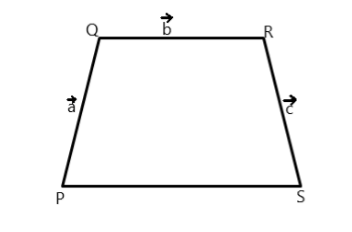
The direction of \[\overrightarrow a \] is from P to Q, $ \overrightarrow b $ is from Q to R, $ \overrightarrow c $ is from R to S and the direction of $ 2\overrightarrow b $ is from P to S. That is when we start from P and take one revolution around PQRS, we see that the vector $ \overrightarrow b $ starts from the head of the $ \overrightarrow a $ , the $ \overrightarrow c $ starts from the head of the $ \overrightarrow b $ but the $ 2\overrightarrow b $ starts from the foot of $ \overrightarrow a $ and ends at the head of the $ \overrightarrow c $ . Thus $ 2\overrightarrow b $ is the only vector that is in the opposite direction while completing the revolution that’s why it is taken as negative while expressing the sum of all vectors in the closed trapezium PQRS.
We are given that $ QR\parallel PS $ and $ 2QR = PS $ , so $ PS = 2\overrightarrow b $
Now, the sum of all the vectors in a closed figure is equal to zero, so –
$
\overrightarrow a + \overrightarrow b + \overrightarrow c + \overrightarrow {( - 2b} ) = 0 \\
\overrightarrow b = \overrightarrow a + \overrightarrow c \\
\Rightarrow \overrightarrow a = \overrightarrow b - \overrightarrow c \;
$
So, the correct answer is “ $ \overrightarrow a = \overrightarrow b - \overrightarrow c \; $ ”.
Note: If a closed polygon is formed by the set of vectors in a given order then the resultant vector is a null vector or zero vector. Using this information, we can find out the correct answer.
Complete step-by-step answer:
The direction of \[\overrightarrow a \] is from P to Q, $ \overrightarrow b $ is from Q to R, $ \overrightarrow c $ is from R to S and the direction of $ 2\overrightarrow b $ is from P to S. That is when we start from P and take one revolution around PQRS, we see that the vector $ \overrightarrow b $ starts from the head of the $ \overrightarrow a $ , the $ \overrightarrow c $ starts from the head of the $ \overrightarrow b $ but the $ 2\overrightarrow b $ starts from the foot of $ \overrightarrow a $ and ends at the head of the $ \overrightarrow c $ . Thus $ 2\overrightarrow b $ is the only vector that is in the opposite direction while completing the revolution that’s why it is taken as negative while expressing the sum of all vectors in the closed trapezium PQRS.
We are given that $ QR\parallel PS $ and $ 2QR = PS $ , so $ PS = 2\overrightarrow b $
Now, the sum of all the vectors in a closed figure is equal to zero, so –
$
\overrightarrow a + \overrightarrow b + \overrightarrow c + \overrightarrow {( - 2b} ) = 0 \\
\overrightarrow b = \overrightarrow a + \overrightarrow c \\
\Rightarrow \overrightarrow a = \overrightarrow b - \overrightarrow c \;
$
So, the correct answer is “ $ \overrightarrow a = \overrightarrow b - \overrightarrow c \; $ ”.
Note: If a closed polygon is formed by the set of vectors in a given order then the resultant vector is a null vector or zero vector. Using this information, we can find out the correct answer.
Recently Updated Pages
Master Class 12 Economics: Engaging Questions & Answers for Success

Master Class 12 English: Engaging Questions & Answers for Success
Master Class 12 Social Science: Engaging Questions & Answers for Success
Master Class 12 Maths: Engaging Questions & Answers for Success
Master Class 12 Physics: Engaging Questions & Answers for Success
Master Class 12 Business Studies: Engaging Questions & Answers for Success
Trending doubts
Which are the Top 10 Largest Countries of the World?
Draw a labelled sketch of the human eye class 12 physics CBSE
Differentiate between homogeneous and heterogeneous class 12 chemistry CBSE
Sulphuric acid is known as the king of acids State class 12 chemistry CBSE
Why is the cell called the structural and functional class 12 biology CBSE
Draw ray diagrams each showing i myopic eye and ii class 12 physics CBSE