




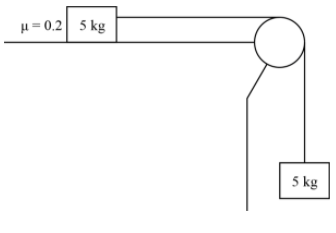
In this given figure, the magnitude of the acceleration of the centre of mass of the system is
Answer
 Verified
576.3k+ views
Hint: This the pulley problem with two masses attached with one string over the pulley. First, you need to draw the Free Body Diagram of both the vertical and horizontal masses and then analyse it with Newton’s 2nd law of motion. Free body diagram shows us all the forces acting on the body apart from the whole system, hence the analysis gets easier.
Complete step by step answer:
The vertical and horizontal masses are the same, i.e., $m = 5\;{\rm{kg}}$
The table friction coefficient is $\mu = 0.2$
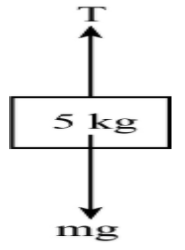
For vertical mass which is hanging outside the pulley, Newton’s 2nd law of motion applied to this mass. Then from Newton’s second law,
$mg - T = ma$
Putting the value of $m = 5\;{\rm{kg}}$ in the above equation,
$50 - T = 5a$ ……………………………. (1)
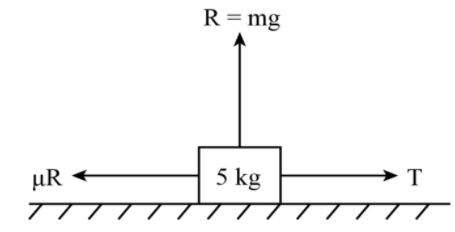
For Horizontal Mass.
From Newton’s second law
$T - \mu R = ma$
Putting the value of m,$\mu $ and $R$ in the above equation,
$T - 10 = 5a$ …………………………… (2)
The solution of equation (1) and (2) gives us the acceleration “a.”
Adding equation (1) and (2), we get
$\begin{array}{l}
10a = 40\\
\Rightarrow a = 4\;{\rm{m/se}}{{\rm{c}}^{\rm{2}}}
\end{array}$
The horizontal acceleration is calculated by
${a_x} = \dfrac{{{\rm{total}}\;\;{\rm{horizontal}}\;{\rm{force}}}}{{{\rm{total}}\;{\rm{mass}}}}$
So,
$\begin{array}{c}
{a_x} = \dfrac{{ma + 0}}{{m + m}}\\
\Rightarrow {a_x} = \dfrac{{50}}{{100}}\\
\Rightarrow {a_x} = 2\;{\rm{m/se}}{{\rm{c}}^{\rm{2}}}
\end{array}$
The vertical acceleration is calculated by
${a_y} = \dfrac{{{\rm{total}}\;{\rm{vertical}}\;{\rm{force}}}}{{{\rm{total}}\;{\rm{mass}}}}$
So,
$\begin{array}{c}
{a_y} = \dfrac{{0 + ma}}{{m + m}}\\
\Rightarrow {a_y} = \dfrac{{50}}{{100}}\\
\Rightarrow {a_y} = 2\;{\rm{m/se}}{{\rm{c}}^{\rm{2}}}
\end{array}$
Net acceleration can be calculated by using the expression,
\[a = \sqrt {{a_x}^2 + {a_y}^2} \]
Putting the value of ${a_x}$ and ${a_y}$
\[\begin{array}{l}
a = \sqrt {{2^2} + {2^2}} \\
\Rightarrow a = 2\sqrt 2 \;{\rm{m/se}}{{\rm{c}}^{\rm{2}}}
\end{array}\]
So, the net acceleration for the system is \[2\sqrt 2 \;{\rm{m/se}}{{\rm{c}}^{\rm{2}}}\].
Newton’s second law mostly governs pulley systems, and we can find out the tension in the string and acceleration by creating the equations for each mass in the system. There is another approach we can follow to solve these kinds of problems that use relative motion analysis. In a relative motion approach if both two objects have motion or acceleration, then we fix one object and continue the analysis of the 2nd object by implementing the effect of the first object on the 2nd.
So, the correct answer is “Option D”.
Note:
We used Newton’s 2nd law of motion for the analysis of two masses. You may go wrong in drawing the free body diagram with each and every force in the right direction. When the direction of the forces is not clearly mentioned in the free body diagram, then the equation may go unuseful.
Complete step by step answer:
The vertical and horizontal masses are the same, i.e., $m = 5\;{\rm{kg}}$
The table friction coefficient is $\mu = 0.2$
For vertical mass which is hanging outside the pulley, Newton’s 2nd law of motion applied to this mass. Then from Newton’s second law,
$mg - T = ma$
Putting the value of $m = 5\;{\rm{kg}}$ in the above equation,
$50 - T = 5a$ ……………………………. (1)
For Horizontal Mass.
From Newton’s second law
$T - \mu R = ma$
Putting the value of m,$\mu $ and $R$ in the above equation,
$T - 10 = 5a$ …………………………… (2)
The solution of equation (1) and (2) gives us the acceleration “a.”
Adding equation (1) and (2), we get
$\begin{array}{l}
10a = 40\\
\Rightarrow a = 4\;{\rm{m/se}}{{\rm{c}}^{\rm{2}}}
\end{array}$
The horizontal acceleration is calculated by
${a_x} = \dfrac{{{\rm{total}}\;\;{\rm{horizontal}}\;{\rm{force}}}}{{{\rm{total}}\;{\rm{mass}}}}$
So,
$\begin{array}{c}
{a_x} = \dfrac{{ma + 0}}{{m + m}}\\
\Rightarrow {a_x} = \dfrac{{50}}{{100}}\\
\Rightarrow {a_x} = 2\;{\rm{m/se}}{{\rm{c}}^{\rm{2}}}
\end{array}$
The vertical acceleration is calculated by
${a_y} = \dfrac{{{\rm{total}}\;{\rm{vertical}}\;{\rm{force}}}}{{{\rm{total}}\;{\rm{mass}}}}$
So,
$\begin{array}{c}
{a_y} = \dfrac{{0 + ma}}{{m + m}}\\
\Rightarrow {a_y} = \dfrac{{50}}{{100}}\\
\Rightarrow {a_y} = 2\;{\rm{m/se}}{{\rm{c}}^{\rm{2}}}
\end{array}$
Net acceleration can be calculated by using the expression,
\[a = \sqrt {{a_x}^2 + {a_y}^2} \]
Putting the value of ${a_x}$ and ${a_y}$
\[\begin{array}{l}
a = \sqrt {{2^2} + {2^2}} \\
\Rightarrow a = 2\sqrt 2 \;{\rm{m/se}}{{\rm{c}}^{\rm{2}}}
\end{array}\]
So, the net acceleration for the system is \[2\sqrt 2 \;{\rm{m/se}}{{\rm{c}}^{\rm{2}}}\].
Newton’s second law mostly governs pulley systems, and we can find out the tension in the string and acceleration by creating the equations for each mass in the system. There is another approach we can follow to solve these kinds of problems that use relative motion analysis. In a relative motion approach if both two objects have motion or acceleration, then we fix one object and continue the analysis of the 2nd object by implementing the effect of the first object on the 2nd.
So, the correct answer is “Option D”.
Note:
We used Newton’s 2nd law of motion for the analysis of two masses. You may go wrong in drawing the free body diagram with each and every force in the right direction. When the direction of the forces is not clearly mentioned in the free body diagram, then the equation may go unuseful.
Recently Updated Pages
Master Class 11 Computer Science: Engaging Questions & Answers for Success

Master Class 11 Business Studies: Engaging Questions & Answers for Success
Master Class 11 Economics: Engaging Questions & Answers for Success
Master Class 11 English: Engaging Questions & Answers for Success
Master Class 11 Maths: Engaging Questions & Answers for Success
Master Class 11 Biology: Engaging Questions & Answers for Success
Trending doubts
One Metric ton is equal to kg A 10000 B 1000 C 100 class 11 physics CBSE
There are 720 permutations of the digits 1 2 3 4 5 class 11 maths CBSE
Discuss the various forms of bacteria class 11 biology CBSE
Draw a diagram of a plant cell and label at least eight class 11 biology CBSE
State the laws of reflection of light
Explain zero factorial class 11 maths CBSE