




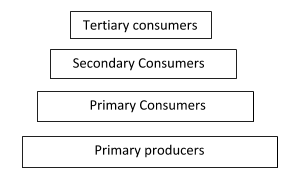
In this food chain, the organism which belongs to the second trophic level is
A. Snake
B. Plant
C. Grasshopper
D. Frog
Answer
 Verified
581.4k+ views
Hint: Food chain is a cycle that transfers energy from lower organisms to higher organisms. The trophic level of an organism in an ecosystem is the rank of position it occupies. The first position is generally occupied by plants or algae or organisms who produce their own food.
Complete answer: The ecological pyramid of any environment always begins with producers such as plants, bacteria, etc. These organisms produce their own food by sunlight or nutrients they receive. They occupy the base level or first level in the pyramid. These producers are then eaten by herbivores, such as insects, grasshoppers, frogs, etc. Herbivores are also called primary consumers in the ecosystem. They occupy the second position in the pyramid of an ecosystem. These herbivores are in turn eaten by carnivores such as fox, dog, cats, owl, etc. Carnivores are also known as secondary consumers. These organisms occupy the third position in the pyramid. Carnivores are then eaten by apex predators such as eagle, lion, tiger, etc. Organisms occupying the second trophic level are snakes.
Hence, the correct answer is option A.
Note: Whenever one organism eats another organism present in a lower rank, the energy transferred from a higher level to base level is only ten percent. It sends only ten percent of the energy to it's a subsequent higher level. This law is known as the 10th percent law. 90 percent of the energy is lost in the form of heat.
Complete answer: The ecological pyramid of any environment always begins with producers such as plants, bacteria, etc. These organisms produce their own food by sunlight or nutrients they receive. They occupy the base level or first level in the pyramid. These producers are then eaten by herbivores, such as insects, grasshoppers, frogs, etc. Herbivores are also called primary consumers in the ecosystem. They occupy the second position in the pyramid of an ecosystem. These herbivores are in turn eaten by carnivores such as fox, dog, cats, owl, etc. Carnivores are also known as secondary consumers. These organisms occupy the third position in the pyramid. Carnivores are then eaten by apex predators such as eagle, lion, tiger, etc. Organisms occupying the second trophic level are snakes.
Hence, the correct answer is option A.
Note: Whenever one organism eats another organism present in a lower rank, the energy transferred from a higher level to base level is only ten percent. It sends only ten percent of the energy to it's a subsequent higher level. This law is known as the 10th percent law. 90 percent of the energy is lost in the form of heat.
Recently Updated Pages
Master Class 12 Social Science: Engaging Questions & Answers for Success

Master Class 12 Physics: Engaging Questions & Answers for Success
Master Class 12 Maths: Engaging Questions & Answers for Success
Master Class 12 Economics: Engaging Questions & Answers for Success
Master Class 12 Chemistry: Engaging Questions & Answers for Success
Master Class 12 Business Studies: Engaging Questions & Answers for Success
Trending doubts
Which are the Top 10 Largest Countries of the World?
Draw a labelled sketch of the human eye class 12 physics CBSE
Explain the structure of megasporangium class 12 biology CBSE
What are the major means of transport Explain each class 12 social science CBSE
How many chromosomes are found in human ovum a 46 b class 12 biology CBSE
The diagram of the section of a maize grain is given class 12 biology CBSE