




In this diagram AB and AC are the equal sides of an isosceles $\Delta $ABC, in which is inscribed equilateral triangle DEF. designate $\angle $BFD by a, $\angle $ADE by b, and $\angle $FEC by c, then:
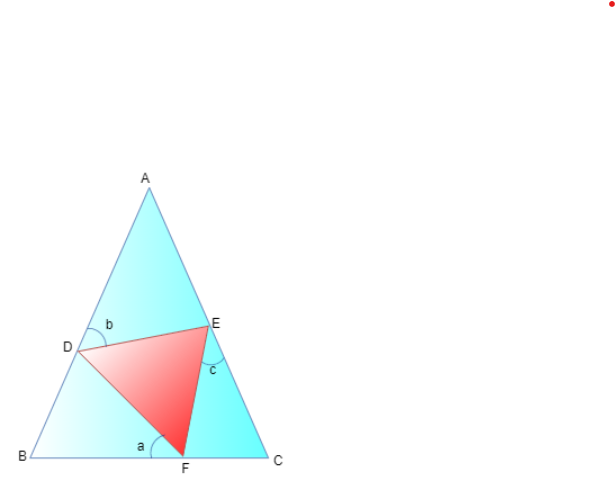
(A). $b = \dfrac{{a + c}}{2}$
(B). $b = \dfrac{{a - c}}{2}$
(C). $a = \dfrac{{b - c}}{2}$
(D). $a = \dfrac{{b + c}}{2}$
Answer
 Verified
597.3k+ views
Hint: In this question use the properties of isosceles and equilateral triangles and also remember that every angle of equilateral triangle is equal to ${60^ \circ }$using the values of $\angle $B and $\angle $C and substitutive in this equation i.e. $\angle $B = $\angle $C which is the property of an isosceles triangle, using these instructions will help you to approach towards the solution to the problem
Complete step-by-step answer:
According to the given information we know that triangle ABC is an isosceles triangle and side AB and AC are equal to each other so by the property of isosceles triangle we get
$\angle $B = $\angle $C let taking this equation as equation 1
Now it is given in the question that triangle DEF is an equilateral triangle so by the property of equilateral triangle we get
$\angle $EDF = $\angle $DFE = $\angle $FED = ${60^ \circ }$
So since we know that sum of angles formed on the straight line is equal to ${180^ \circ }$
Therefore for $\angle $b
b + $\angle $EDF + $\angle $BDF = ${180^ \circ }$
Substituting the value of $\angle $EDF in above equation we get
b + ${60^ \circ }$+ $\angle $BDF = ${180^ \circ }$
$ \Rightarrow $ $\angle $BDF = ${180^ \circ }$ – ${60^ \circ }$ – b
$ \Rightarrow $ $\angle $BDF = ${120^ \circ }$ – b
Now for $\angle $a
So since we know that sum of angles formed on the straight line is equal to ${180^ \circ }$
Therefore a + $\angle $DFE + $\angle $EFC = ${180^ \circ }$
Substituting the value of $\angle $DFE in above equation we get
a + ${60^ \circ }$+ $\angle $EFC = ${180^ \circ }$
$ \Rightarrow $$\angle $EFC = ${180^ \circ }$ – a – ${60^ \circ }$
$ \Rightarrow $$\angle $EFC = ${180^ \circ }$ – a – ${60^ \circ }$
$ \Rightarrow $$\angle $EFC = ${120^ \circ }$ – a
For $\angle $c
So since we know that sum of angles formed on the straight line is equal to ${180^ \circ }$
Therefore c + $\angle $DEF + $\angle $AED = ${180^ \circ }$
$ \Rightarrow $c + $\angle $DEF + $\angle $AED = ${180^ \circ }$
$ \Rightarrow $c + ${60^ \circ }$+ $\angle $AED = ${180^ \circ }$
$ \Rightarrow $$\angle $AED = ${180^ \circ }$ – c – ${60^ \circ }$
$ \Rightarrow $$\angle $AED = ${120^ \circ }$ – c
In triangle BDF by the angle sum property
$\angle $B + $\angle $BDF + $\angle $BFD = ${180^ \circ }$
Substituting the given values in the above equation we get
$\angle $B + (${120^ \circ }$ – b) + a = ${180^ \circ }$
$ \Rightarrow $$\angle $B = ${180^ \circ }$– ${120^ \circ }$ + b – a
$ \Rightarrow $$\angle $B = ${60^ \circ }$+ b – a
In the triangle EFC by the angle sum property
$\angle $C + $\angle $EFC+ $\angle $CEF = ${180^ \circ }$
Substituting the given values in the above equation
$ \Rightarrow $$\angle $C + ${120^ \circ }$ – a + c = ${180^ \circ }$
$ \Rightarrow $$\angle $C = ${180^ \circ }$ – ${120^ \circ }$ + a – c
$ \Rightarrow $$\angle $C = ${60^ \circ }$ + a – c
Substituting the value of $\angle $B and $\angle $C in the equation 1
${60^ \circ }$+ b – a = ${60^ \circ }$ + a – c
$ \Rightarrow $b – a = a – c
$ \Rightarrow $b + c = a + a
$ \Rightarrow $b + c = 2a
$ \Rightarrow $a = $\dfrac{{b + c}}{2}$
Hence option D is the correct option.
Note: In the above solution we came around two types of triangle isosceles and equilateral triangle which have many dissimilarities such as isosceles triangle is a 2-D shape which consist of 2 equal sides due to which the two angles are also equal to each other whereas equilateral triangle is also a 2-D shape but it have all equal sides and all angles are equal to each other and equal to${60^ \circ }$.
Complete step-by-step answer:
According to the given information we know that triangle ABC is an isosceles triangle and side AB and AC are equal to each other so by the property of isosceles triangle we get
$\angle $B = $\angle $C let taking this equation as equation 1
Now it is given in the question that triangle DEF is an equilateral triangle so by the property of equilateral triangle we get
$\angle $EDF = $\angle $DFE = $\angle $FED = ${60^ \circ }$
So since we know that sum of angles formed on the straight line is equal to ${180^ \circ }$
Therefore for $\angle $b
b + $\angle $EDF + $\angle $BDF = ${180^ \circ }$
Substituting the value of $\angle $EDF in above equation we get
b + ${60^ \circ }$+ $\angle $BDF = ${180^ \circ }$
$ \Rightarrow $ $\angle $BDF = ${180^ \circ }$ – ${60^ \circ }$ – b
$ \Rightarrow $ $\angle $BDF = ${120^ \circ }$ – b
Now for $\angle $a
So since we know that sum of angles formed on the straight line is equal to ${180^ \circ }$
Therefore a + $\angle $DFE + $\angle $EFC = ${180^ \circ }$
Substituting the value of $\angle $DFE in above equation we get
a + ${60^ \circ }$+ $\angle $EFC = ${180^ \circ }$
$ \Rightarrow $$\angle $EFC = ${180^ \circ }$ – a – ${60^ \circ }$
$ \Rightarrow $$\angle $EFC = ${180^ \circ }$ – a – ${60^ \circ }$
$ \Rightarrow $$\angle $EFC = ${120^ \circ }$ – a
For $\angle $c
So since we know that sum of angles formed on the straight line is equal to ${180^ \circ }$
Therefore c + $\angle $DEF + $\angle $AED = ${180^ \circ }$
$ \Rightarrow $c + $\angle $DEF + $\angle $AED = ${180^ \circ }$
$ \Rightarrow $c + ${60^ \circ }$+ $\angle $AED = ${180^ \circ }$
$ \Rightarrow $$\angle $AED = ${180^ \circ }$ – c – ${60^ \circ }$
$ \Rightarrow $$\angle $AED = ${120^ \circ }$ – c
In triangle BDF by the angle sum property
$\angle $B + $\angle $BDF + $\angle $BFD = ${180^ \circ }$
Substituting the given values in the above equation we get
$\angle $B + (${120^ \circ }$ – b) + a = ${180^ \circ }$
$ \Rightarrow $$\angle $B = ${180^ \circ }$– ${120^ \circ }$ + b – a
$ \Rightarrow $$\angle $B = ${60^ \circ }$+ b – a
In the triangle EFC by the angle sum property
$\angle $C + $\angle $EFC+ $\angle $CEF = ${180^ \circ }$
Substituting the given values in the above equation
$ \Rightarrow $$\angle $C + ${120^ \circ }$ – a + c = ${180^ \circ }$
$ \Rightarrow $$\angle $C = ${180^ \circ }$ – ${120^ \circ }$ + a – c
$ \Rightarrow $$\angle $C = ${60^ \circ }$ + a – c
Substituting the value of $\angle $B and $\angle $C in the equation 1
${60^ \circ }$+ b – a = ${60^ \circ }$ + a – c
$ \Rightarrow $b – a = a – c
$ \Rightarrow $b + c = a + a
$ \Rightarrow $b + c = 2a
$ \Rightarrow $a = $\dfrac{{b + c}}{2}$
Hence option D is the correct option.
Note: In the above solution we came around two types of triangle isosceles and equilateral triangle which have many dissimilarities such as isosceles triangle is a 2-D shape which consist of 2 equal sides due to which the two angles are also equal to each other whereas equilateral triangle is also a 2-D shape but it have all equal sides and all angles are equal to each other and equal to${60^ \circ }$.
Recently Updated Pages
Master Class 10 Computer Science: Engaging Questions & Answers for Success

Master Class 10 General Knowledge: Engaging Questions & Answers for Success
Master Class 10 English: Engaging Questions & Answers for Success
Master Class 10 Social Science: Engaging Questions & Answers for Success
Master Class 10 Maths: Engaging Questions & Answers for Success
Master Class 10 Science: Engaging Questions & Answers for Success
Trending doubts
What is the median of the first 10 natural numbers class 10 maths CBSE
Which women's tennis player has 24 Grand Slam singles titles?
Who is the Brand Ambassador of Incredible India?
Why is there a time difference of about 5 hours between class 10 social science CBSE
Write a letter to the principal requesting him to grant class 10 english CBSE
A moving boat is observed from the top of a 150 m high class 10 maths CBSE