




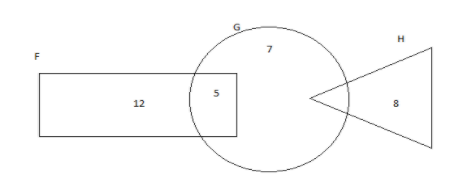
In the venn diagram, the numbers represent the number of elements in the subsets. Given that \[\xi = F \cup G \cup H\] and \[n\left( \xi \right) = 42,\] find \[n\left( {G' \cup H} \right)\] .
A.18
B.28
C.30
D.38
Answer
 Verified
574.8k+ views
Hint: Here, we have to find the cardinality of the given set. We will find the values of the cardinality from the Venn diagram and then by using the set formula, we will find the cardinality of the set. A set is defined as a collection of well-defined objects. Cardinality is defined as the number of elements in a set.
Formula Used:
We will use the following formula:
1.If we are given three finite set, then the total number is given by the formula \[n\left( U \right) = n\left( A \right) + n\left( B \right) + n\left( C \right) + n\left( {A \cap B} \right) + n\left( {B \cap C} \right) + n\left( {A \cap C} \right)\]
2.\[n\left( {G' \cup H} \right) = n\left( {G'} \right) + n\left( H \right) - n\left( {G' \cap H} \right)\]
Complete step-by-step answer:
Let F, G, H represent the number of elements in the subsets respectively.
Number of elements in a subsets \[n\left( F \right) = 12\]
Number of elements in a subsets \[n\left( G \right) = 7\]
Number of elements in a subsets \[n\left( H \right) = 8\]
Number of elements in both the subsets \[n\left( {F \cap G} \right) = 5\]
From the venn diagram, there are no common elements in the subsets F and H and there are no common elements in all the three subsets F, G, H.
We are also given that the total number of elements in the subset is 42.
If we are given three finite set, then the total number is given by the formula \[n\left( U \right) = n\left( A \right) + n\left( B \right) + n\left( C \right) + n\left( {A \cap B} \right) + n\left( {B \cap C} \right) + n\left( {A \cap C} \right)\]
Now, substituting the terms in the above formula, we get
\[n\left( U \right) = n\left( F \right) + n\left( G \right) + n\left( H \right) + n\left( {F \cap G} \right) + n\left( {H \cap G} \right) + n\left( {F \cap H} \right)\]
Substituting \[n\left( U \right) = 42\], \[n\left( F \right) = 12\],\[n\left( G \right) = 7\], \[n\left( H \right) = 8\] and \[n\left( {F \cap G} \right) = 5\] in the above equation, we get
\[ \Rightarrow 42 = 12 + 7 + 8 + 5 + \left( {H \cap G} \right)\]
Subtracting the like terms, we get
\[ \Rightarrow n\left( {G \cap H} \right) = 42 - 12 - 7 - 8 - 5\]
\[ \Rightarrow n\left( {G \cap H} \right) = 10\]
Now, we will find \[n\left( {G' \cup H} \right)\].
\[n\left( {G'} \right) = n\left( U \right) - n\left( G \right)\]
\[ \Rightarrow n\left( {G'} \right) = 42 - 22 = 20\]
We know that \[n\left( {G \cap H} \right) = 10\]
\[n\left( H \right) = 10 + 8 = 18\]
Clearly \[n\left( {G' \cap H} \right) = n\left( H \right) - n\left( {G \cap H} \right)\]
\[ \Rightarrow n\left( {G' \cap H} \right) = 18 - 10 = 8\]
\[ \Rightarrow n\left( {G' \cup H} \right) = n\left( {G'} \right) + n\left( H \right) - n\left( {G' \cap H} \right)\]
By substituting the values, we get
\[ \Rightarrow n\left( {G' \cup H} \right) = 20 + 18 - 8\]
\[ \Rightarrow n\left( {G' \cup H} \right) = 30\]
Therefore, \[n\left( {G' \cup H} \right)\] is 30.
Thus Option(C) is the correct answer.
Note: Venn diagram is a method to represent the relationships between the finite sets. A finite set is defined as the set which is countable. We should know that the universal set is defined as a set that contains all the elements of a set under consideration. We should know that the total members in the set is known as the universal set. The complement of a set \[\left( {A'} \right)\] is defined as the number of elements in the universal set but not in the set.
Formula Used:
We will use the following formula:
1.If we are given three finite set, then the total number is given by the formula \[n\left( U \right) = n\left( A \right) + n\left( B \right) + n\left( C \right) + n\left( {A \cap B} \right) + n\left( {B \cap C} \right) + n\left( {A \cap C} \right)\]
2.\[n\left( {G' \cup H} \right) = n\left( {G'} \right) + n\left( H \right) - n\left( {G' \cap H} \right)\]
Complete step-by-step answer:
Let F, G, H represent the number of elements in the subsets respectively.
Number of elements in a subsets \[n\left( F \right) = 12\]
Number of elements in a subsets \[n\left( G \right) = 7\]
Number of elements in a subsets \[n\left( H \right) = 8\]
Number of elements in both the subsets \[n\left( {F \cap G} \right) = 5\]
From the venn diagram, there are no common elements in the subsets F and H and there are no common elements in all the three subsets F, G, H.
We are also given that the total number of elements in the subset is 42.
If we are given three finite set, then the total number is given by the formula \[n\left( U \right) = n\left( A \right) + n\left( B \right) + n\left( C \right) + n\left( {A \cap B} \right) + n\left( {B \cap C} \right) + n\left( {A \cap C} \right)\]
Now, substituting the terms in the above formula, we get
\[n\left( U \right) = n\left( F \right) + n\left( G \right) + n\left( H \right) + n\left( {F \cap G} \right) + n\left( {H \cap G} \right) + n\left( {F \cap H} \right)\]
Substituting \[n\left( U \right) = 42\], \[n\left( F \right) = 12\],\[n\left( G \right) = 7\], \[n\left( H \right) = 8\] and \[n\left( {F \cap G} \right) = 5\] in the above equation, we get
\[ \Rightarrow 42 = 12 + 7 + 8 + 5 + \left( {H \cap G} \right)\]
Subtracting the like terms, we get
\[ \Rightarrow n\left( {G \cap H} \right) = 42 - 12 - 7 - 8 - 5\]
\[ \Rightarrow n\left( {G \cap H} \right) = 10\]
Now, we will find \[n\left( {G' \cup H} \right)\].
\[n\left( {G'} \right) = n\left( U \right) - n\left( G \right)\]
\[ \Rightarrow n\left( {G'} \right) = 42 - 22 = 20\]
We know that \[n\left( {G \cap H} \right) = 10\]
\[n\left( H \right) = 10 + 8 = 18\]
Clearly \[n\left( {G' \cap H} \right) = n\left( H \right) - n\left( {G \cap H} \right)\]
\[ \Rightarrow n\left( {G' \cap H} \right) = 18 - 10 = 8\]
\[ \Rightarrow n\left( {G' \cup H} \right) = n\left( {G'} \right) + n\left( H \right) - n\left( {G' \cap H} \right)\]
By substituting the values, we get
\[ \Rightarrow n\left( {G' \cup H} \right) = 20 + 18 - 8\]
\[ \Rightarrow n\left( {G' \cup H} \right) = 30\]
Therefore, \[n\left( {G' \cup H} \right)\] is 30.
Thus Option(C) is the correct answer.
Note: Venn diagram is a method to represent the relationships between the finite sets. A finite set is defined as the set which is countable. We should know that the universal set is defined as a set that contains all the elements of a set under consideration. We should know that the total members in the set is known as the universal set. The complement of a set \[\left( {A'} \right)\] is defined as the number of elements in the universal set but not in the set.
Recently Updated Pages
Basicity of sulphurous acid and sulphuric acid are

Master Class 11 Business Studies: Engaging Questions & Answers for Success
Master Class 11 Computer Science: Engaging Questions & Answers for Success
Master Class 11 Economics: Engaging Questions & Answers for Success
Master Class 11 Social Science: Engaging Questions & Answers for Success
Master Class 11 English: Engaging Questions & Answers for Success
Trending doubts
One Metric ton is equal to kg A 10000 B 1000 C 100 class 11 physics CBSE
The largest wind power cluster is located in the state class 11 social science CBSE
Explain zero factorial class 11 maths CBSE
State and prove Bernoullis theorem class 11 physics CBSE
Which among the following are examples of coming together class 11 social science CBSE
Can anyone list 10 advantages and disadvantages of friction